

Lifestyle
The stratospheric rise of South African fashion designer Thebe Magugu


Thebe Magugu may not yet be a name that trips off the tongue, but that’s about to change. Because Thebe (pronounced “Tebe”; the h is silent) is, by most accounts, a force to be reckoned with.
Hailing from Kimberley in South Africa, a small town more famous for diamonds than fashion, Magugu is in the midst of what can only be described as a stratospheric rise. The creator of quietly beautiful menswear and womenswear, he launched his label in 2016. His work was picked up by Italian Vogue and in 2019, he won the LVMH prize. Presently, he is in the final six for the International Woolmark Prize 2021 (the winner will be announced later this year) and is part of MatchesFashion’s Innovators Programme.

A design by Thebe Magugu. Courtesy Thebe Magugu
“Getting the message from Natalie [Kingham, buying director at MatchesFashion] that she was considering me to be part of the Matches Innovator programme was such an honour,” Magugu tells me.
“Natalie and I go back. She was one of the judges for the International Fashion Showcase in London. She was so interested in what I was doing, so it’s sort of a full circle,” he adds.
It is worth noting that Magugu won the 2019 International Fashion Showcase prize so convincingly that the judges, including Kingham, hailed him as a “leader of his generation”. Now he has been reunited with Kingham for the Innovators Programme, as part of which 12 emerging fashion labels receive backing, support and mentorship from MatchesFashion experts, and are given space on the online platform. Yet, despite so many accolades, Magugu remains disarmingly grounded, and deeply appreciative of the power of learning directly from experts.

Magugu’s designs delve into the footnotes of history. Courtesy Thebe Magugu
“I am based in Johannesburg, so I am quite far from fashion in that sense, so in the past it has been quite a struggle. I went to a fashion school here that was great in terms of creativity, but it didn’t really delve into the buying process or other facets of the industry. But the biggest blessing in my life was meeting people along the way who have acted as mentors to me, and taken the time to teach me. I am really grateful for that.”
A sense of learning runs through his collections, which, despite at first glance appearing stripped back and simple, are brimming with artful tailoring and sparse patterning that reflect hours of meticulous research on topics that hover on the fringes of society.
“I feel a lot of history runs the risk of being forgotten, because it is in the margins. So I make it a point to try to read as much as possible about obscure South African history that not a lot of people know about. I think people understand the big things that come out of South Africa, such as Nelson Mandela and apartheid, but there are so many footnotes that get forgotten,” he explains.

Magugu is a finalist for the International Woolmark Prize 2021. Courtesy Thebe Magugu
One such footnote inspired his spring 2020 collection. Entitled Prosopography, it was inspired by the Black Sash movement that was founded in 1955 in protest to apartheid. As well as wearing black sashes, the all-female movement would conduct what they called “hauntings”, and would stand in silent vigil against pro-segregation figures. This is echoed in the collection as ghostly images of distorted patterning, running across impeccably cut clothes in vivid red and denim blue.
Magugu even tracked down former members of the movement to record their story. “I tried to reach out to the ones who are still alive today, so essentially I can document what they have done. And I love doing that, because, as much as it is about educating others, it is about educating myself as well.”

Thebe Magugu’s spring / summer 2021 collection. Courtesy Thebe Magugu
For his spring/summer 2021 collection, called Counter Intelligence, he looked to the South African female spies who had worked on both sides of the apartheid regime. Again, he sought out the characters involved, using those interviews as the basis for his entire collection. Filled with subtle blink-and-you’ll-miss-it details, there is a small zig-zag pattern based on a polygraph test, a shirt covered in written testament, and even a polka dot that turns out, on closer inspection, to be a fingerprint. The men’s pieces are in muddy olives and teals, and come with discreetly mismatched buttons.
This cerebral approach is what sets Magugu apart and it runs alongside a deeper thread in his work: the idea that one person can make a difference. He himself is committed to empowering and enriching his wider community.
I think all of us were questioning our contribution to fashion, and certainly in the past, fashion could get away with being fashion for fashion’s sake
And yet, just like everyone else, he has been impacted by the Covid-19 pandemic, with stores around the world shutting down even as he was shipping his collections to them. “That was a hit, certainly, but I just feel my values have been calibrated even further.
“I think all of us were questioning our contribution to fashion, and certainly in the past, fashion could get away with being fashion for fashion’s sake” he says. ” But with the pandemic, we are all starting to think: ‘How has this bettered the community? What value is in this product?’
“I have always been obsessed with the idea of education, because I know what it does for a community. I am from a very small town and I have seen what a lack of education can do to a society. I have seen the effects of poverty and HIV quite close up,” he tells me.

A look from Thebe Magugu’s spring/summer 2021 collection. Courtesy Thebe Magugu
Now in a position to be collaborating with large, established companies, Magugu is using this platform to help uplift others. “There are so many wonderful opportunities that have come my way, but I have to sift through and really veer towards the ones that are in line with what I want to create, while empowering whoever is involved,” he explains.
Case in point, at the start of 2021, Magugu was invited to take part in the Lucky Charms exhibition at Bon Marché in Paris, for which he enlisted regional handworkers. “We sent thousands of embroidered flowers to Paris, done by the women in Ladysmith, which is a very small town.” In December, he teamed up with Adidas in South Africa to create a protective face mask based on a traditional tablecloth print, which was given out for free.
“Masks are not accessible to certain parts of the community in South Africa, so that’s what I mean by purpose-driven projects. Things that contribute over and above the actual product.
“My overall mission is to create a brand that is based in South Africa and very strong here, but with roots all over the world, to show people that it is possible to have localised manufacturing in places that are not known for that. It is quite a mission and very ambitious, but I really feel it can be done.





Houston philanthropist and community leader reflects on five decades of faith, family, resilience and service as friends and well-wishers prepare for her grand golden jubilee celebration on October 31, 2026.
HOUSTON, TEXAS — Turning 50 represents far more than reaching a milestone in age. It is a celebration of maturity, accumulated wisdom, personal accomplishments and the extraordinary journey through life’s challenges and triumphs. For many, the golden jubilee offers an opportunity to reflect on meaningful relationships, embrace renewed purpose and look toward the future with gratitude and confidence.
For Houston-based philanthropist and community leader Chief Oby Marcel, that milestone has arrived with excitement, thanksgiving and an unmistakable sense of fulfillment.

Chief Oby Marcel: This milestone has arrived with excitement, thanksgiving and an unmistakable sense of fulfillment.
All roads will lead to the Trinity Event Center, 8402 Howell Sugarland Road, Houston, Texas, on Saturday, October 31, 2026, when Chief Oby Marcel hosts a prestigious golden jubilee celebration beginning at 7 p.m. The anticipated all-formal gathering will bring together family members, friends, community leaders, associates and well-wishers to celebrate a woman whose life reflects a commitment to family, cultural identity, community engagement and service.
Speaking enthusiastically about her approaching birthday, Chief Oby Marcel described the occasion as a deeply personal celebration of divine grace and the experiences that have shaped her journey.
“Wow! I can hardly believe I’m stepping into the radiant glow of 50! My heart is dancing with joy, overflowing with excitement, and wrapped in deep gratitude,” she declared.
“Fifty beautiful years of God’s grace, unfailing love, abundant blessings, renewed strength, and memories that shimmer like precious jewels. Through every storm and sunrise, every challenge and triumph, every tear and laughter-filled moment, God has remained faithful.”
Beyond the birthday festivities, Chief Oby Marcel’s golden jubilee highlights her active participation in several cultural, religious and philanthropic organizations within Houston’s Nigerian community.
She is a prominent member of Gold Club International, where she holds the distinction of Lady Gold and serves as Admission Chairlady. She also serves as Treasurer of Prestige International and Assistant Financial Secretary of CWO Aquinas. Her community involvement extends to First Umuokpu Anambra USA, the Aguleri-Otu cabinet and the Omambala Cultural Association in Houston. Through these affiliations, Petersen maintains connections with organizations dedicated to cultural preservation, fellowship, mutual support and community development.
As a mother, philanthropist and community leader, she represents a generation of Nigerian women in the diaspora who balance family responsibilities with active participation in organizations that strengthen cultural bonds and promote collective progress.

The Young Shall Grow: From the Innocence of Yesterday to the Golden Glory of Today — 50 Years of Grace, Beauty, and Becoming.
The significance of turning 50 reaches beyond organizational achievements or public recognition. It represents an opportunity to embrace life with greater wisdom, confidence and optimism. According to Chief Oby Marcel, “I’m not simply turning 50; I’m crossing the threshold into a dazzling new chapter filled with wisdom, confidence, happiness, purpose, and endless possibilities.”
“I’m proud of the woman I’ve become, grateful for every mile God has carried me, and thrilled by the beautiful horizons unfolding before me.” Her enthusiasm captures the spirit of the forthcoming celebration: an occasion dedicated not merely to marking five decades but to honoring a journey defined by resilience, gratitude and enduring faith.
As preparations continue for the October 31 festivities, Chief Oby Marcel is approaching her golden milestone with a message of renewed hope and determination. “At 50, I’m not getting older; I’m blooming brighter, standing stronger, growing wiser, and becoming even more fabulous!”
And with that declaration, the celebrant offers a fitting conclusion to her golden jubilee reflections: “Cheers to my golden jubilee! My best years are still ahead of me!”
Branch considers annual induction as August celebration of prestige, culture and comradeship inspires growing community interest
HOUSTON, TEXAS — Membership requests to the Sugar Land Branch of People’s Club of Nigeria International (PCNI) have risen significantly following its successful August induction ceremony, prompting the organization to consider making the event an annual affair.
Group Chairman, Hon. Prof. Chris Ulasi, confirmed the surge in interest, saying the branch has received numerous inquiries from prospective members since the ceremony that formally admitted 16 new members to the organization.
“The response since the induction has been remarkable. We have seen a significant increase in people asking about membership and how they can become part of the People’s Club family,” Ulasi said. “Many of them attended the event or heard about it afterward and were impressed by the fellowship, dignity, cultural pride, and genuine comradeship they witnessed.”
Ulasi said the development, including a possible change from the current bi-annual induction arrangement to an annual ceremony, would be discussed at the branch’s September general meeting.
The renewed interest in membership comes on the heels of an elaborate induction that attracted national officers, patrons, branch chairmen, members, and guests from across the People’s Club family.
National President, Atty. Fidelis Onyebueke, who presided over the swearing-in of the 16 inductees, described the event as a total success and commended the Sugar Land Branch, PCNI’s First International Branch, for what he called an exceptional celebration of fellowship, culture, service, and unity.
During the formal ceremony, each inductee was invited to the podium to take the membership oath and receive a certificate from the national president, who was assisted by PCNI Attorney Chukwuka John Ukadike.
Beyond the admission of new members, however, the event offered guests a public display of the traditions that have historically defined the People’s Club: prestige, love, service, and comradeship. Those characteristics were reflected throughout the ceremony, from the reception of national officers and interaction among members to the formal induction, cultural presentation, and extended social celebration that followed.
Grand Patron, Ide Obinna Nnanyelugo Mbachu, said the growing interest in membership was an indication that the organization’s values resonated with guests who experienced the event.
“What people witnessed was the character of People’s Club—the love among members, respect for one another, willingness to serve, and the comradeship that brings us together,” Mbachu said. “Prestige is not simply about appearance; it is about how we conduct ourselves and how we treat people. When the community sees those values demonstrated, it is understandable that others would want to become part of the organization.”
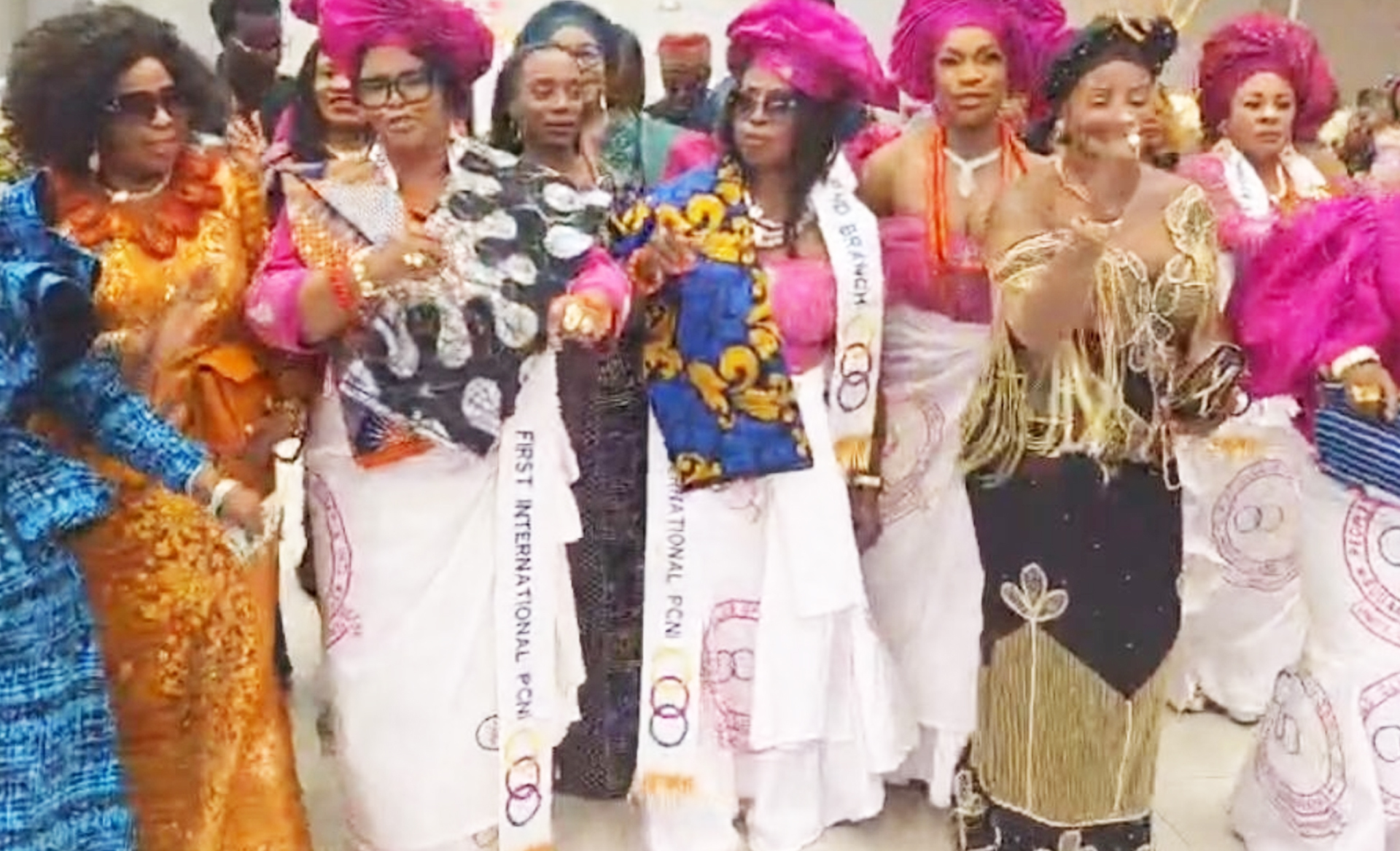
The cultural presentation was among the most visible features of the evening. Women members and associates appeared in coordinated traditional attire featuring red-pinkish blouses with matching head ties and white wrappers bearing the PCNI logo. The men wore all-white outfits complemented by customized PCNI cap pins and distinctive PCNI sashes worn as neckpieces.

The coordinated appearance created a colorful expression of Nigerian cultural identity while reinforcing the sense of unity that characterized the gathering.
As the formal program concluded, the ceremony transitioned into an extended social celebration. Members, inductees, and guests shared food and drinks before taking to the dance floor, with music and festivities continuing into the early hours of Sunday.
The presence of members and officials from different branches also gave the ceremony broader significance for Sugar Land, whose status as the First International Branch places it prominently in PCNI’s history outside Nigeria.
For Ulasi, however, the strongest indication of the event’s impact came afterward, as inquiries from prospective members continued to reach the branch.
He said that while the organization welcomes the increased interest, prospective members would be expected to understand the responsibilities and traditions associated with belonging to the People’s Club. “Membership is about much more than attending social events,” Ulasi said. “It is about service, friendship, responsibility, and commitment to one another. Those are the values we intend to preserve as the branch continues to grow.”
The September meeting is expected to consider how the branch will respond to increased membership interest and whether the success of the August ceremony provides sufficient grounds to move to an annual induction schedule. For the Sugar Land Branch, the aftermath of the August induction may prove as significant as the ceremony itself: 16 members entered the People’s Club that evening, but the celebration appears to have inspired many more to seek a place within its ranks.
National President Atty. Fidelis Onyebueke hails First International Branch for a spectacular celebration of culture, fellowship and service
HOUSTON, TEXAS — The Sugar Land People’s Club of Nigeria International (PCNI), the organization’s First International Branch, has been declared a total success following a spectacular bi-annual induction ceremony that brought together national leaders, branch chairmen, patrons, members, and guests from across the People’s Club family.
National President Atty. Fidelis Onyebueke, who presided over the swearing-in ceremony, commended the Houston branch for delivering an outstanding event that reflected the organization’s enduring traditions of friendship, fellowship, service, and community.

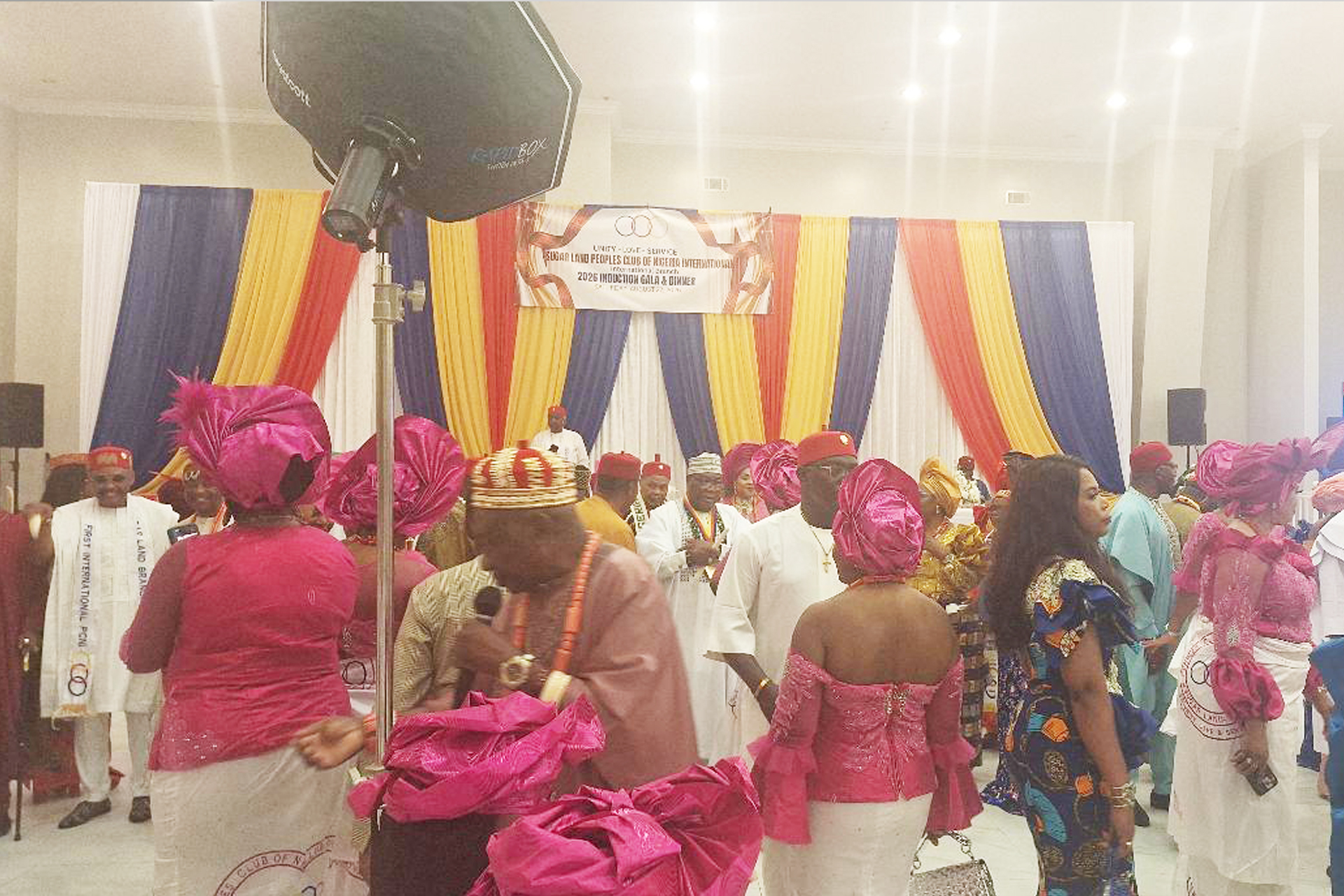
Hon. Prof. Chris Ulasi, SLPCNI Chairman, leads the grand entrance of the national leadership during the induction ceremony, followed by National President Atty. Fidelis Onyebueke and his wife.
“The Houston branch has once again demonstrated what People’s Club represents at its very best. This was a beautifully organized and highly successful event, rich in culture, fellowship, dignity, and unity. I commend the leadership, members, and entire Houston family for an exceptional celebration worthy of the First International Branch.”
The ceremony witnessed the formal swearing-in of 16 new members, each of whom was individually invited forward to receive a certificate of membership from the national president. Onyebueke was assisted in administering the oath by PCNI Attorney Chukwuka John Ukadike.

Group Photo: Women Members and Associates of SLPCNI
The inductees joined an impressive gathering that reflected the diversity and strength of the People’s Club community. Members and guests traveled from various branches across the United States and beyond, transforming the Houston ceremony into a truly international gathering.
The cultural elegance of the occasion was equally striking. Women appeared in colorful, coordinated traditional attire, featuring red-pinkish blouses and matching head ties paired with white wrappers prominently designed with the PCNI logo. The ensemble created a distinctive and dignified traditional look. Men complemented the occasion with elegant all-white outfits, customized PCNI cap pins, and special PCNI sashes worn as neckpieces.
Among those in attendance were Grand Patron Ide Obinna Nnanyelugo Mbachu; Hon. Prof. Chris Ulasi, Group Chairman; patrons and chairmen from various branches, and People’s Club members representing chapters across the globe.
The formal proceedings eventually gave way to an extended celebration of friendship and camaraderie. Food, drinks, music, and dancing carried the festivities well beyond the scheduled program, continuing for hours into the early morning of Sunday.
For the Houston branch, the celebration represented more than the admission of new members. It reaffirmed the historic importance of the First International Branch and demonstrated the continuing strength of People’s Club as a transnational fellowship rooted in Nigerian identity, friendship, service, and mutual support.
The successful ceremony also underscored the organization’s ability to bring generations and branches together while preserving the cultural traditions that have sustained its membership across continents.
By the end of the celebration, Houston had delivered more than an induction. It had delivered a memorable demonstration of unity, culture, friendship, and organizational excellence—an event that fully embodied the People’s Club spirit.


Houston2 days ago
Fifty and Fabulous: Chief Oby Marcel Celebrates a Golden Milestone in Houston

Community2 weeks ago
People’s Club Sugar Land Is Growing — Grand Patron Mbachu Explains Why

Education3 weeks ago
Professor Josephine Onyido Earns Prestigious Nigerian Academy of Education Induction

Nellie Onwuchekwa6 years ago
Emotional Conflict: Is She Toying with Me?

Africa6 years ago
Corruption at the Nigerian Consulate Atlanta – A Victim’s Nightmarish Experience

Anthony Obi Ogbo5 months ago
Gowon’s Book and the Dangerous Politics of Selective Memory

Houston1 year ago
Video: Omambala Cultural Association in Houston Celebrates Motherhood with Joyous Igbo-Inspired Mother’s Day Event

Houston2 years ago
VIDEO: Chris Hollins Opens Cartoon Art Showcase at TSU’s CommWeek

Community2 years ago
Commissioner Dexter L. McCoy speaks about the African-American Memorial Event
-

 Houston3 weeks ago
PCNI Elevates Chief Dr. Emmanuel Opara to Patron in Historic Ihiagwa Investiture
-

 Houston1 month ago
Membership Interest Soars After Sugar Land People’s Club’s Successful Induction
-

 Houston4 weeks ago
Membership Surge Continues as Dr. Nkem Ugwu Joins People’s Club
-
 Community2 weeks ago
People’s Club Sugar Land Is Growing — Grand Patron Mbachu Explains Why
-
 Education3 weeks ago
Professor Josephine Onyido Earns Prestigious Nigerian Academy of Education Induction
-
 Houston2 days ago
Fifty and Fabulous: Chief Oby Marcel Celebrates a Golden Milestone in Houston