

Houston
Houston is back in the Final Four, primed to end a streak of truly bad luck

INDIANAPOLIS — They danced, they laughed, Kelvin Sampson gave his kids hugs. Houston was one band of happy Cougars to be back in the Final Four this week. Of course, the program has been there before, quite some time ago.
It didn’t end well.
Five times it didn’t end well. In fact, you could make the case that few programs have had a more star-crossed Final Four history than Houston, which now has a chance to vastly improve on that situation. Illinois and Oklahoma are the only other schools who have been to as many as five Final Fours and are yet to win a title. If the current Cougars lose next weekend, they will stand alone at six.

And it’s just not the record, but how it’s happened. They have had meaty roles for two of the most famous Final Four games in history — as the victims. In their five past trips they somehow managed to run into Kareem Abdul-Jabbar . . . and Michael Jordan . . . and Patrick Ewing. A wall of Hall of Famers for Houston to beat its collective heads against.
But let’s start at the beginning.
1967 — Timing is everything, and the Cougars didn’t have it. They advanced to their first Final Four and who should be waiting for them but one of the greatest teams in history; unbeaten UCLA with Lew Alcindor – later Abdul-Jabbar — in his first season of steamrolling college basketball.
The Houston players had an idea of what they were in for the day prior to the game, when they were sitting in their hotel lobby pretty much to themselves and in strolled the Bruins, surrounded by a gaggle of fans and media. UCLA arrived like rock stars, while the Cougars, Don Chaney would say years later, “felt like country bumpkins.”
The next day, Alcindor had 19 points and 20 rebounds and UCLA breezed to a 15-point victory.
1968 — Houston ended UCLA’s 47-game winning streak by two points in the Astrodome in a made-for-TV January spectacular that was instantly billed The Game of the Century. Two months later they were together again in the Final Four in Los Angeles, with the Cougars unbeaten and No. 1 and the Bruins with only that one loss. It was the rematch everyone wanted, and the nation settled back to watch college basketball’s version of Frazier vs. Ali.
What the nation got was more like an accountant vs. Ali. The first bad sign for Houston was when its student manager – selling leftover tickets from the team allotment outside the arena as coach Guy Lewis had requested – was arrested by LA police, taken to jail and charged with scalping.
It wasn’t any more pleasant inside the building for the players. Alcindor had a scratched cornea in the January meeting but was at full speed for the rematch, and he and the rest of the Bruins had a message to send. It ended 101-69. Houston star Elvin Hayes, who had vexed the Bruins with 39 points in January, was held to 10, nearly 28 points under his average.
Lewis called it then “the greatest exhibition of basketball I have ever seen in my life.” A lot of people could say that.
1982 — More than 61,000 people were in the Superdome audience when Houston took on North Carolina, which included stars such as Sam Perkins and James Worthy, and a freshman named Jordan. As was their custom back then, the Tar Heels got the lead and then four-cornered the Cougars into oblivion, 68-63.
1983 — The one that haunts the most. Phi Slama Jama was all the rage, as the high-flying Cougars soared into the national championship game by beating Louisville in a 94-81 dunkathon in the semifinals. The media immediately dubbed that game 21st century basketball, and all that was left for No. 1 Houston was to finish off a 10-loss team from North Carolina State that barely eked into the tournament.
The Wolfpack dictated a slow tempo in this pre-shot clock era, but the Cougars put together a 17-2 run for a late seven-point lead. Then Houston started missing free throws, North Carolina State rallied and had the ball in the final seconds in a 52-52 tie. Guard Dereck Whittenburg put up a desperation 30-foot shot with four seconds left that was way short and . . . you might know the rest. They do in Houston. Lorenzo Charles was waiting under the basket to grab the errant shot and slammed it home with one second left. Phi Slama Jama had lived by the dunk, and died by the dunk. The scene of North Carolina State coach Jim Valvano running wildly around the court gets replayed every spring as an iconic and wonderful tournament moment – except for the team he had just beaten.
For hollow consolation, Houston’s Akeem later-to-be-Hakeem Olajuwon was named Most Outstanding Player, and 38 years later, is still the last member of a losing team to be so.
1984 — There was enough left over of Phi Slama Jama — especially Olajuwon — that Houston returned to the national title game. But the Cougars ran into Ewing and Georgetown’s defense and lost 84-75. The golden days were over. Houston would not win another NCAA tournament game for 34 years.
The Cougars’ special brand of Final Four pain can be measured with numbers. They are one of only four programs to go to three consecutive Final Fours and not win any of them. UCLA, Ohio State and North Carolina are also in that club, but those three all have national championships from other years. Houston is also one of four programs to lose consecutive title games — with Cincinnati, Michigan and Butler.
But maybe another number explains how tough it has been for the Cougars, because the opponent has a lot to do with fate. Take away the North Carolina State fairy tale, and the four other teams Houston lost to in the Final Four had a combined record of 118-6 when they met

So now here the Cougars are again 37 years later, and Sampson is telling stories about how much he wishes his parents were alive to see this. And about the Sweet 16 in 2002 when he was coaching at Oklahoma, and how he was in the hospital until 4 a.m. the day of the game waiting for his father to come out of surgery with a brain aneurysm. Those Sooners would eventually get to the Final Four. And how his old boss at Oklahoma, athletics director Joe Castiglione sent Sampson a big package when he got the job at Houston. Inside the package was a ladder to both symbolize Sampson’s career climb and the hope he would be needing it to cut down nets in the future.
Final Four: Here’s what the world was like last time Baylor made it
This Houston team has nothing like the glamour of Phi Slama Jama or the Elvin Hayes bunch that took down UCLA in the middle of the Astrodome. “We may not have the brightest lights,” Sampson said, “but our lights shine as bright as anybody else’s.”
These Cougars now have a chance to do what those Houston teams could not. And if it doesn’t turn out, if there is defeat at the end for a sixth time?
Well, it’s not a bad legacy for a program to have, losing lots of Final Four games.
_______________
Culled from the NCAA.COM. Writer, Mike Lopresti is a member of the US Basketball Writers Hall of Fame, Ball State journalism Hall of Fame and Indiana Sportswriters and Sportscasters Hall of Fame. He has covered college basketball for 43 years, including 39 Final Fours. He is so old he covered Bob Knight when he had dark hair and basketball shorts were actually short.
The views on this page do not necessarily reflect the views of the NCAA or its member institutions.




Houston philanthropist and community leader reflects on five decades of faith, family, resilience and service as friends and well-wishers prepare for her grand golden jubilee celebration on October 31, 2026.
HOUSTON, TEXAS — Turning 50 represents far more than reaching a milestone in age. It is a celebration of maturity, accumulated wisdom, personal accomplishments and the extraordinary journey through life’s challenges and triumphs. For many, the golden jubilee offers an opportunity to reflect on meaningful relationships, embrace renewed purpose and look toward the future with gratitude and confidence.
For Houston-based philanthropist and community leader Chief Oby Marcel, that milestone has arrived with excitement, thanksgiving and an unmistakable sense of fulfillment.

Chief Oby Marcel: This milestone has arrived with excitement, thanksgiving and an unmistakable sense of fulfillment.
All roads will lead to the Trinity Event Center, 8402 Howell Sugarland Road, Houston, Texas, on Saturday, October 31, 2026, when Chief Oby Marcel hosts a prestigious golden jubilee celebration beginning at 7 p.m. The anticipated all-formal gathering will bring together family members, friends, community leaders, associates and well-wishers to celebrate a woman whose life reflects a commitment to family, cultural identity, community engagement and service.
Speaking enthusiastically about her approaching birthday, Chief Oby Marcel described the occasion as a deeply personal celebration of divine grace and the experiences that have shaped her journey.
“Wow! I can hardly believe I’m stepping into the radiant glow of 50! My heart is dancing with joy, overflowing with excitement, and wrapped in deep gratitude,” she declared.
“Fifty beautiful years of God’s grace, unfailing love, abundant blessings, renewed strength, and memories that shimmer like precious jewels. Through every storm and sunrise, every challenge and triumph, every tear and laughter-filled moment, God has remained faithful.”
Beyond the birthday festivities, Chief Oby Marcel’s golden jubilee highlights her active participation in several cultural, religious and philanthropic organizations within Houston’s Nigerian community.
She is a prominent member of Gold Club International, where she holds the distinction of Lady Gold and serves as Admission Chairlady. She also serves as Treasurer of Prestige International and Assistant Financial Secretary of CWO Aquinas. Her community involvement extends to First Umuokpu Anambra USA, the Aguleri-Otu cabinet and the Omambala Cultural Association in Houston. Through these affiliations, Petersen maintains connections with organizations dedicated to cultural preservation, fellowship, mutual support and community development.
As a mother, philanthropist and community leader, she represents a generation of Nigerian women in the diaspora who balance family responsibilities with active participation in organizations that strengthen cultural bonds and promote collective progress.

The Young Shall Grow: From the Innocence of Yesterday to the Golden Glory of Today — 50 Years of Grace, Beauty, and Becoming.
The significance of turning 50 reaches beyond organizational achievements or public recognition. It represents an opportunity to embrace life with greater wisdom, confidence and optimism. According to Chief Oby Marcel, “I’m not simply turning 50; I’m crossing the threshold into a dazzling new chapter filled with wisdom, confidence, happiness, purpose, and endless possibilities.”
“I’m proud of the woman I’ve become, grateful for every mile God has carried me, and thrilled by the beautiful horizons unfolding before me.” Her enthusiasm captures the spirit of the forthcoming celebration: an occasion dedicated not merely to marking five decades but to honoring a journey defined by resilience, gratitude and enduring faith.
As preparations continue for the October 31 festivities, Chief Oby Marcel is approaching her golden milestone with a message of renewed hope and determination. “At 50, I’m not getting older; I’m blooming brighter, standing stronger, growing wiser, and becoming even more fabulous!”
And with that declaration, the celebrant offers a fitting conclusion to her golden jubilee reflections: “Cheers to my golden jubilee! My best years are still ahead of me!”
…Credits principled leadership, philanthropy, and a renewed commitment to “Unity, Love and Service” for the historic branch’s growing membership and influence.
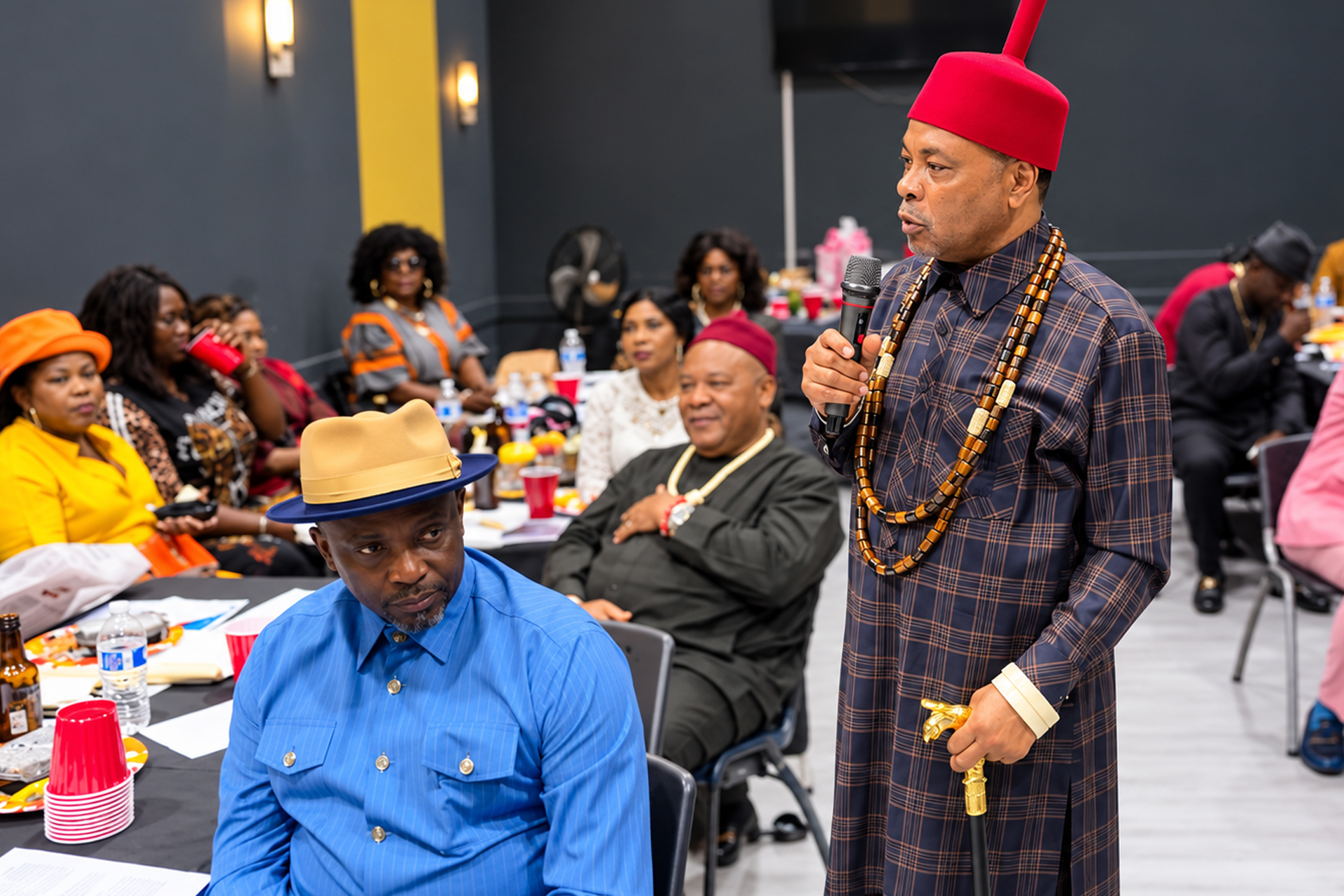
SUGAR LAND, TEXAS — The recent growth and renewed visibility of the Sugar Land People’s Club of Nigeria International did not happen by accident. According to the branch’s Grand Patron, Ide Obinna Nnanyelugo Mbachu, its resurgence is rooted in something far more enduring than ceremonies, titles, or social gatherings: a commitment to putting the organization’s guiding principles into practice.
In an interview reflecting on the branch’s recent progress, Mbachu said the philosophy of “Unity, Love, and Service” remains central to the People’s Club’s identity and is increasingly defining the direction of its Sugar Land branch.
“Unity means recognizing that our individual differences must never become greater than the institution that brings us together,” Mbachu said. “Love means genuinely caring about one another—not only when we celebrate, but when members and their families face difficult moments. Service is where those values become action. If we cannot translate fellowship into service to humanity, then we have missed the purpose of the organization.”

Grand Patron, Ide Obinna Nnanyelugo Mbachu.
People’s Club of Nigeria International traces its origins to Nigeria in 1971 and has since expanded through branches in Nigeria and internationally. Sugar Land occupies a distinctive place in that history as the organization’s First International Branch.
Mbachu said that legacy carries responsibility.
“People’s Club is not simply a social club where people gather, celebrate, and go home,” he said. “At its core, it is a philanthropic institution committed to community welfare. Our fellowship must have a human purpose. We must be able to look beyond ourselves, identify needs within our communities, and respond with compassion, resources, and action.”
He pointed to the COVID-19 pandemic as one example of that philosophy at work.
“I will never forget the COVID period, when fear and uncertainty had disrupted virtually every aspect of life,” Mbachu recalled. “Members of our Sugar Land branch stepped forward to distribute food to families struggling through that crisis. People were concerned about their own safety, yet our members understood that service was most meaningful when the community needed us most. That experience demonstrated what the People’s Club should represent.”
The branch has recently experienced renewed momentum in membership. Following its successful 2026 biannual induction, 16 new members were formally admitted, while additional community members have continued to express interest in joining.
Mbachu attributes that growth partly to greater organizational visibility, active programming, and an environment where prospective members can see fellowship and community engagement working together.
He particularly credited Hon. Prof. Chris Ulasi, Group Chairman of SLPCNI, and his executive team with helping reposition the branch.
“Professor Ulasi and his team deserve tremendous credit,” Mbachu said. “Leadership requires consistency, patience, and the ability to bring different personalities together around a common objective. The progress we are witnessing reflects considerable work behind the scenes; organizing members, strengthening participation, and ensuring that the branch continues moving forward.”
Mbachu also acknowledged PCNI National President Atty. Fidelis Onyebueke, whose leadership he said has contributed to stronger relationships across the organization.
“The National President has emphasized peace, reconciliation, and mutual respect among branches,” he said. “An international organization cannot prosper when its branches operate in unnecessary conflict. His efforts to promote understanding, dialogue, and unity across the People’s Club family have contributed significantly to the stability and renewed enthusiasm we are experiencing.”
For Mbachu, however, growth cannot simply be measured by numbers. The quality and commitment of those joining remain equally important.
“Our doors are open to reputable men and women who believe in what People’s Club represents and are prepared to contribute positively,” he said. “We welcome people who value integrity, fellowship, community service, and mutual respect. Membership should never be about what title you receive; it should be about what value you bring.”
That distinction, Mbachu argues, will determine whether the current momentum becomes lasting institutional progress.
For Sugar Land People’s Club, the formula he offers is remarkably straightforward: protect unity, practice love and make service visible. “When those three principles are genuinely lived,” Mbachu said, “the organization does not have to advertise its greatness. The community will see it.”


Fifty and Fabulous: Chief Oby Marcel Celebrates a Golden Milestone in Houston

People’s Club Sugar Land Is Growing — Grand Patron Mbachu Explains Why

Professor Josephine Onyido Earns Prestigious Nigerian Academy of Education Induction

Emotional Conflict: Is She Toying with Me?

Corruption at the Nigerian Consulate Atlanta – A Victim’s Nightmarish Experience

Gowon’s Book and the Dangerous Politics of Selective Memory

Video: Omambala Cultural Association in Houston Celebrates Motherhood with Joyous Igbo-Inspired Mother’s Day Event

VIDEO: Chris Hollins Opens Cartoon Art Showcase at TSU’s CommWeek

Commissioner Dexter L. McCoy speaks about the African-American Memorial Event
-

 Houston4 weeks ago
PCNI Elevates Chief Dr. Emmanuel Opara to Patron in Historic Ihiagwa Investiture
-

 Houston1 month ago
Membership Surge Continues as Dr. Nkem Ugwu Joins People’s Club
-
 Community4 weeks ago
People’s Club Sugar Land Is Growing — Grand Patron Mbachu Explains Why
-
 Education4 weeks ago
Professor Josephine Onyido Earns Prestigious Nigerian Academy of Education Induction
-
 Houston2 weeks ago
Fifty and Fabulous: Chief Oby Marcel Celebrates a Golden Milestone in Houston