

News
Why GOP Governor Wants a Georgia Boycott So He’ll Have ‘Someone to Blame’ ―Stacey Abrams


Stacey Abrams says that Georgia governor Brian Kemp is “reveling in the potential of a boycott” from Hollywood or other organizations because it would give the GOP governor “someone to blame for his own actions.”
Abrams said she’s a daughter of the South and respects the idea of boycotts. But in this situation, in response to the restrictive voting laws passed by the state’s legislature, she feels a boycott could be “devastating” to the economy and to the people the oppressive voting laws specifically impact.
“Boycotts work best when the target of your boycott is responsive, and unfortunately we are not dealing with good actors here. The governor of Georgia is reveling in the potential of a boycott because it gives him someone to blame for his own actions,” Abrams said in a panel discussion Friday. “Unlike previous boycotts that have worked in the South, the length of time it takes for a boycott to take effect would be devastating to an economy, devastating to people, devastating to the targets of this terrible, vicious legislation.”
Abrams spoke on a panel called “Women in Focus” sponsored through Chapman University and Glamour and was asked specifically about the prospect of Hollywood pulling productions from Georgia by moderator Janice Min, the contributing editor of TIME.
“My deep concern is that if we call for a boycott, the very people who are helping change the nature of economic opportunity and political opportunity will leave us behind. So my message is stay and fight,” Abrams continued. “Come and lift up your voices and join us. But do not let them force out the very people we need to have here and the very jobs we need to have here to make the potential change real in the South. So come, stay, fight, we’ll get it done.”
Abrams was joined on the panel by Samantha Barry, editor-in-chief of Glamour, “Full Frontal” host Samantha Bee, Amazon’s Jennifer Salke, Walt Disney Television chairman of entertainment Dana Walden, and actor and activist Eva Longoria.
Stacey Abrams previously pleaded with corporate leaders to not boycott the state of Georgia, laying out three steps organizations can take to combat voter suppression. And it was also reported earlier this week that Abrams tried to convince MLB to keep the All-Star Game in Georgia.
Abrams was also asked by Min whether she’s planning on running for governor in Georgia, though she said that she has not yet made any decisions. She is however already having conversations for what her next project will be in Hollywood.




Education
TSU’s CommWeek Positions School of Communication at the Forefront of AI, Innovation, and Student Success
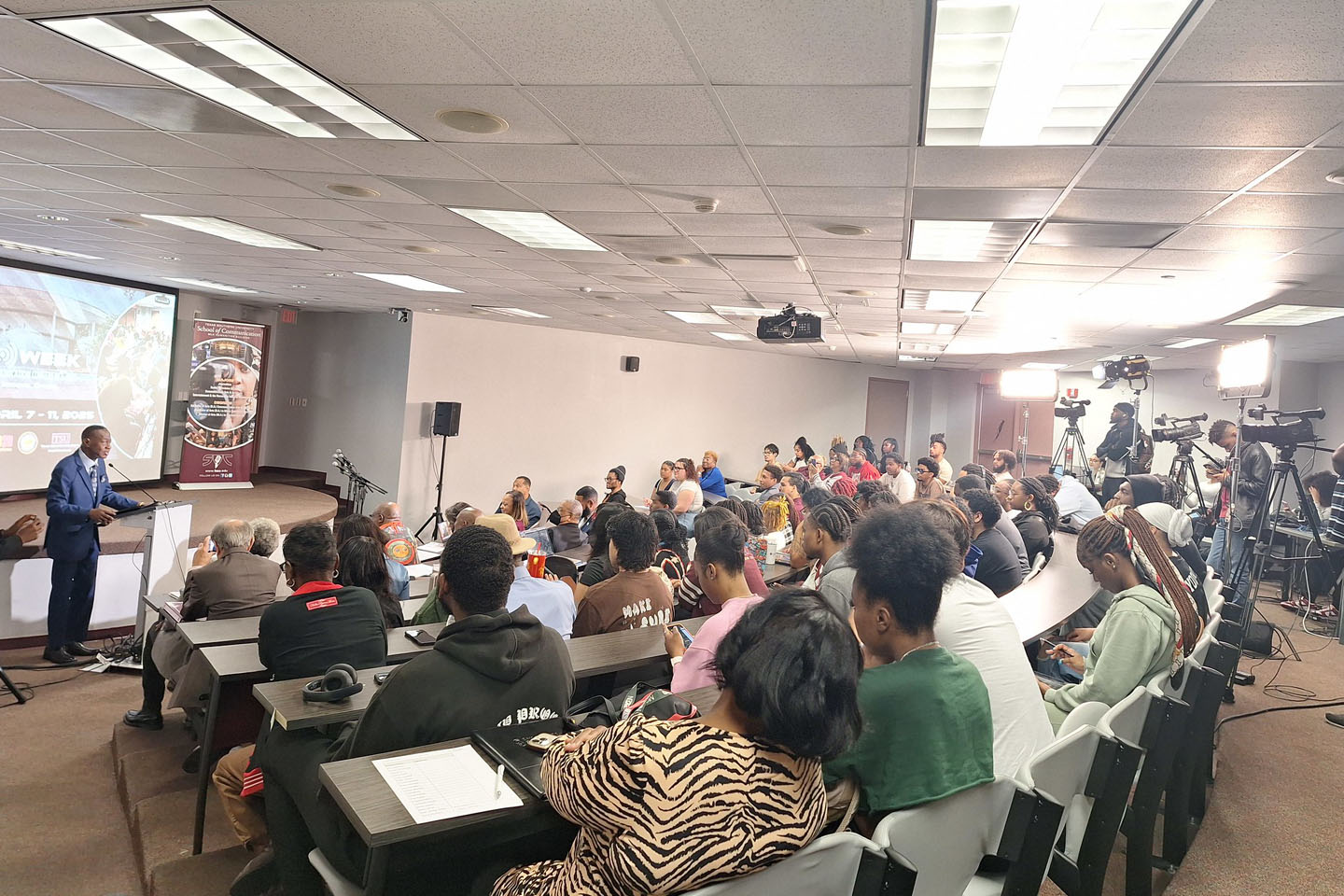
HOUSTON, TX — Texas Southern University’s School of Communication is set to host its 44th Annual Media and Communication Conference (CommWeek 2026) from April 6–10 at the Martin Luther King Jr. Building, bringing together a dynamic mix of scholars, students, industry professionals, and civic leaders to examine the future of media in an increasingly digital and AI-driven world.
Widely regarded as one of the School’s signature academic and professional events, CommWeek has evolved into a powerful platform for intellectual exchange, industry engagement, and student-centered learning. This year’s theme, “Beyond the Algorithm: Reimagining Media, Learning & Innovation with AI,” reflects the growing influence of artificial intelligence across journalism, entertainment, digital storytelling, and communication education.
Throughout the week, participants will engage in a series of panels, workshops, masterclasses, and networking sessions designed to explore how emerging technologies are reshaping media ecosystems. Discussions will address critical topics such as AI-driven content creation, ethical considerations in automated communication, evolving media business models, and the future of audience engagement.
According to Interim Dean Dr. Alan K. Caldwell, CommWeek represents a strategic opportunity to elevate the School’s academic and professional profile.
“Communication Week represents more than a conference; it is a powerful platform to strengthen the School of Communication’s brand, showcase the excellence of our students and faculty, and highlight the innovative work happening across our programs,” Caldwell said. “By bringing together industry leaders, scholars, and alumni, we create collaborative connections that position our school as a hub for forward-thinking communication education.”

Conference Chair Dr. Anthony Obi Ogbo (left) and Interim Dean Dr. Alan K. Caldwell: CommWeek has evolved into a powerful platform for intellectual exchange, industry engagement, and student-centered learning.
In addition to its academic significance, CommWeek plays a vital role in advancing student success. A key highlight of the conference is the Dean’s Banquet and Scholarship Awards, which raises funds to support academically talented and financially underserved students. These scholarships help reduce financial barriers, cover tuition and educational resources, and improve student retention and graduation outcomes.
For Conference Chair Dr. Anthony Obi Ogbo, CommWeek 2026 represents both a continuation of tradition and a bold step toward the future of communication education.
“CommWeek is where scholarship meets practice and where innovation becomes accessible,” Ogbo said. “This conference is not only about examining the future of media—it is about preparing our students to lead it. By integrating academic rigor with industry insight, we are building a platform that empowers our students, strengthens our institutional identity, and fosters meaningful collaborations that extend far beyond the classroom.”
The conference also emphasizes experiential learning, offering students direct access to industry professionals, hands-on workshops, and career development opportunities. These interactions provide invaluable exposure to real-world practices and help bridge the gap between academic training and professional application.
As a historically Black university with a long-standing commitment to cultural responsiveness and community impact, Texas Southern University continues to position its School of Communication as a leader in preparing students for both local and global media landscapes. CommWeek reinforces this mission by creating an inclusive space where diverse voices, perspectives, and ideas can thrive.
Open to students, alumni, and the broader community, CommWeek 2026 is free to attend and serves as a testament to TSU’s commitment to accessibility, innovation, and academic excellence.
For more information and the full conference schedule, visit www.soc-commweek.com.

As the US-Israel and Iran war enters its 6th week, the Iranian military has responded to Donald Trump‘s threats from the Sunday outburst. The president warned Iran that they would be “living in hell” if they didn’t open the Strait of Hormuz. Responding to Trump’s Sunday rant, Iran’s military responded that if he plans to harm the civilians, then their retaliation would be far stronger and larger in scale.
Following threats from Donald Trump, the Iranian military issued a statement warning that if civilian infrastructure is impacted, they will not remain silent, and their retaliation would be more severe. The statement read, “If attacks on civilian targets are repeated, the next stages of our offensive and retaliatory operations will be much more devastating and widespread.”
This statement comes amid Trump’s outburst on Truth Social, where he demanded that Iran open the Strait of Hormuz or face serious consequences. Naming potential targets, he said, “Tuesday will be Power Plant Day and Bridge Day, all wrapped up in one in Iran. There will be nothing like it!!!” Threatening Iran further, he added, “Open the F*ckin’ Strait, you crazy b*st*rds, or you’ll be living in Hell – JUST WATCH!” He concluded his post with, “Praise be to Allah.”
Additionally, Mohammad Bagher Qalibaf, the speaker from Iran’s Parliament, also responded to Trump’s public threats on X (formerly Twitter). He noted that his “reckless” moves are pushing the US into “living hell” for every person residing there. Condemning the president’s latest tweet, he added, “Our whole region is going to burn because you insist on following Netanyahu’s commands. Make no mistake: You won’t gain anything through war crimes.”
In a follow-up tweet, Qalibaf wrote that the only solution to this conflict is for the president to start respecting the Iranian people and to put a stop to this “dangerous game.”

Burbank, Calif. — What began as a seemingly happy two-year marriage ended in confrontation and police involvement after a Burbank woman allegedly used multiple electronic tracking devices to monitor her husband’s movements, authorities and sources familiar with the situation said.

According to information obtained by this outlet, the marriage between Amos and Yolanda deteriorated after Yolanda allegedly placed Apple AirTags, Tile trackers, and a GPS tracking device on Amos’ vehicle and personal belongings without his knowledge. The devices reportedly allowed her to monitor his location in real time and reconstruct his daily movements across the city.

Friends of the couple said the marriage appeared stable during its early years, with the pair often seen together at community events and social gatherings. However, tensions reportedly escalated when Yolanda began confronting Amos about his whereabouts, referencing locations and timelines he had not shared with her.
The situation reached a breaking point when Yolanda allegedly tracked Amos to an apartment complex in Burbank, where she believed he had gone without informing her. Sources say she arrived at the location shortly after he did, leading to a heated confrontation in the parking area of the building. Neighbors, alarmed by raised voices, contacted local authorities.
Burbank police responded to the scene and separated the parties. While no arrests were immediately announced, the incident marked the effective end of the couple’s marriage, according to individuals close to Amos.
Legal experts note that the unauthorized use of tracking devices may raise serious privacy and stalking concerns under California law, depending on intent and consent. Law enforcement officials have not publicly disclosed whether an investigation remains ongoing.
The case underscores growing concerns about the misuse of consumer tracking technology, originally designed to help locate lost items, but increasingly implicated in domestic disputes and surveillance-related allegations.
As of publication, neither Amos nor Yolanda had publicly commented on the incident.


TSU’s CommWeek Positions School of Communication at the Forefront of AI, Innovation, and Student Success

Report Indicates Africa faces growth slowdown due to war on Iran

Donald Trump Receives Message From Iran After His Threats

Emotional Conflict: Is She Toying with Me?

Corruption at the Nigerian Consulate Atlanta – A Victim’s Nightmarish Experience

From Threats to Partnership: How Diplomacy Repositioned Nigeria in Washington

Video: Omambala Cultural Association in Houston Celebrates Motherhood with Joyous Igbo-Inspired Mother’s Day Event

VIDEO: Chris Hollins Opens Cartoon Art Showcase at TSU’s CommWeek

Commissioner Dexter L. McCoy speaks about the African-American Memorial Event
-

 Books2 days ago
The Color of Memory: A Rescue Mission in Print
-
 Education2 days ago
TSU’s CommWeek Positions School of Communication at the Forefront of AI, Innovation, and Student Success
-
 News2 days ago
Donald Trump Receives Message From Iran After His Threats
-
 United States2 days ago
Report Indicates Africa faces growth slowdown due to war on Iran