Nigeria
Ohanaeze laments marginalisation, Buhari says Igbo control economy
Published
5 years agoon
The apex Igbo socio-cultural body, Ohanaeze Ndigbo, has lamented that the people of the South-East are marginalised in Nigeria’s governance structure.
Ohanaeze’s spokesman, Alex Ogbonnia, who said this in an interview with one of our correspondents on Thursday, noted that the fact that the Igbo were scattered all over Nigeria and were successful in business should not be a reason for the current regime to deny them their share in the governance structure of the country.
He spoke in response to the remarks by the President, Major General Muhammadu Buhari (retd.), who was on a one-day visit to Imo State, that the people of the South-East were enterprising and in charge of the country’s economy.
At a town hall meeting with Igbo leaders in Owerri, Buhari stated, “The fundamental thing about the Igbo people is that there is no town you will visit in Nigeria without seeing them being in charge of either the infrastructure or the pharmaceutical industry.
“Therefore, it is unthinkable for me that any Igbo man will consider himself not to be a part of Nigeria. The evidence is there for everyone to see that the Igbo are in charge of Nigeria’s economy.”
In his response, Ogbonnia noted that though the Igbo remained an entrepreneurial set of people, they were still neglected.
He stated, “The Igbo are marginalised in governance structure of this country; it is very clear and self-evident. There is no doubt about it and Buhari himself knows it. But what he said, which is true, is that everywhere you go in Nigeria, you are likely to find an Igbo man in one trade or managing buildings or things like that. So, that is true; but one must know that this is under self-enterprise.
“That is Igbo tenacity for survival and self- enterprise. It is entirely a different ball game. So, the marginalisation we are talking about is in governance structure; the injustice we are talking about is in governance structure.
“You cannot because they are an enterprising set of people deny them their fair share in the governance structure of this country.”
Igbo not secessionists, says Obiozor
Earlier in Owerri during the President’s visit, the President-General of Ohanaeze Ndigbo, Prof George Obiozor, said contrary to the claim in some quarters, Igbo people were not secessionists.
Obiozor urged Buhari to ensure that Igbo youths being held in various detention facilities by security agents were released.
He said Ndigbo would continue to be part of Nigeria as long as there was justice in the country.
He said, “After all Nigeria has gone through in its nearly 60 years’ chequered history of crises and continuity, and the spectacular patriotic role of Ndigbo to ensure its unity and survival, the consistent perception that the Igbo are separatists and secessionist agitators is a historical fallacy.
“Indeed, if the truth must be told, Ndigbo are the most federating unit among all Nigerian citizens. Generally speaking, anywhere in Nigeria you don’t find the Igbo, run away; something is wrong there. Igbo are market people and travel adventurers.
“Consequently, what defines the Igbo character are the propensity for friendliness and harmonious peaceful coexistence and spirit of universalism of mankind. This is who we are. Our Igbo adage says, ‘Ojemba enweghi iro’, which literally translates to: ‘A traveller makes no enemy’.
“Also, another misconception of Ndigbo is that they cannot speak with one voice; ironically, that is another fallacy. The Igbo spirit defies conditions that are obstacles for the expression of their individual or group opinion. This sense of egalitarianism is what defines the Igbo system of governance based on liberal democracy and social justice.
“Mr President, in spite of all the threats of secession or separatism facing the country, there is no doubt that no secessionist element can succeed in Nigeria provided there is good governance based on equity, justice and fairness to all the citizens.”
Igbo leaders in Owerri to welcome Buhari
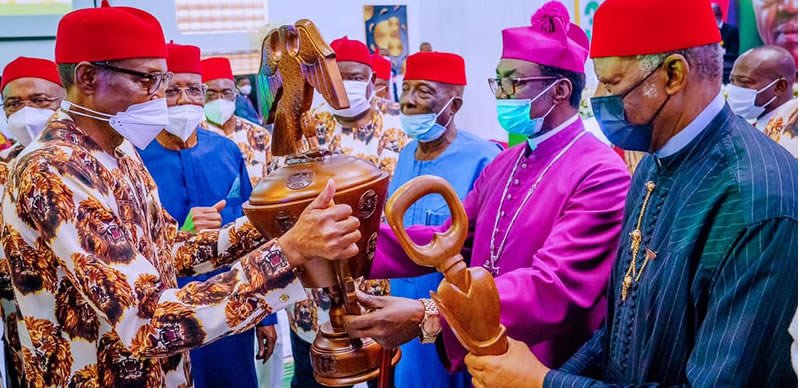
Meanwhile, the cream of the Igbo leadership converged on Owerri to join Governor Hope Uzodimma to welcome the President.
Governor David Umahi of Ebonyi State and the Deputy Governor of Abia State, Sir Ude Oko Chukwu, were physically present, while the other governors in the South-East were represented as Buhari inaugurated four strategic projects executed by the Uzodimma administration.
The President, who arrived in Owerri to a rousing reception, said he was impressed with the quality of jobs executed by the Uzodimma administration.
Among the projects inaugurated by the President were the Ihiagwa/Nekede/Obinze Road, the Ballon underground tunnel to check flooding in Owerri and the Egbeada Bypass Road.
Church attendant shot, activities paralysed in Anambra
In Anambra State, the visit of President Buhari to Imo State had ripple consequences as there were pockets of violence in some parts of the state by the enforcers of the Indigenous People of Biafra’s sit-at-home order.
In Oba, Idemili South Local Government Area of the state, gunmen were said to have shot dead an occupant of a vehicle, who was returning from a church service.
In a viral video, a voice was heard warning people who defied the IPOB order to have a rethink or be ready to face the consequences.
A trader at the Onitsha Main Market told one of our correspondents on the telephone that he complied with the order because of the fear of attack.
“IPOB has instilled fear in everybody, not only in Anambra, but the entire South-East,” he stated.
Commercial activities in the state were crippled as a result of the compliance with the sit-at-home order by the IPOB to register their disapproval of the President’s visit to the South-East.
Though IPOB later denied ordering the sit-at-home, socio-economic activities in the state were halted.
Banks, shops, markets, motor parks, government establishments and allied institutions were shut down.
At Agulu in the Anaocha Local Government Area of the state, a commercial motorcycle was set ablaze for operating.
In a video that when viral, a voice was heard telling people to learn from the incident.
The speaker, who spoke in Igbo, said, “When we ask people to stay at home in their own interest, they will continue to disobey our order.
“Those of you, who doubt us and try to test our will, should learn from this incident. We have burnt this motorcycle and chased away those old women, who came to the market to sell rubbish.”
When contacted, the state Police Public Relations Officer, Ikenga Tochukwu, said he was only aware of the violent attack at Oko in the Orumba North Local Government Area of the state.
Owerri deserted, civil servants abscond from work
However, Owerri, the Imo State capital, was a shadow of its former self on Thursday as Buhari visited the state.
One of our correspondents, who monitored the situation in the town, observed that banks, schools, markets and malls were shut.
The state secretariat complex located at New Owerri was a ghost town as civil servants absented themselves from work.
While the city was militarised, Ikenegbu, Mbari, Douglas, the Imo State University junction, Control Post, Wethedral Road, Warehouse junction and others were empty.
The media noticed security operatives patrolling the town in Armoured Personnel Carriers.
Shops, filling stations, markets shut down in Ebonyi
Also, in Ebonyi State, economic activities were paralysed as shops, markets, filling stations and other business premises were shut down in Abakaliki, the state capital.
The PUNCH observed that gates of bank branches in different locations in the town were under lock and key.
Okorocha, Kalu, others absent
Meanwhile, former governors of Imo and Abia states, Senator Rochas Okorocha and Orji Kalu, were prominent chieftains of the All Progressives Congress in the South-East, who were absent during the President’s visit to Imo State.
Speaking on his absence from the event, Okorocha said the incumbent governor, Uzodimma, did not invite him to the occasion.
Okorocha’s media aide, Sam Onwuemeodo, said Uzodimma and the state government were playing politics of hate, vendetta and intolerance.
Onwuemeodo stated that it was unfortunate that Uzodimma choose to ignore Okorocha when it was the former governor, who brought the APC to South-East and Imo State in particular.
Culled from the Punch News Nigeria
You may like
-
From Noise to Votes: Nigerian Youth Must Turn Online Fire into Electoral Power
-
Between Silence and Sabotage: Jonathan’s Return to Political Manipulation
-
The Devastation of Insurgency: Nigeria Cannot Kill Its Way Out of Insecurity
-
Igbo Dynamism and The Politics of Misalignment
-
Gowon’s Book and the Dangerous Politics of Selective Memory
-
Donald Trump Receives Message From Iran After His Threats
- Book Title: FOOD FOR THOUGHT: Nourishing the Soul, One Bite at a Time
- Author: Professor Rev. Dr. Darlington Iheonu I. Ndubuike
- Publishers: WestBow Press.
- Reviewer: Dr Emeaba O. Emeaba
- Pages: 220
In Food for Thought, Darlington Ndubuike transforms the produce aisle into a pulpit, finding in seventy fruits and vegetables a complete theology of the examined life; its trials, its silences, and its unexpected harvests.
Consider, for a moment, the humble prune. Dismissed by most as a geriatric remedy, shriveled and graceless beside its more glamorous neighbors in the produce section, it is not the obvious vehicle for theological meditation. Yet it is precisely here, at the unglamorous end of the fruit bowl, that Professor Rev. Dr. Darlington Iheonu I. Ndubuike begins his ambitious, idiosyncratic, and occasionally arresting book of devotional reflections. “Before it becomes a prune,” he writes, “the plum undergoes a transformation; it is dried, its moisture removed, and its form altered. Though the process may seem like a loss, the prune becomes more concentrated, sweeter, and longer-lasting than the original fruit.” The pruning of the plum becomes, in Ndubuike’s telling, the pruning of the soul; God as Master Gardener, cutting away what comforts in order to cultivate what endures.
This is the central conceit of Food for Thought, and it is one the author pursues with a kind of joyful relentlessness across seventy chapters, each devoted to a different fruit, vegetable, or herb. From peach to peas, from chard to walnut, from kiwi to kale, each item in Ndubuike’s spiritual pantry yields a devotional lesson, a biblical parallel, and an acronymic framework for right living. The book belongs to a long lineage of nature-as-sermon writing; from the medieval Physiologus, which found moral instruction in the habits of real and fantastical animals, to the pastoral homiletics of the American evangelical tradition. But Ndubuike brings to the genre something distinctly his own: an exuberant fondness for wordplay, an autobiographical candor that occasionally startles, and a devotional warmth that persists even when the metaphors strain their seams.
The book’s organizing principle is phonetic rather than botanical. Ndubuike pairs each food with a homophonic or near-homophonic English word or phrase: the peach becomes a meditation on the “pitch,” or the power of words; the kiwi prompts a reflection on “Can we?”—a question of communal possibility and spiritual unity; the walnut, with a brisk semantic pivot, becomes “Worry Not.” The raisin asks us to search for “reason” in the dry seasons of life; the lettuce implores us to “Let Us” choose reconciliation; the cantaloupe reminds us that we “Can’t Elope” from our responsibilities. Some of these puns land with the satisfying click of genuine insight. Others; the beet becoming “beats,” the corn becoming “con;” are more strained, their theological freight arriving at the station considerably ahead of any logical locomotive to carry it. Ndubuike is clearly aware that he is operating in the territory of the playful homily rather than the systematic treatise, and he generally deploys his puns with enough good humor to disarm objection.
What distinguishes Food for Thought from its devotional shelf-mates is the quality of Ndubuike’s autobiographical interjections. In a chapter ostensibly about chard—”charred,” in his reading, as a metaphor for transformation through trial—he pivots without warning into a searing personal memoir: his years as an international student in Houston, the hurricane that destroyed his workplace, the repossessed car, the miles walked before dawn from Stella Link Road to West Belfort, folding newspapers in the back of a pickup truck, shoulder still aching decades later. These passages are written with a plainness and precision that distinguish them sharply from the book’s more ornate homiletical moments. They arrest the reader because they are specific in a way that allegory rarely is; because they insist that the fire he describes is not only figurative. “I had a return ticket,” he writes. “I could have gone home. But I stayed. That was over forty years ago. What felt like the end was actually the beginning.” The chard chapter, in other words, becomes something more than a meditation on resilience; it becomes testimony.
The book’s theological framework is unambiguously evangelical and Protestant, rooted in the conviction that Scripture is the primary lens through which the natural world—and human experience—ought to be interpreted. Ndubuike cites Proverbs, the Psalms, the Pauline epistles, and the Gospels with the ease of long familiarity. His approach to biblical narrative is typological and hortatory: Joseph, Esther, Naomi, Gideon, Abraham, and Ruth appear as recurring figures, their stories pressed into service as analogues for contemporary spiritual dilemmas. This is a deeply traditional mode of Christian preaching, and readers already within that tradition will find the interpretive moves intuitive, even comforting. Those approaching from other perspectives—secular, interfaith, or from within Christianity’s more historically minded wings—may find the hermeneutic at once earnest and occasionally reductive. Ndubuike is not much interested in the ambiguities of biblical narrative, in the gaps and silences that have occupied critical scholarship for a century and a half. He reads for moral and spiritual direction, and he finds it consistently wherever he looks.
Structurally, the book follows a disciplined if somewhat formulaic pattern. Nearly every chapter concludes with an acronym that spells out the chapter’s food—the pecan yields PECAN (Positioned in Christ, Empowered by the Spirit, Called with Purpose, Anchored in Faith, Nourished by Grace); the peach yields PITCH (Pause Before You Speak, Intend to Build, Tell the Truth in Love, Choose Words Carefully, Honor God and Others). These frameworks are designed, one senses, for pedagogical application; for church small groups, Sunday school classes, sermons, and workshops. As pastoral tools, they are admirably efficient. As literary devices, they occasionally impose a tidiness on complexity that the preceding meditation has not quite earned. Life, as Ndubuike himself demonstrates when he is writing from memory rather than from schema, is rarely as categorical as an acronym.
The book’s range is its most impressive quality. In the space of a single volume, Ndubuike moves from modesty and bodily dignity (the citrus chapter’s meditation on “see-throughs” and discretion) to individuality and self-expression (the garlic chapter’s spirited defense of the “Gar-ilk,” those uncommon souls who carry bold presence without apology), from the communal ethics of the kiwi to the eschatological patience of wheat. The chapter on basil is perhaps the most quietly searching in the collection: Ndubuike warns against what he calls “basil living”—a life of safe, flavorless adequacy, the spiritual equivalent of the default herb—and invokes Esau’s sale of his birthright as its scriptural type. The Israelites in the wilderness, longing for the cucumbers and garlic of Egypt even after their miraculous deliverance, are pressed into service here as cautionary archetypes of comfort-seeking and diminished vision.
The final chapter, devoted to peas—peace—arrives with the warmth of a well-prepared meal’s last course. Peas, Ndubuike observes, “grow together in a pod, side by side, close-knit, and in harmony. They don’t compete for space; they share it.” It is a fittingly communal image with which to close a book that is, at its best, an invitation to a shared table; to the practice of attending carefully to the ordinary, of finding in the quotidian not distraction but direction.
Food for Thought is not a book without faults. It is uneven in texture, moving between passages of genuine spiritual depth and others that settle for the pleasant cliché. The acronymic scaffolding, useful as a preaching tool, can feel mechanical when encountered seventy times. And there are moments when the phonetic conceits require a suspension of credulity that the theological argument is not quite strong enough to support. But Ndubuike writes from a place of authentic vocation; he tells his readers, only half in jest, that he cannot cook, and that the Holy Spirit is the true chef of this volume, and that sincerity has a flavor of its own.
For readers willing to receive it on its own terms; as an extended pastoral exercise in finding sacred meaning in the ordinary world, written by a man who has walked miles in the dark and emerged with his faith intact; Food for Thought offers something genuinely nourishing. Ndubuike’s grandfather’s voice can be heard throughout: in the dedication to his grandson Lennox, he sets the book as “a table I’ve set with care, each page a dish seasoned with reflection, truth, and love.” That is, in the end, exactly what it is.
This book is available on Amazon (Click on Image).
_________
♦ Dr. Emeaba, the author of “A Dictionary of Literature,” writes dime novels in the style of the Onitsha Market Literature sub-genre.
Column
From Noise to Votes: Nigerian Youth Must Turn Online Fire into Electoral Power
Published
1 month agoon
June 1, 2026
Young Nigerians have shown a remarkable ability to create waves in the digital space. With a single click, they can expose a politician’s corruption, rally tens of thousands of supporters behind a single hashtag, and keep every political actor on edge from dawn until dusk. However, as the 2027 general elections draw closer, it is time to face an uncomfortable truth: loud online noise isn’t the same as real power in the political sphere. If Nigerian youth wish to get the best possible leadership from their nation’s leaders, they need to take their online activity offline (i.e., to places where actual democracy occurs) and start showing up to cast votes.

There is simply too much evidence to ignore that this needs to occur. Nigeria is a young country demographically. Together, Gen Z and Millennials comprise approximately half of the total population—50.1 percent—according to IntelPoint. Gen Z makes up 25.8 percent and Millennials account for 24.3 percent. When we consider Gen Alpha, the percentage rises to 85.7% of the population under 44. According to ActionAid Nigeria, more than 60% of Nigeria’s population is under 30. According to Afrobarometer, Nigeria has a median age of 18.1 years, and 58% of its population is aged 0-29. Therefore, Nigeria isn’t merely a young country; it is a country dominated by young people.
Based on this information, this dominant demographic should wield considerable political influence. Unfortunately, there often appears to be little correlation between these statistics and political influence. The contrast is striking. While a majority of Nigeria’s population is young, there remains a significant gap between how influential young people are politically and how influential they could be. This lack of influence is not due to a lack of ability among young people; rather, it stems from many young people stopping short of completing what is often called the “civic journey,” which involves moving from awareness to action. They consume politics, engage in political debate on social media, participate in meme politics, and express frustration with politics through social media rants; however, many young people still fail to register to vote (PVCs) or participate in elections in sufficient numbers to affect the outcome.
This disparity is important because youth dissatisfaction is far from abstract. More than 23% of Nigerian youth report being unemployed or seeking employment, according to Afrobarometer. Additionally, more than two-thirds of youth aged 18 to 35 report having some form of postsecondary or secondary-level education. Despite Nigeria ranking among the lowest in providing employment and opportunities for youth, and despite identifying high costs of living, unemployment, crime and security concerns, poverty, poor economic management practices, and insufficient access to electricity as the top five issues requiring immediate attention from government officials, youth dissatisfaction cannot be considered indifferent. Rather, youth dissatisfaction reflects citizens’ grievances and legitimate reasons to be deeply interested in who governs their country.
However, mere interest alone will not suffice. Democracy does not reward passion without participation. A young person can identify every weakness inherent in a political system; however, unless that person participates by casting a vote, they will remain a spectator to their own future. If you are mature enough to understand concepts such as inflation, insecurity, broken campaign promises, unemployment rates, and poorly managed governance systems, you are mature enough to accept responsibility for your role in creating solutions to those problems. That responsibility begins with voting.
In addition to continuing to use social media to raise awareness of voter registration, election knowledge, fact-checking mechanisms used during elections, and peaceful participation methods, social media can also serve as a vehicle for facilitating the transition from social media activism to actual civic engagement. Young Nigerians should leverage their social media presence to encourage voter registration, promote election literacy programs, provide fact-checking services to counter election misinformation, and advocate for nonviolent participation throughout the electoral cycle. They should convert their social media timelines into civic classrooms. Where can I find the information I need about voter registration processes? Where is my assigned polling station located? Where do I receive my Permanent Voter Card? How do I protect myself from spreading misinformation? How do I properly monitor election results? These are not dull topics; they represent essential tools required for surviving democracy.
Youth organizations, creators, and social media entities can also help facilitate offline civic engagement. Use your WhatsApp groups to alert others as registration deadlines approach. Use X Spaces and Instagram Live to focus on discussing relevant issues rather than hurling insults. Use TikTok to simplify the voting process. Use Facebook to motivate family members and first-time voters to participate in elections. Use whatever platforms are available to make civic obligation contagious. Nigeria’s youth have shown they can create viral content. Now they must begin to generate participation on a viral scale.
One of the most damaging myths in Nigerian politics is that “your vote doesn’t matter.” It is a self-fulfilling prophecy that only serves the interests of cynics, crooks, and machines whose success depends solely on low turnout. Yes, Nigeria’s electoral process has flaws. Yes, there have been numerous disappointments. However, the response to a flawed democracy is not abandonment; it is increased participation. By staying home on Election Day, youth essentially give their votes — and therefore control — directly to the very same groups they loathe.
Another mythological excuse for the youth’s failure to vote in Nigeria is the claim that “all politicians are alike.” No — they’re not all the same. While some politicians are inept, others are corrupt, and others exhibit both characteristics, democracy is not about seeking holy men or women; it is about making selections and enforcing accountability. An individual who refuses to make a selection for office because none of the options appear acceptable is ultimately selecting the candidate most likely to emerge victorious by default.
Nigeria’s youth already constitute the country’s largest demographic group. It is time for them to become its strongest democratic force as well. However, that will not be achieved by trending hashtags alone. Instead, it will be achieved when online energy is harnessed and directed toward political organization, civic education, voter registration, increasing voter turnout, and holding elected representatives accountable after elections.
The 2023 election saw remarkable youth participation but lacked follow-up. Therefore, the 2027 election should not produce another generation of disillusioned observers; instead, it should yield a new generation of participatory citizens. Let online flames ignite electoral power. Let debates become ballots. Let criticism evolve into participation. If Nigerian youth can dominate social media, they can also dominate democracy. The future will not be handed to them in a retweet. They must elect it into existence.
_________
♦ Chris Ulasi is on the Editorial Board of The West African Pilot News. He contributes stories about culture and tradition, elite politics, ethnicity and national integration, civil society, and social movement. He is a university professor, community builder, poet, film producer, recording the emergent Nollywood cultural history through film.
Anthony Obi Ogbo
Between Silence and Sabotage: Jonathan’s Return to Political Manipulation
Published
1 month agoon
June 1, 2026By
Anthony Ogbo
“Jonathan’s calculated and weaponized ambiguity breeds deception and weakens emerging political alliances.” —Dr. Anthony Obi Ogbo
Former Nigerian President Goodluck Jonathan has once again found himself at the center of presidential speculation, floating silently above the country’s political waters while supporters aggressively market him as a possible candidate ahead of another critical election cycle. And once again, Jonathan is doing what he has mastered throughout his political career: saying nothing clearly while allowing political confusion to grow around him.

This pattern is not new. It is the same indecisive political behavior that defined some of the most consequential moments of his rise and fall. Jonathan became president in 2010 following the death of President Umaru Musa Yar’Adua. At the time, many northern political stakeholders within the then-ruling PDP believed there was an informal understanding that Jonathan would complete Yar’Adua’s term but not seek another full term in 2011, thereby preserving the party’s zoning arrangement between North and South. Instead of taking a clear and immediate position, Jonathan spent months dribbling the nation politically. He neither fully denied nor openly confirmed his intentions until the political tension had already escalated nationwide.
By the time he eventually declared his candidacy, the damage had been done. Many northern allies who initially supported him felt betrayed, politically cornered, or deceived. The PDP fractured internally, regional distrust deepened, and Jonathan’s relationship with major northern power blocs deteriorated permanently. Though he won the 2011 election, the cracks created by that indecision followed him into 2015, contributing significantly to the coalition that eventually removed him from power.
Yet Jonathan learned little from that experience. Since losing reelection in 2015, his name has repeatedly surfaced during every major electoral cycle as a potential presidential contender. Each time, his supporters strategically floated his candidacy across media platforms and political circles. Each time, Jonathan refused to decisively shut the door. Silence became his political instrument, whereas ambiguity became his strategy.
Now the country is witnessing the same playbook again. As coalition politics intensify and opposition forces attempt to consolidate around alternative political movements, Jonathan’s name has resurfaced aggressively. Reports and speculations about his presidential ambition continue to dominate political discussions, especially within camps seeking to disrupt the growing momentum surrounding Peter Obi and emerging opposition realignments.
The troubling part is not merely that Jonathan’s supporters are campaigning. The troubling part is that Jonathan fully understands the implications of his silence. He knows that his political stature carries enough weight to destabilize fragile coalition negotiations. He knows his name alone can divide campaign structures, weaken consensus-building, and inject uncertainty into opposition calculations. Yet he refuses to publicly and definitively state where he stands.
That is not statesmanship. That is calculated political ambiguity. Jonathan’s political history is filled with similarly contradictory choices. After losing power in 2015, he received widespread praise for conceding defeat peacefully. He initially framed that decision as a sacrifice made to preserve Nigerian lives and prevent violence. Later, however, different narratives emerged suggesting international pressure, particularly from the United States under President Obama. The shifting explanations weakened what could have remained one of his strongest democratic legacies.
Then came another contradiction. Despite emerging politically from the PDP, Jonathan gradually aligned himself closely with the administration of former President Muhammadu Buhari, serving in diplomatic and goodwill capacities that many PDP loyalists considered politically inappropriate. This unusual closeness fueled longstanding allegations that elements within the APC establishment viewed Jonathan as a useful political instrument capable of destabilizing opposition coalitions from within. Whether those allegations are true or not, Jonathan’s conduct has consistently created room for suspicion.
His political base remains uncertain. His campaign structure is invisible.
Today, his undeclared ambition is already generating confusion among supporters, coalition organizers, and opposition strategists. His political base remains uncertain. His campaign structure is invisible. His intentions are unclear. Yet his loyalists continue mobilizing aggressively in his name while he watches silently from the shadows.
Nigeria is too politically fragile for this kind of elite gamesmanship. At critical national moments, leadership demands clarity, courage, and accountability. Jonathan cannot continue operating as a permanent “maybe” in Nigeria’s political future, thoughtlessly hovering around every election season like an unanswered question designed to manipulate negotiations and weaken emerging alliances.
At this time, Jonathan should sit in or sit out! If he wants to run, he should declare openly, defend his record, and face the democratic process directly. If he does not intend to run, he should immediately and publicly withdraw his name from the political marketplace. Anything short of that increasingly looks less like political strategy and more like calculated deception. Nigeria deserves leaders who make difficult choices openly—not politicians who weaponize silence while others gamble with national uncertainty in their name.
♦ Publisher of the Guardian News, Professor Anthony Obi Ogbo, Ph.D., is on the Editorial Board of the West African Pilot News. He is the author of the Influence of Leadership (2015) and the Maxims of Political Leadership (2019). Contact: anthony@guardiannews.us
Book Review: The Gospel According to the Grocery Aisle
Wazobia Family Funfair AT 10 – Decade of Family, Culture, and Community
From Noise to Votes: Nigerian Youth Must Turn Online Fire into Electoral Power
Emotional Conflict: Is She Toying with Me?
Corruption at the Nigerian Consulate Atlanta – A Victim’s Nightmarish Experience
Gowon’s Book and the Dangerous Politics of Selective Memory
Video: Omambala Cultural Association in Houston Celebrates Motherhood with Joyous Igbo-Inspired Mother’s Day Event
VIDEO: Chris Hollins Opens Cartoon Art Showcase at TSU’s CommWeek
Commissioner Dexter L. McCoy speaks about the African-American Memorial Event
Trending
-
Books6 days agoBook Review: The Gospel According to the Grocery Aisle
-
Anthony Obi Ogbo1 month agoNigeria, South Africa: When Memory Fails, Brotherhood Burns
-
Anthony Obi Ogbo1 month agoBetween Silence and Sabotage: Jonathan’s Return to Political Manipulation
-
Column1 month agoFrom Noise to Votes: Nigerian Youth Must Turn Online Fire into Electoral Power
-
Anthony Obi Ogbo1 month agoIgbo Dynamism and The Politics of Misalignment
-
Community1 month agoWazobia Family Funfair AT 10 – Decade of Family, Culture, and Community
-
Nigeria1 month agoThe Devastation of Insurgency: Nigeria Cannot Kill Its Way Out of Insecurity