Connect with us

Nigeria

Governor Zulum Describes Bomb Blasts In Maiduguri As Unfortunate, Urge Military To Wake Up

Published

on

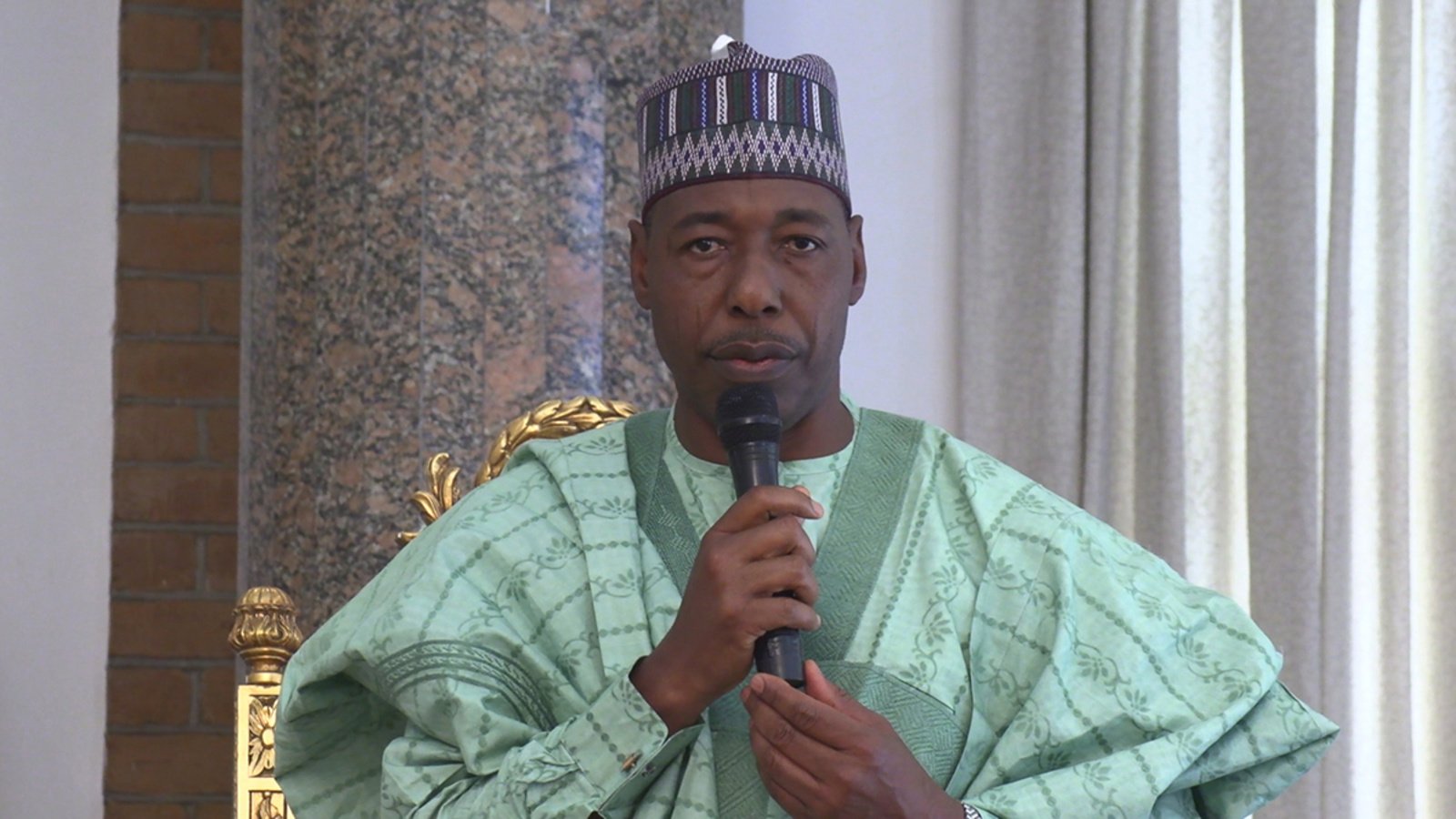
Governor Babagana Zulum of Borno state has urged the military to put necessary measures to avert Boko Haram or ISWAP targeting any part of the state.

Zulum was speaking when he visited Gomari community and 1,000 Housing estates in Maiduguri rocked by explosions, but no death recorded.

The rocket launchers were believed to have been fired by the insurgents on Saturday morning.

The Governor said that the incident was avoidable, noting that there was something wrong that needed to be checked otherwise the insurgents would not have come closer to the city to fire launchers or mortal bombs.

“It is very sad and unfortunate that this kind of attack and others are happening at this time. It seems the insurgents came very close to Maiduguri. Our military have to wake up and ensure adequate surveillance.

“We have to fortify Maiduguri as we will continue to do around other cities and towns across the state. We have to ensure adequate patrols on daily basis to avert future attacks,” he said.

Zulum promised to set up a committee to investigate the incident and access damage done to houses.

Meanwhile, the Nigerian Army, in a statement signed by the spokesperson of the Nigerian Army, Brigadier-General Onyema Nwachukwu has urged the public not to panic over the incident.

The army described the attack as a “security breach by suspected Boko Haram and Islamic State of West Africa Province (ISWAP) terrorists who made futile attempt to maintain potency early this morning, December 4, 2021, with explosions in the outskirt of Maiduguri Metropolitan Council.”

The statement read in part: “This unfortunate incident has caused some level of damage and apprehension in residential areas. Although no life was lost, sadly a minor sustained injury.

“Ground troops in conjunction with the Air Component of OPHK responded swiftly and dominated the area with ground and air interdictions that successfully neutralized the threats and infiltration attempt by the terrorists.

“The general public is urged not to panic as troops are on the ground and aggressively dominating the city to effectively take out any perceived threat.

“The good people of Maiduguri are equally enjoined to go about their normal socio-economic activities and provide actionable information on the movement of these criminal elements.”
Saturday’s attack comes a day after seven soldiers were reportedly killed by ISWAP jihadists near a base at Rann, close to the Cameroonian border.

Also, the Borno Police Command said a six-month-old baby was injured when ISWAP terrorists fired five mortar bombs into Maiduguri.

The Commissioner of Police, Abdul Umar, told the News Agency of Nigeria (NAN) in Maiduguri that the six-month-old victim was treated for minor injuries at the Umaru Shehu Ultra-Modern Hospital and discharged.

Umar added that the terrorists fired the bombs from the outskirt of Ngomari Old Airport, behind Borno State University and the mortars landed in different locations within the city causing minor damages.
The CP said the first bomb landed inside a house belonging to one Ibrahim Abba-Fori, burning down a Honda Civic car while another destroyed a room in Alhaji Bukar Modu-Kullima house and injured the six-month-old baby, Fatima Alhaji-Bukar.
“Another one landed at Gambari Njimtilo Ward near the house of Ahmed Yahaya, where the fence of the house was destroyed.
“The last explosive landed in a farm at Shuwarin Atom Village,” he said.

CP said no life was lost in the attack, adding that more police and military personnel had been deployed to the outskirt of Maiduguri for monitoring and patrols.

He urged residents to be on alert and report any suspected activities that would be detrimental to peace while assuring them of the total readiness of security agencies to protect lives and properties in the state

The insurgents were said to have misfired the rockets meant for the Nigerian Air Force Base but went into their community causing great havoc to some structures.


Houston

People’s Club Sugar Land Celebrates Landmark Induction of 16 New Members

Published

on

National President Atty. Fidelis Onyebueke hails First International Branch for a spectacular celebration of culture, fellowship and service

HOUSTON, TEXAS — The Sugar Land People’s Club of Nigeria International (PCNI), the organization’s First International Branch, has been declared a total success following a spectacular bi-annual induction ceremony that brought together national leaders, branch chairmen, patrons, members, and guests from across the People’s Club family.

National President Atty. Fidelis Onyebueke, who presided over the swearing-in ceremony, commended the Houston branch for delivering an outstanding event that reflected the organization’s enduring traditions of friendship, fellowship, service, and community.

Hon. Prof. Chris Ulasi, SLPCNI Chairman, leads the grand entrance of the national leadership during the induction ceremony, followed by National President Atty. Fidelis Onyebueke and his wife.

“The Houston branch has once again demonstrated what People’s Club represents at its very best. This was a beautifully organized and highly successful event, rich in culture, fellowship, dignity, and unity. I commend the leadership, members, and entire Houston family for an exceptional celebration worthy of the First International Branch.”

The ceremony witnessed the formal swearing-in of 16 new members, each of whom was individually invited forward to receive a certificate of membership from the national president. Onyebueke was assisted in administering the oath by PCNI Attorney Chukwuka John Ukadike.

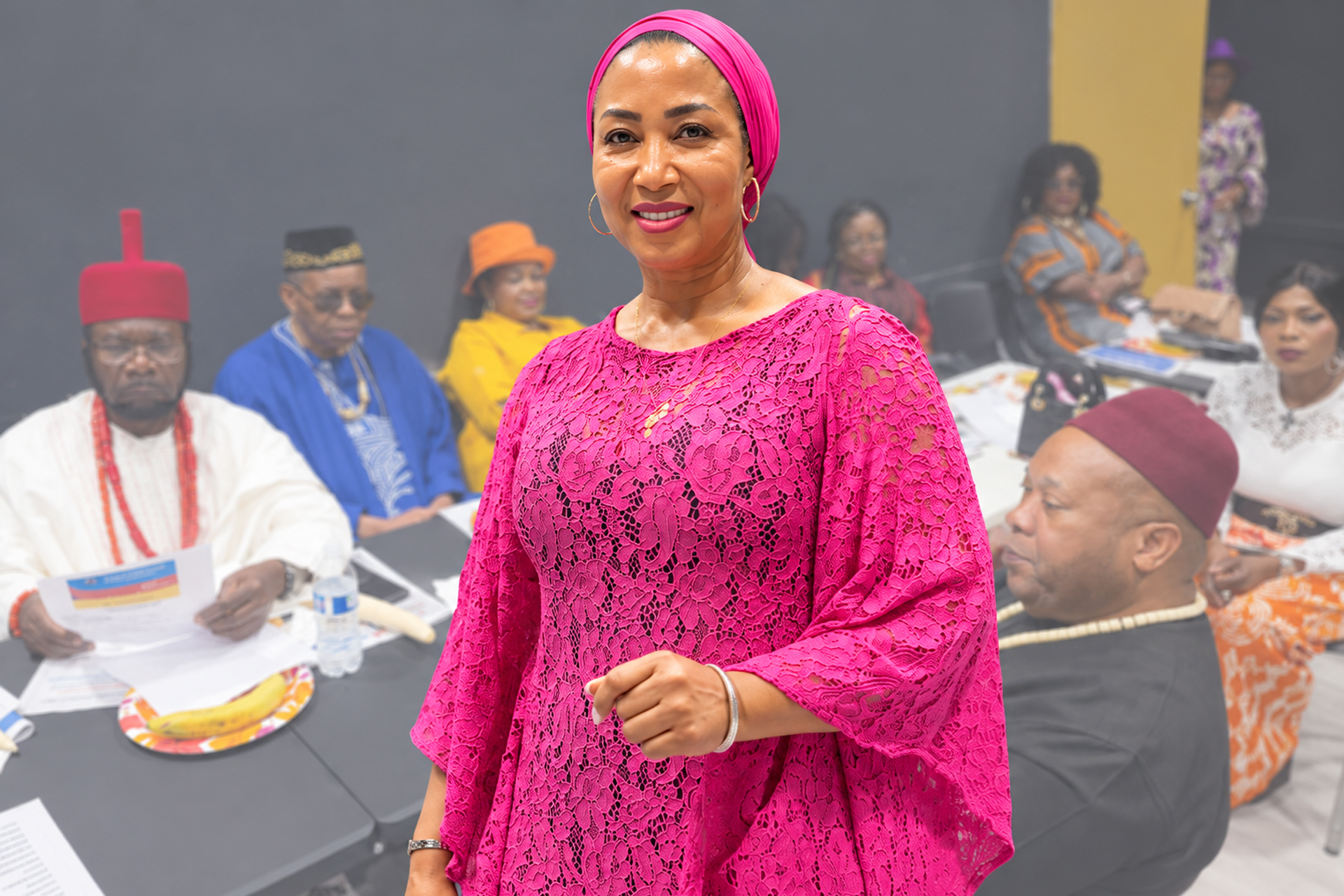
Group Photo: Women Members and Associates of SLPCNI

The inductees joined an impressive gathering that reflected the diversity and strength of the People’s Club community. Members and guests traveled from various branches across the United States and beyond, transforming the Houston ceremony into a truly international gathering.

The cultural elegance of the occasion was equally striking. Women appeared in colorful, coordinated traditional attire, featuring red-pinkish blouses and matching head ties paired with white wrappers prominently designed with the PCNI logo. The ensemble created a distinctive and dignified traditional look. Men complemented the occasion with elegant all-white outfits, customized PCNI cap pins, and special PCNI sashes worn as neckpieces.

Among those in attendance were Grand Patron Ide Obinna Nnanyelugo Mbachu; Hon. Prof. Chris Ulasi, Group Chairman; patrons and chairmen from various branches, and People’s Club members representing chapters across the globe.

The formal proceedings eventually gave way to an extended celebration of friendship and camaraderie. Food, drinks, music, and dancing carried the festivities well beyond the scheduled program, continuing for hours into the early morning of Sunday.

For the Houston branch, the celebration represented more than the admission of new members. It reaffirmed the historic importance of the First International Branch and demonstrated the continuing strength of People’s Club as a transnational fellowship rooted in Nigerian identity, friendship, service, and mutual support.

The successful ceremony also underscored the organization’s ability to bring generations and branches together while preserving the cultural traditions that have sustained its membership across continents.

By the end of the celebration, Houston had delivered more than an induction. It had delivered a memorable demonstration of unity, culture, friendship, and organizational excellence—an event that fully embodied the People’s Club spirit.

Continue Reading

Houston

Houston Ready as People’s Club National President Arrives for Historic Sugar Land Branch Induction

Published

on

Atty. Fidelis Onyebueke’s arrival signals final preparations for the August 22 ceremony as the First International Branch prepares to welcome 17 new members into the People’s Club family

HOUSTON, TEXAS — Final preparations are underway in Houston as the Sugar Land People’s Club of Nigeria International (SPCNI), the First International Branch, puts the finishing touches on what promises to be a landmark evening of fellowship, leadership, and community celebration.

The arrival of Atty. Fidelis Onyebueke, National President of the People’s Club of Nigeria International, has added renewed excitement to the event, underscoring the significance of the Sugar Land branch and its place within the wider People’s Club family.

Grand Patron Ide Obinna Nnanyelugo Mbachu addresses Sugar Land PCNI’s August Conference. Insert: Atty. Fidelis Onyebueke, National President of the People’s Club of Nigeria International.

The organization will hold its 2026 Bi-Annual Induction Ceremony on Saturday, August 22, 2026, from 7:00 p.m. at the Igbo Catholic Community Hall, 8250 Creekbend Drive, Houston, Texas.

Seventeen distinguished men and women are expected to be formally inducted into the organization during the ceremony. The event is expected to bring together People’s Club members, community leaders, professionals, families, friends, and guests from Houston and beyond for an evening celebrating friendship, cultural identity, service, and community.

The arrival of Atty. Onyebueke is particularly significant because the Sugar Land organization is recognized as the First International Branch of People’s Club of Nigeria International.

Group photo during PCNI’s August Conference.

While People’s Club has grown into a broad network with branches in Nigeria, North America, and Europe, the Sugar Land branch occupies a unique place in that expansion. It represents the first international extension of the organization and continues to regard itself as a custodian of the principles established by the founders of People’s Club in Nigeria.

For the branch’s leadership, that history carries both pride and responsibility. Grand Patron Ide Obinna Nnanyelugo Mbachu said that the national leadership’s presence in Houston reinforces the importance of the occasion and the values the organization represents.

“This is more than an induction ceremony; it is a celebration of continuity, friendship, love, and service. The arrival of our National President makes this occasion even more meaningful because it connects our First International Branch directly with the larger People’s Club family. We are welcoming new members into a legacy that must be protected, strengthened, and passed forward.”

Mbachu said the organization’s enduring values remain relevant because they are rooted in the fundamental needs of society: friendship, mutual respect, fellowship, responsibility, and service.


From left: Inductee, Hon. Evangelist Philomena Umoh, Chief Executive Officer of BlessedComfort Home; New member, Hon. Shanteria Onyemem, Houston-based entrepreneur.

Among the seventeen inductees is Evangelist Philomena Umoh, Chief Executive Officer of BlessedComfort Home, a philanthropist and titled chief whose work and personal commitment to helping others have touched numerous lives. For Umoh, the forthcoming induction represents both a personal honor and an opportunity to join a community whose values closely align with her commitment to service.

“I am deeply honored and genuinely excited to become part of the People’s Club family. For me, this is not simply about receiving a title or joining a social organization. It is about belonging to a community that values friendship, service, love, compassion, and giving back. I look forward to contributing meaningfully and building lasting relationships.” Her induction adds another dimension to an occasion already defined by diversity of professional experience, community involvement, and public service.

From Left: Hon. Ike Nwokoye; Hon. Prof. Emmanuel Opara; Hon. Basil Mbuba; and Hon. Udoji Achebe.


Left: Hon. Sir Charles Eloka Ikebuaku, wife, and Hon. Dr. Chris Ulasi.

Hon. Prof. Chris Ulasi, the Group’s Chairman, said that the ceremony will represent an important moment for both the inductees and the organization. Ulasi said the branch is prepared to receive its new members and celebrate the enduring relationships that have sustained the organization.

“Everything is coming together for what we expect to be a memorable evening. We are excited to welcome our National President and our distinguished inductees. This ceremony is about strengthening the bonds that make our organization a true family.”

The chairman emphasized that membership is not merely ceremonial. According to him, those joining the organization become part of an established fellowship with expectations to participate, contribute, and help strengthen the community.

The August 22 event is expected to combine the formal traditions of induction with the warmth and conviviality for which the Sugar Land branch is known. For an organization rooted in Nigerian cultural traditions but operating in one of America’s most diverse metropolitan areas, the ceremony also represents the continuing evolution of the Nigerian-American community in Houston.

Continue Reading

Books

A Chronicle of Community: Tracing the Roots of Amaiyi Igbere

Published

on

  • Book Title: Amaiyi Igbere: A Historical Look Back on Life, People, and Places That Shaped the Community
  • Author: By Emmanuel O. Ukandu, P.E.
  • Publishers: Intekspress Publishers
  • Reviewer: Emeaba O. Emeaba
  • Pages: 285

There is a particular kind of historical work that does not begin in an archive but around family compounds, market squares, church yards, streams, and evening conversations. Amaiyi Igbere: A Historical Look Back on Life, People, and Places That Shaped the Community by Emmanuel O. Ukandu belongs to that tradition. It is not merely a local history. It is an act of cultural preservation, an ambitious effort to rescue an entire way of life from the erosion of memory. The book announces that purpose immediately, presenting itself as a historical record of “life, people, and places that shaped the community.”

Ukandu understands something many professional historians sometimes overlook: the disappearance of everyday knowledge is often more permanent than the loss of famous events. Kings, wars, and politicians usually find chroniclers. The names of neighbors, customs surrounding childbirth, wrestling ceremonies, market routines, childhood games, and village footpaths frequently vanish within two generations. His response is encyclopedic. Across eighteen chapters, the author documents everything from family genealogies and village compounds to agricultural practices, religious life, education, folklore, the Nigerian–Biafran War, and changing social values.

Rather than pretending to produce an objective, omniscient history, Ukandu openly defines the book as a “personal history.” He carefully explains the limits of eyewitness testimony while arguing that memory itself deserves preservation. In one of the book’s strongest passages, he writes that:

“What may appear to be a small fragment of history today… may spare them the considerable effort and resources that would otherwise be required to search for traces of what transpired.”

That sentence serves as the philosophical foundation for everything that follows. The author is less interested in constructing grand historical theories than in ensuring that ordinary facts survive.

One of the book’s greatest achievements is its treatment of genealogy. Hundreds of names appear throughout the narrative—not as dry census entries but as participants in a living community. Families are connected across compounds, marriages, occupations, churches, schools, and public service. Future descendants searching for ancestors decades from now may find this volume invaluable. The author’s hope that young readers will build their own family trees transforms the book from history into an invitation for continuing scholarship.

The strongest chapters are those describing daily life before modernization transformed southeastern Nigeria. The discussions of rites of passage, farming seasons, fishing traditions, folklore evenings, marriage customs, health practices, markets, and village maintenance recreate a society whose rhythms depended upon community rather than institutions. The cumulative effect resembles an ethnography written by someone who lived the culture rather than observing it from the outside.

Ukandu also demonstrates how education shaped modern Amaiyi. His accounts of scholarship programs, pioneering teachers, and community leaders reveal how one generation deliberately invested in the next. Particularly memorable is his reflection that:

“Good seeds planted in children at an early age may produce results that last for a very long time.”

That observation quietly becomes one of the book’s central themes. Throughout the narrative, the community advances not through dramatic revolutions but through teachers, mentors, churches, scholarship funds, and families determined to educate their children.

The prose possesses an unusual sincerity. Ukandu rarely writes as though he is attempting a literary flourish. Instead, his voice reflects someone determined not to forget. That straightforwardness gives emotional weight to passages describing migration, the Nigeria–Biafra War, and the gradual disappearance of customs that once organized everyday existence.

Perhaps the book’s most affecting declaration appears near the beginning:

“The material presented in this book constitutes ‘a time window’ on a particular period in the life of the people of Amaiyi Igbere.”

The metaphor is exactly right. Readers are not simply learning dates; they are looking through a window into a vanished social world.

What does the book do less well?

Its greatest strength is also its principal weakness.

The book frequently favors completeness over narrative momentum. Long catalogues of names, family relationships, and community figures provide extraordinary documentary value, but they occasionally interrupt the flow for readers unfamiliar with Amaiyi. A more selective organization—or the addition of supplementary family charts, maps, timelines, and genealogical diagrams—would have made the wealth of information easier to absorb.

Editorially, the work could also benefit from tighter compression. Many anecdotes repeat similar themes, particularly regarding exemplary community leaders and educational pioneers. A more robust synthesis would strengthen the narrative without sacrificing historical content.

There are moments when personal admiration for certain individuals overtakes critical historical distance. Since the author explicitly identifies the volume as a personal history grounded in lived memory, this is understandable. Still, readers seeking extensive engagement with conflicting interpretations, documentary evidence beyond recollection, or broader regional historiography may occasionally wish for more comparative analysis.

Yet these criticisms ultimately reflect the book’s chosen mission rather than its failure. Ukandu is not writing a conventional scholarly monograph. He is preserving communal memory before it disappears.

The result is an important contribution to local African historiography and a reminder that history survives not only in national archives but also in villages whose stories are too often left unwritten. If every community possessed a chronicler as determined as Emmanuel Ukandu, historians of the next century would inherit a far richer record of Africa’s social past.

Amaiyi Igbere demonstrates that preserving memory is itself an act of public service. It stands as both a historical record and a gift to future generations seeking to understand not merely where they came from, but how ordinary people built a community whose legacy deserved to be written before it was forgotten.

This book is available on Amazon (Click on Image).


_________

♦ Dr. Emeaba, the author of “A Dictionary of Literature,” writes dime novels in the style of the Onitsha Market Literature sub-genre.

Continue Reading

Trending