Connect with us

News

Daunte Wright’s funeral sets up another emotional day in Minneapolis

Published

on

Just days after a Minneapolis police officer was convicted for the murder of George Floyd, the city gathered for another emotional day as family, friends and community members gather for the funeral of Daunte Wright, a 20-year-old Black man who was killed during a traffic stop by police.

Wright’s casket arrived Thursday afternoon at the Shiloh Temple International Ministries In Minneapolis, Minnesota, where civil rights leader Rev. Al Sharpton delivered his eulogy. Body-camera footage released by Brooklyn Center police of an officer shooting Wright awakened renewed protest against police brutality in the area amid the trial of former Minneapolis officer Derek Chauvin in the death of George Floyd.

Floyd’s family was in attendance for Wright’s funeral, along with their attorney Ben Crump, who is also representing Wright’s family.

Jazz artist Keyon Harrold helped to open the funeral service with a trumpet performance, as an artist painted a portrait of Wright in black and white on the stage. Harrold made headlines last year after a woman falsely accused his teenage son of stealing her iPhone at a hotel in New York City. The family filed a lawsuit against the woman, Miya Ponsetto, the hotel and the hotel manager earlier this year.

Crump took the stage after Harrold’s performance, leading mourners in a chant that “Daunte Wright’s life mattered” before he offered a speech that he described as a “plea for justice.”

He spoke to the crowd about a lack of de-escalation in the video released in Wright’s case and how too often traffic stops end up as death sentences for Black people.

“We can expect nobody else to fight for children like us,” Crump said. “We have to fight for our children…because our children need to know how much we believe in them, how much we believe in their future, because they do have a right to life and liberty and their American dream, and that is the plea for justice.”

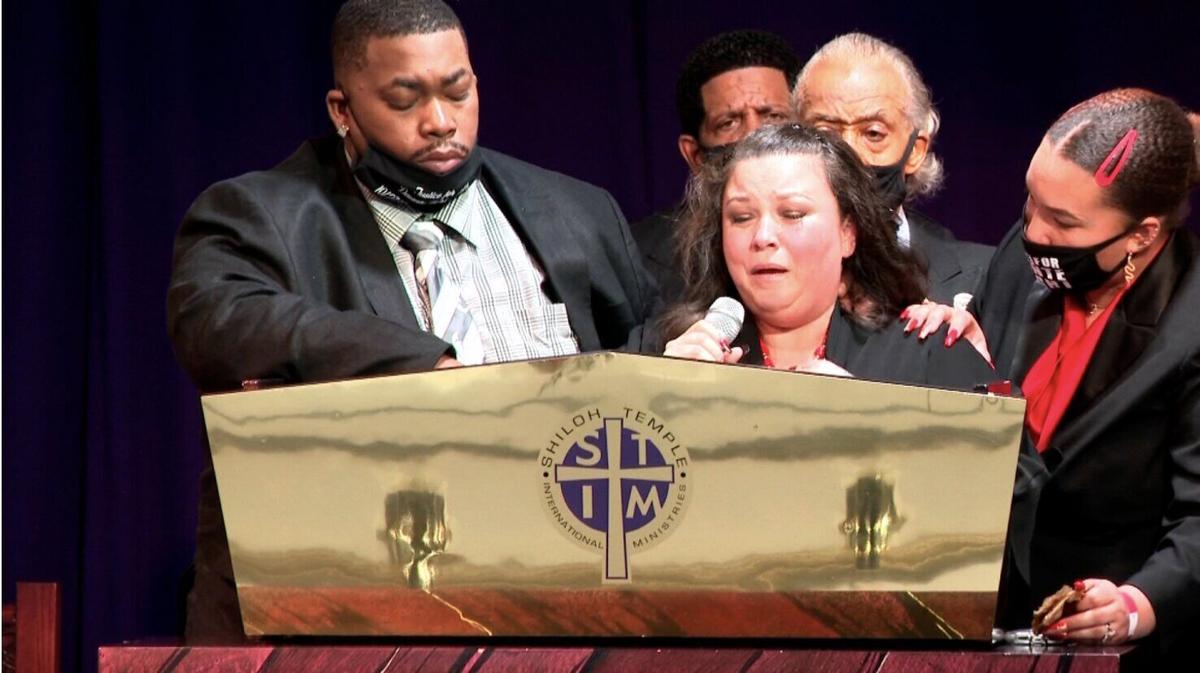
Wright’s parents, Katie and Aubrey Wright, took the stage to offer reflections on their son as a person. His mother spoke through tears, explaining how much her son loved his own child, Daunte, Jr., and how she never expected to be in the position of burying him.

“My son had a smile that was worth a million dollars,” she said. “When he walked in the room, you lit up. He was a brother, a jokester. He was loved by so many.”

Dallas Bryant, 23, is one of Wright’s older siblings and characterized his relationship with Wright as the closest of the siblings.

“I am going to miss this man so much, because he was literally my best friend,” Bryant said. “Through thick and thin, through all the late night conversations we had about him trying to better himself as a man and the man he wanted to be for [Daunte, Jr.]. We talked for hours on it and he was doing just that. I was just so proud of the man he was becoming.”

Image: Daunte Wright funeral

The casket of Daunte Wright rests in place before funeral services at Shiloh Temple International Ministries in Minneapolis, on April 22, 2021.John Minchillo / Pool via AP

Sharpton gave the eulogy for Wright on Thursday, reflecting on decades of racial injustice and the fight for civil rights. He equated the chant of “no justice, no peace” with the quote of “the way of peace they do not know; there is no justice in their paths” in the Bible’s Book of Isaiah.

“You can’t go to church on Sunday and read this book that we call the Bible and not fight against oppression,” Sharpton said. “God is not on the side of the oppressor, God is on the side of the oppressed…we must come into the tradition of what God’s plans was and when you oppress us, we must stand up.”

Daunte Wright is the “Prince of Brooklyn Center,” Sharpton said, referencing a person who compared the funeral procession to that of famed Minneapolis musician Prince.

“I read that he was the center when he played basketball,” Sharpton said. “Now he’s the center of a movement of God.”

Rev. Sharpton at Daunte Wright funeral: ‘We came to bury the prince of Brooklyn Center’  APRIL 22, 202104:26

Rep. Ilhan Omar, D-Minn., a member of the Congressional Black Caucus, read a portion of the resolution of congressional condolences for Wright. She also presented his parents with the flag that was flown at the Capitol in their son’s honor.

Minnesota Sen. Amy Klobuchar spoke to mourners in the pews about the urgent need to pass the George Floyd Justice in Policing Act. She offered a proclamation to Wright’s mother that she will not rest until “true justice” is done for her son by uprooting the “status quo.”

“Racism in this country is not isolated, it’s systemic,” Klobuchar said. “And so, when we ask ourselves why Daunte, Jr. has to grow up without a dad, when we think about what could possibly fill this hole Daunte left in the world, we come up empty. Instead, we find a much bigger hole where justice should be.”

Rep. Ilham Omar presents Wright family with flag flown over U.S. Capitol for Daunte

Brooklyn Center police Officer Kim Potter and the department’s police chief resigned in the wake of Wright’s death. Former Brooklyn Center Police Chief Tim Gannon alleged after the shooting that Potter mistakenly grabbed her firearm instead of her department-issued Taser, a claim that drew skepticism from protesters and the Wright family.

“After 26 years, you would think that you know what side your gun is on and what side your Taser is on,” Crump said. “You know the weight of your gun, and you know the weight of the Taser.”

Potter, a 26-year veteran officer, was charged with second-degree manslaughter and has not yet entered a plea. Bryant said following the charge announcement that his family had been hoping for a more serious charge.

“I’m not too happy about it, but I’ll take every win I can get at the moment,” said Bryant, 23. “My family wants peace. Me and our family are going to try and do it the right way.”

Minnesota Gov. Tim Walz asked residents to join him in a two-minute moment of silence to honor Wright at 12 p.m. CST, the same time Wright’s funeral began.

Texas Guardian News
Continue Reading
Click to comment

Leave a Reply

Column

From Noise to Votes: Nigerian Youth Must Turn Online Fire into Electoral Power

Published

on

Young Nigerians have shown a remarkable ability to create waves in the digital space. With a single click, they can expose a politician’s corruption, rally tens of thousands of supporters behind a single hashtag, and keep every political actor on edge from dawn until dusk. However, as the 2027 general elections draw closer, it is time to face an uncomfortable truth: loud online noise isn’t the same as real power in the political sphere. If Nigerian youth wish to get the best possible leadership from their nation’s leaders, they need to take their online activity offline (i.e., to places where actual democracy occurs) and start showing up to cast votes.

There is simply too much evidence to ignore that this needs to occur. Nigeria is a young country demographically. Together, Gen Z and Millennials comprise approximately half of the total population—50.1 percent—according to IntelPoint. Gen Z makes up 25.8 percent and Millennials account for 24.3 percent. When we consider Gen Alpha, the percentage rises to 85.7% of the population under 44. According to ActionAid Nigeria, more than 60% of Nigeria’s population is under 30. According to Afrobarometer, Nigeria has a median age of 18.1 years, and 58% of its population is aged 0-29. Therefore, Nigeria isn’t merely a young country; it is a country dominated by young people.

Based on this information, this dominant demographic should wield considerable political influence. Unfortunately, there often appears to be little correlation between these statistics and political influence. The contrast is striking. While a majority of Nigeria’s population is young, there remains a significant gap between how influential young people are politically and how influential they could be. This lack of influence is not due to a lack of ability among young people; rather, it stems from many young people stopping short of completing what is often called the “civic journey,” which involves moving from awareness to action. They consume politics, engage in political debate on social media, participate in meme politics, and express frustration with politics through social media rants; however, many young people still fail to register to vote (PVCs) or participate in elections in sufficient numbers to affect the outcome.

This disparity is important because youth dissatisfaction is far from abstract. More than 23% of Nigerian youth report being unemployed or seeking employment, according to Afrobarometer. Additionally, more than two-thirds of youth aged 18 to 35 report having some form of postsecondary or secondary-level education. Despite Nigeria ranking among the lowest in providing employment and opportunities for youth, and despite identifying high costs of living, unemployment, crime and security concerns, poverty, poor economic management practices, and insufficient access to electricity as the top five issues requiring immediate attention from government officials, youth dissatisfaction cannot be considered indifferent. Rather, youth dissatisfaction reflects citizens’ grievances and legitimate reasons to be deeply interested in who governs their country.

However, mere interest alone will not suffice. Democracy does not reward passion without participation. A young person can identify every weakness inherent in a political system; however, unless that person participates by casting a vote, they will remain a spectator to their own future. If you are mature enough to understand concepts such as inflation, insecurity, broken campaign promises, unemployment rates, and poorly managed governance systems, you are mature enough to accept responsibility for your role in creating solutions to those problems. That responsibility begins with voting.

In addition to continuing to use social media to raise awareness of voter registration, election knowledge, fact-checking mechanisms used during elections, and peaceful participation methods, social media can also serve as a vehicle for facilitating the transition from social media activism to actual civic engagement. Young Nigerians should leverage their social media presence to encourage voter registration, promote election literacy programs, provide fact-checking services to counter election misinformation, and advocate for nonviolent participation throughout the electoral cycle. They should convert their social media timelines into civic classrooms. Where can I find the information I need about voter registration processes? Where is my assigned polling station located? Where do I receive my Permanent Voter Card? How do I protect myself from spreading misinformation? How do I properly monitor election results? These are not dull topics; they represent essential tools required for surviving democracy.

Youth organizations, creators, and social media entities can also help facilitate offline civic engagement. Use your WhatsApp groups to alert others as registration deadlines approach. Use X Spaces and Instagram Live to focus on discussing relevant issues rather than hurling insults. Use TikTok to simplify the voting process. Use Facebook to motivate family members and first-time voters to participate in elections. Use whatever platforms are available to make civic obligation contagious. Nigeria’s youth have shown they can create viral content. Now they must begin to generate participation on a viral scale.

One of the most damaging myths in Nigerian politics is that “your vote doesn’t matter.” It is a self-fulfilling prophecy that only serves the interests of cynics, crooks, and machines whose success depends solely on low turnout. Yes, Nigeria’s electoral process has flaws. Yes, there have been numerous disappointments. However, the response to a flawed democracy is not abandonment; it is increased participation. By staying home on Election Day, youth essentially give their votes — and therefore control — directly to the very same groups they loathe.

Another mythological excuse for the youth’s failure to vote in Nigeria is the claim that “all politicians are alike.” No — they’re not all the same. While some politicians are inept, others are corrupt, and others exhibit both characteristics, democracy is not about seeking holy men or women; it is about making selections and enforcing accountability. An individual who refuses to make a selection for office because none of the options appear acceptable is ultimately selecting the candidate most likely to emerge victorious by default.

Nigeria’s youth already constitute the country’s largest demographic group. It is time for them to become its strongest democratic force as well. However, that will not be achieved by trending hashtags alone. Instead, it will be achieved when online energy is harnessed and directed toward political organization, civic education, voter registration, increasing voter turnout, and holding elected representatives accountable after elections.

The 2023 election saw remarkable youth participation but lacked follow-up. Therefore, the 2027 election should not produce another generation of disillusioned observers; instead, it should yield a new generation of participatory citizens. Let online flames ignite electoral power. Let debates become ballots. Let criticism evolve into participation. If Nigerian youth can dominate social media, they can also dominate democracy. The future will not be handed to them in a retweet. They must elect it into existence.

_________

♦ Chris Ulasi is on the Editorial Board of The West African Pilot News. He contributes stories about culture and tradition, elite politics, ethnicity and national integration, civil society, and social movement. He is a university professor, community builder, poet, film producer, recording the emergent Nollywood cultural history through film.

Texas Guardian News
Continue Reading

Education

TSU’s CommWeek Positions School of Communication at the Forefront of AI, Innovation, and Student Success

Published

on

HOUSTON, TX — Texas Southern University’s School of Communication is set to host its 44th Annual Media and Communication Conference (CommWeek 2026) from April 6–10 at the Martin Luther King Jr. Building, bringing together a dynamic mix of scholars, students, industry professionals, and civic leaders to examine the future of media in an increasingly digital and AI-driven world.

Widely regarded as one of the School’s signature academic and professional events, CommWeek has evolved into a powerful platform for intellectual exchange, industry engagement, and student-centered learning. This year’s theme, “Beyond the Algorithm: Reimagining Media, Learning & Innovation with AI,” reflects the growing influence of artificial intelligence across journalism, entertainment, digital storytelling, and communication education.

Throughout the week, participants will engage in a series of panels, workshops, masterclasses, and networking sessions designed to explore how emerging technologies are reshaping media ecosystems. Discussions will address critical topics such as AI-driven content creation, ethical considerations in automated communication, evolving media business models, and the future of audience engagement.

According to Interim Dean Dr. Alan K. Caldwell, CommWeek represents a strategic opportunity to elevate the School’s academic and professional profile.

“Communication Week represents more than a conference; it is a powerful platform to strengthen the School of Communication’s brand, showcase the excellence of our students and faculty, and highlight the innovative work happening across our programs,” Caldwell said. “By bringing together industry leaders, scholars, and alumni, we create collaborative connections that position our school as a hub for forward-thinking communication education.”

Conference Chair Dr. Anthony Obi Ogbo (left) and Interim Dean Dr. Alan K. Caldwell: CommWeek has evolved into a powerful platform for intellectual exchange, industry engagement, and student-centered learning.

In addition to its academic significance, CommWeek plays a vital role in advancing student success. A key highlight of the conference is the Dean’s Banquet and Scholarship Awards, which raises funds to support academically talented and financially underserved students. These scholarships help reduce financial barriers, cover tuition and educational resources, and improve student retention and graduation outcomes.

For Conference Chair Dr. Anthony Obi Ogbo, CommWeek 2026 represents both a continuation of tradition and a bold step toward the future of communication education.

“CommWeek is where scholarship meets practice and where innovation becomes accessible,” Ogbo said. “This conference is not only about examining the future of media—it is about preparing our students to lead it. By integrating academic rigor with industry insight, we are building a platform that empowers our students, strengthens our institutional identity, and fosters meaningful collaborations that extend far beyond the classroom.”

The conference also emphasizes experiential learning, offering students direct access to industry professionals, hands-on workshops, and career development opportunities. These interactions provide invaluable exposure to real-world practices and help bridge the gap between academic training and professional application.

As a historically Black university with a long-standing commitment to cultural responsiveness and community impact, Texas Southern University continues to position its School of Communication as a leader in preparing students for both local and global media landscapes. CommWeek reinforces this mission by creating an inclusive space where diverse voices, perspectives, and ideas can thrive.

Open to students, alumni, and the broader community, CommWeek 2026 is free to attend and serves as a testament to TSU’s commitment to accessibility, innovation, and academic excellence.

For more information and the full conference schedule, visit www.soc-commweek.com.

Texas Guardian News
Continue Reading

News

Donald Trump Receives Message From Iran After His Threats

Published

on

As the US-Israel and Iran war enters its 6th week, the Iranian military has responded to Donald Trump‘s threats from the Sunday outburst. The president warned Iran that they would be “living in hell” if they didn’t open the Strait of Hormuz. Responding to Trump’s Sunday rant, Iran’s military responded that if he plans to harm the civilians, then their retaliation would be far stronger and larger in scale.

Following threats from Donald Trump, the Iranian military issued a statement warning that if civilian infrastructure is impacted, they will not remain silent, and their retaliation would be more severe. The statement read, “If attacks on civilian targets are repeated, the next stages of our offensive and retaliatory operations will be much more devastating and widespread.”

This statement comes amid Trump’s outburst on Truth Social, where he demanded that Iran open the Strait of Hormuz or face serious consequences. Naming potential targets, he said, “Tuesday will be Power Plant Day and Bridge Day, all wrapped up in one in Iran. There will be nothing like it!!!” Threatening Iran further, he added, “Open the F*ckin’ Strait, you crazy b*st*rds, or you’ll be living in Hell – JUST WATCH!” He concluded his post with, “Praise be to Allah.”

Additionally, Mohammad Bagher Qalibaf, the speaker from Iran’s Parliament, also responded to Trump’s public threats on X (formerly Twitter). He noted that his “reckless” moves are pushing the US into “living hell” for every person residing there. Condemning the president’s latest tweet, he added, “Our whole region is going to burn because you insist on following Netanyahu’s commands. Make no mistake: You won’t gain anything through war crimes.”

In a follow-up tweet, Qalibaf wrote that the only solution to this conflict is for the president to start respecting the Iranian people and to put a stop to this “dangerous game.”

Texas Guardian News
Continue Reading

Trending