Connect with us

Nigeria

Oil experts list benefits as National Assembly breaks 12-year jinx, passes PIB

Published

on

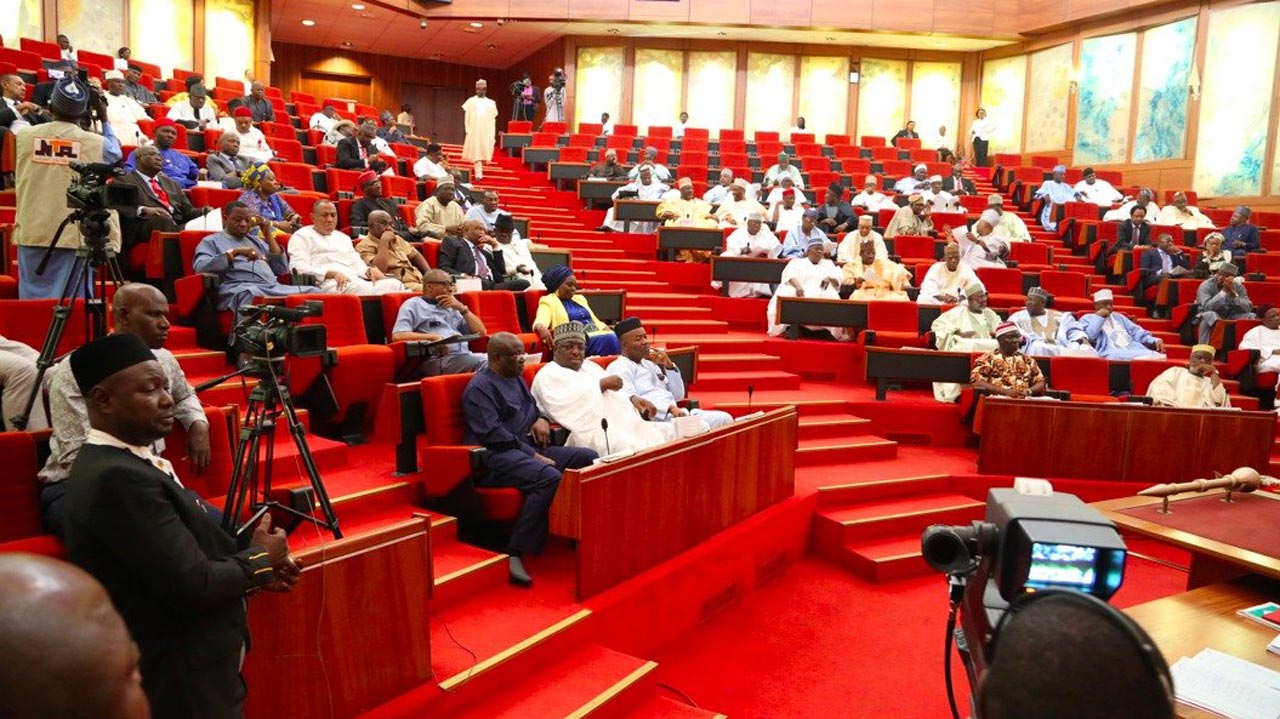
The Senate on Thursday passed the Petroleum Industry Bill and approved that three per cent of profit made by oil firms should be shared to host communities.

The upper chamber passed the PIB, 2021 after the clause by clause consideration of the report of its joint committee on Petroleum (Upstream, Downstream and Gas) on PIB.

Lawmakers from the South-South geopolitical zone however protested against the three per cent approved for the host communities and called for five per cent.

The Senate had before then held a closed session with the Minister of State for Petroleum, Timipre Sylva, and the Group Managing Director of the Nigerian National Petroleum Corporation, Mele Kyari.

The Senate also approved that 30 per cent of profits accruing from oil and gas operations by the Nigeria National Petroleum Corporation would be set aside for exploration of oil in the frontier basin.

The proposed law stipulated that all exploration of frontier basins would fall under the purview of the Upstream Regulatory Commission.

It also clarified that the three per cent from the oil firm’s profits would be reserved for the development of host communities.

However, before the Senate approved the clauses, the plenary was thrown into a rowdy session following the disagreements over the right percentage of oil revenue that should accrue to the host community.

This was because the report of the Senate Joint Committee on Petroleum which processed the bill had proposed five per cent for host communities.

However, when the Senate carried out the clause by clause consideration of the bill, it was reduced to three per cent.

The development led to a stalemate as senators from the Niger Delta region vehemently opposed the decision.

For instance, the Senator representing Delta South, Senator James Manager, proposed an amendment to retain the provision of five per cent in the report but he was defeated.

Also, another attempt by the Senator representing Rivers State, George Sekibo, to call for a division was overruled by the Senate President, Ahmad Lawan, who hit the gavel to re-confirm the three per cent host community provision.

The development led to a serious tension.

The Senate leadership swiftly moved to pacify the southern senators who were insisting on division to resolve the impasse.

The Leader of the Senate, Yahaya Abdullahi, said the Senate would be ‘heading for a state of Armageddon’ if it allowed that division to happen.

Lawan also supported the Senate Leader and urged his colleagues to exhibit patriotism and Sekibo later agreed to withdraw his motion.

Similarly, the House of Representatives, on Thursday, passed the controversial bill, following the consideration and adoption of the report on the controversial legislation.

Speaker of the House, Femi Gbajabiamila, hailed the lawmakers for the record passage of the controversial bill, describing it as significant in the history of the parliament.

The Majority Whip and Chairman of the Ad Hoc Committee on PIB, Mohammed Monguno, had laid the report at the plenary on Wednesday.

He prayed the House to consider the report on the ‘Bill for an Act to Provide Legal, Governance, Regulatory and Fiscal Framework for the Nigerian Petroleum Industry, the Development of Host Communities; and for Related Matters, 2021 (HB. 1061) and Approve the Recommendations Therein’.

The report, as passed, provided five per cent for the development of the host communities and the establishment of a Host Communities Development Fund, which Monguno put at $895m annually.

The chairman noted that the committee recommended five per cent in order not to scare away investors from the nation’s oil and gas sector, in view of the availability of oil in several countries at the moment.

The House included in the bill, a Frontier Exploration Fund, which is to conserve funds for the exploration of oil in the various River Basins across the country which was not initially part of the bill.

However, the bill passed with an amendment only to Section 240(2) of the bill by increasing the host community funding from 2.5 per cent of actual operating expenditure of oil companies as presented to five per cent.

The section provides that “each settlor, where applicable through the operator, shall make an annual contribution to the applicable host community development trust fund of an amount equal to 2.5 per cent of its actual operating expenditure in the immediately preceding calendar year in respect of all petroleum operations affecting the host communities for which the applicable host community development trust was established.”

Gbajabiamila said, “I want to underscore how big, what this committee has just done because this has been going on for 20 years. I want to commend the 74 wise men whose work product has now become the work product of 360 men. I want to commend these men and women for their commitment, industry and scholarship in producing this 318-section law. This 9th Assembly will be recorded on the right side of history.

Our correspondents report that going by standard legislative procedure, the conference committee of the National Assembly would meet to reconcile the differing positions of the Senate and the House.

Experts and marketers who spoke to our correspondents on telephone expressed delight at the passage of the bill.

The Managing Director of Vhelbherg, an indigenous oil firm, Mr Bank-Anthony Okoroafor, said the passage of the PIB and the expected assent by the President would help to bring the country’s oil and gas industry back on track.

Okoroafor, who is a former chairman of Petroleum Technology Association of Nigeria, said the passage of the bill would improve investor confidence as there would be clarity on the fiscal terms of the industry.

“It brings confidence and stability; so, it is a move in the right direction. I say well done to the Senate and House of Representatives for this giant step,” he added.

The National Operations Controller, Independent Petroleum Marketers Association of Nigeria, Mr Mike Osatuyi, said the passage of the PIB into law would mark the beginning of the repositioning of the oil and gas industry.

“If the President assents to it, then that is the beginning of the reform that we have been expecting in the oil and gas industry. It is the beginning of deregulation in the downstream sector,” he said.

He said the passage of the PIB would allow market forces to determine of petrol prices and curb smuggling of the product.

The outgoing Director-General, Lagos Chamber of Commerce and Industry, Dr Muda Yusuf, described the PIB as a major instrument of reform in the oil and gas sector, with a number of significant implications for the sector and the economy as a whole.

National President, Petroleum Products Retail Outlets Owners Association of Nigeria, Billy Gillis-Harry, described the passage of the bill as a big blessing for Nigeria.

He told one of our correspondents that through the bill, a deregulated downstream oil sector would be achieved, adding that this would boost the fortunes of the country and improve the Nigerian economy.

However, the Pan Niger Delta Forum said it was not time for the oil bearing region to celebrate.

PANDEF’s spokesman, Ken Robinson, told one of our correspondents that the forum would like to take a look at the version of the PIB that was endorsed before responding to it.

Robinson added that it would be unnecessary to begin to celebrate when the President, Major General Muhammadu Buhari (retd.), had yet to give his assent to the bill.

He said, “We like to reserve our comment and see the version they passed, whether they accommodated the input made by host communities – those suffering the impact of oil exploration in the Niger Delta and not benefitting from the system.

“We will see whether the input made by the people is accommodated. It is not time to celebrate; if the National Assembly has passed it and Mr President does not assent to it, then it remains with them.”

The forum’s spokesman said he was not sure that the current National Assembly would have the drive to override the President if he (Buhari) refused to assent to the bill.

Culled from the Punch News Nigeria

Texas Guardian News

Africa

U.S. Signals More Strikes in Nigeria as Abuja Confirms Joint Military Campaign

Published

on

The United States has warned that further airstrikes against Islamic State targets in north-western Nigeria are imminent, as Nigerian officials confirmed that recent attacks were part of coordinated operations between both countries.

The warning came hours after U.S. forces struck militant camps in Sokoto State, an operation President Donald Trump publicly framed as a response to what he described as the killing of Christians in Nigeria. U.S. Defense Secretary Pete Hegseth said the strikes were only the beginning.

“The president was clear last month: the killing of innocent Christians in Nigeria (and elsewhere) must end,” Hegseth wrote on X. “The Pentagon is always ready, so ISIS found out tonight—on Christmas. More to come. Grateful for Nigerian government support & cooperation.”

Nigeria’s foreign minister, Yusuf Tuggar, confirmed on Friday that the strikes were carried out as part of “joint ongoing operations,” pushing back against earlier tensions sparked by Trump’s public criticism of Nigeria’s handling of insecurity.

The airstrikes followed a brief diplomatic rift after Trump accused Nigeria’s government of failing to protect Christians from militant violence. Nigerian officials responded by reiterating that extremist groups in the country target both Christians and Muslims, and that the conflict is driven by insurgency and criminality rather than religious persecution.

Speaking to Channels Television, Tuggar said Nigeria provided intelligence support for the strikes in Sokoto and described close coordination with Washington. He said he spoke with U.S. Secretary of State Marco Rubio for nearly 20 minutes before briefing President Bola Tinubu and receiving approval to proceed, followed by another call with Rubio to finalize arrangements.

“We have been working closely with the Americans,” Tuggar said. “This is what we’ve always been hoping for—to work together to combat terrorism and stop the deaths of innocent Nigerians. It’s a collaborative effort.”

U.S. Africa Command later confirmed that the strikes were conducted in coordination with Nigerian authorities. An earlier statement, later removed, had suggested the operation was carried out at Nigeria’s request.

Trump, speaking in an interview with Politico, said the operation had originally been scheduled for Wednesday but was delayed at his instruction. “They were going to do it earlier,” he said. “And I said, ‘Nope, let’s give a Christmas present.’ They didn’t think that was coming, but we hit them hard. Every camp got decimated.”

Neither the U.S. nor Nigerian authorities have disclosed casualty figures or confirmed whether militants were killed. Tuggar, when asked whether additional strikes were planned, said only: “You can call it a new phase of an old conflict. For us, this is ongoing.”

Nigeria is officially a secular state, with a population split roughly between Muslims and Christians. While violence against Christian communities has drawn increasing attention from religious conservatives in the United States, Nigeria’s government maintains that extremist groups operate without regard to faith, attacking civilians across religious lines.

Trump’s public rhetoric contrasts with his 2024 campaign messaging, in which he cast himself as a “candidate of peace” who would pull the United States out of what he called endless foreign wars. Yet his second term has already seen expanded U.S. military action abroad, including strikes in Yemen, Iran, and Syria, as well as a significant military buildup in the Caribbean directed at Venezuela.

On the ground in Sokoto State, residents of Jabo village—near one of the strike sites—reported panic and confusion as missiles hit nearby areas. Local residents said no casualties had been recorded, but security forces quickly sealed off the area.

“As it approached our area, the heat became intense,” Abubakar Sani told the Associated Press. “The government should take appropriate measures to protect us. We have never experienced anything like this before.”

Another resident, farmer Sanusi Madabo, said the night sky glowed red for hours. “It was almost like daytime,” he said. “We only learned later that it was a U.S. airstrike.”

For now, both Washington and Abuja are projecting unity. Whether the strikes mark a sustained shift in strategy—or another brief escalation in a long war—remains unclear.

Texas Guardian News
Continue Reading

Africa

Nigeria–Burkina Faso Rift: Military Power, Mistrust, and a Region Out of Balance

Published

on

The brief detention of a Nigerian Air Force C-130 Hercules aircraft and its crew in Burkina Faso may have ended quietly, but it exposed a deeper rift shaped by mistrust, insecurity, and uneven military power in West Africa. What was officially a technical emergency landing quickly became a diplomatic and security flashpoint, reflecting not hostility between equals, but anxiety between unequally matched states navigating very different political realities.

On December 8, 2025, the Nigerian Air Force transport aircraft made an unscheduled landing in Bobo-Dioulasso while en route to Portugal. Nigerian authorities described the stop as a precautionary response to a technical fault—standard procedure under international aviation and military safety protocols. Burkina Faso acknowledged the emergency landing but emphasized that the aircraft had violated its airspace, prompting the temporary detention of 11 Nigerian personnel while investigations and repairs were conducted. Within days, the crew and aircraft were released, underscoring a professional, if tense, resolution.

Yet the symbolism mattered. In a Sahel region gripped by coups, insurgencies, and fragile legitimacy, airspace is not merely technical—it is political. Burkina Faso’s reaction reflected a state on edge, hyper-vigilant about sovereignty amid persistent internal threats. Nigeria’s response, measured and restrained, reflected confidence rooted in capacity.

The military imbalance between the two countries is stark. Nigeria fields one of Africa’s most formidable armed forces, with a tri-service structure that includes a large, well-equipped air force, a dominant regional navy, and a sizable army capable of sustained operations. The Nigerian Air Force operates fighter jets such as the JF-17 and F-7Ni, as well as A-29 Super Tucanos for counterinsurgency operations, heavy transport aircraft like the C-130, and an extensive helicopter fleet. This force is designed not only for internal security but for regional power projection and multinational operations.

Burkina Faso’s military, by contrast, is compact and narrowly focused. Its air arm relies on a limited number of light attack aircraft, including Super Tucanos, and a small helicopter fleet primarily dedicated to internal counterinsurgency. There is no navy, no strategic airlift capacity comparable to Nigeria’s, and limited logistical depth. The Burkinabè military is stretched thin, fighting multiple insurgent groups while also managing the political consequences of repeated military takeovers.

This imbalance shapes behavior. Nigeria’s military posture is institutional, outward-looking, and anchored in regional frameworks such as ECOWAS. Burkina Faso’s posture is defensive, reactive, and inward-facing. Where Nigeria seeks stability through deterrence and cooperation, Burkina Faso seeks survival amid constant internal pressure. That difference explains why a technical landing could be perceived as a “serious security breach” rather than a routine aviation incident.

The incident also illuminates why Burkina Faso continues to struggle to regain political balance. Repeated coups have eroded civilian institutions, fractured command structures, and blurred the line between governance and militarization. The armed forces are not just security actors; they are political stakeholders. This creates a cycle where insecurity justifies military rule, and military rule deepens insecurity by weakening democratic legitimacy and regional trust.

Nigeria, despite its own security challenges, has managed to avoid this spiral. Civilian control of the military remains intact, democratic transitions—however imperfect—continue, and its armed forces operate within a clearer constitutional framework. This stability enhances Nigeria’s regional credibility and amplifies its military superiority beyond hardware alone.

The C-130 episode did not escalate into confrontation precisely because of this asymmetry. Burkina Faso could assert sovereignty, but not sustain defiance. Nigeria could have asserted its capability, but chose restraint. In the end, professionalism prevailed.

Still, the rift lingers. It is not about one aircraft or one landing, but about two countries moving in different strategic directions. Nigeria stands as a regional anchor with superior military power and institutional depth. Burkina Faso remains a state searching for equilibrium—politically fragile, militarily constrained, and acutely sensitive to every perceived threat from the skies above.

Texas Guardian News
Continue Reading

Lifestyle

Kaduna Governor Commissions Nigeria’s First 100-Building Prefabricated Housing Estate

Published

on

Kaduna, Nigeria – November 6, 2025 — In a major milestone for Nigeria’s housing sector, the Governor of Kaduna State has commissioned a 100-unit mass housing estate developed by Family Homes and executed by Karmod Nigeria, marking the first-ever large-scale prefabricated housing project in the country.

Completed in under six months, the innovative project demonstrates the power of modern prefabricated construction to deliver high-quality, affordable homes at record speed — a sharp contrast to traditional building methods that often take years.

Each of the 100 units in the estate is designed for a lifespan exceeding 50 years with routine maintenance. The development features tarred access roads, efficient drainage systems, clean water supply, and steady electricity, ensuring a modern and comfortable living environment for residents.

According to Family Homes, the project represents a new era in Nigeria’s mass housing delivery, proving that cutting-edge technology can accelerate the provision of sustainable and cost-effective homes for Nigerians.

“With prefabricated technology, we can drastically reduce construction time while maintaining top-quality standards,” said a spokesperson for Family Homes. “This project is a clear demonstration of what’s possible when innovation meets commitment to solving Nigeria’s housing deficit.”

Reinforcing this commitment, Governor Uba Sani of Kaduna State emphasized the alignment between the initiative and the state’s broader vision for affordable housing.

“The Family Homes Funds Social Housing Project aligns with our administration’s commitment to the provision of affordable houses for Kaduna State citizens. Access to safe, affordable and secure housing is the foundation of human dignity. We have been partnering with local and international investors to frontally address our housing deficit,” he said.

Also speaking at the event, Mr. Ademola Adebise, Chairman of Family Homes Funds Limited, noted that the project embodies inclusivity and social progress.

“The Social Housing Project also reflects our shared vision of inclusive growth, where affordable housing becomes a foundation for economic participation and improved quality of life.”

Karmod Nigeria, the technical partner behind the project, utilized its extensive expertise in prefabricated technology to localize the process, employing local artisans and materials to enhance community participation and job creation.

Industry experts have described the Kaduna project as a blueprint for future housing initiatives nationwide, capable of addressing the country’s housing shortfall more efficiently and sustainably.

With this pioneering development, Kaduna State takes a leading role in introducing modern housing technologies that promise to reshape Nigeria’s urban landscape.

Texas Guardian News
Continue Reading

Trending