

Africa
‘Africa Fashion’ Exhibition Hit Brooklyn Museum With New Designers, Unique Textiles

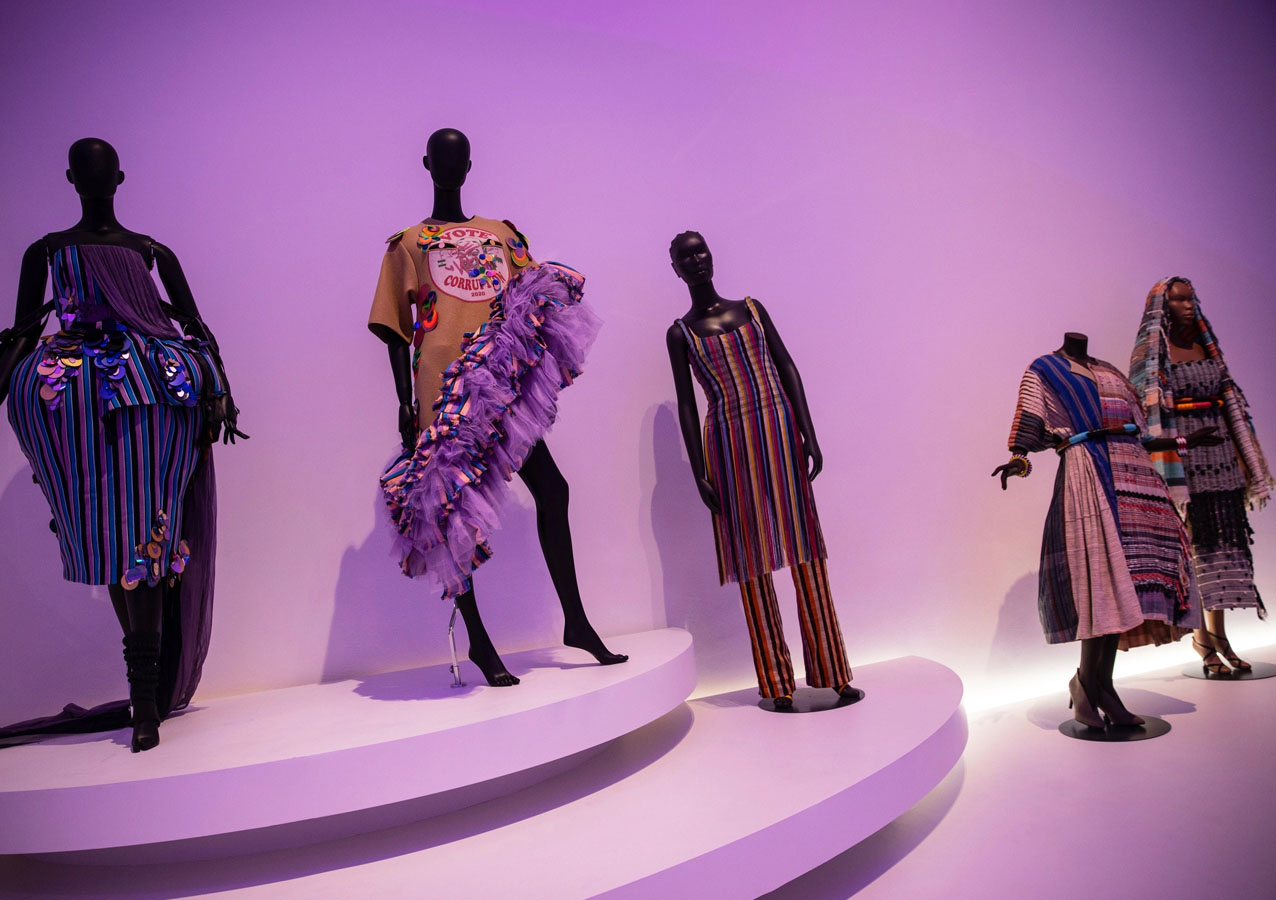
A mannequin stands with head tilted, a knee jutting from the deep bias chiffon and woven fabric hemline of Papa Oppong’s Takari T, a T-shirt worn as a dress from the Ghanaian-born designer’s celebrated 2021 Yopoo collection, which evokes a Ghanaian woman’s life from birth to marriage to death. A “Ghana Must Go” bag — the ubiquitous blue, white and red reusable bags that have come to symbolize the forced migration of millions of Ghanaians from Nigeria — sits on the floor next to the mannequin.
It’s one of two looks from Oppong included in the Brooklyn Museum’s iteration of “Africa Fashion,” the blockbuster exhibition that opened last summer at London’s Victoria and Albert Museum, and which runs Friday through Oct. 22 in New York.
“I can’t believe this is my work,” muses Oppong, as he raises his hands to his cheeks. “It doesn’t seem real. Coming from Ghana, I dreamed of creating work that could be this accessible. So this,” he says, spinning around to take in the work of fellow designers on display in a large central gallery, “is truly a dream come true.”
Like many of the additional designers included in the Brooklyn Museum exhibit, Oppong’s pieces evoke the heritage but also the political and socioeconomic realities of the African diaspora; from political satire and adherence to traditional weaving, hand-dyeing and beading techniques to collaborations with other African artists, from illustrators to weavers to photographers and musicians.
Organized thematically, the exhibition features garments, textiles, photography, books, music and catwalk footage from more than 40 designers and artists from 20 of Africa’s 54 countries, including pioneering 20th-century designers Kofi Ansah (Ghana), Naima Bennis (Morocco), Shade Thomas-Fahm (Nigeria), Chris Seydou (Mali), and Alphadi (Niger) in the “Vanguard” section. “The Cultural Renaissance” section explores the independence era, from the 1950s through the 1990s, a period of dramatic political, social and cultural upheaval reflected in the Pan-African fashion and art scene. “Politics and Poetics of Cloth” surveys the rise of Indigenous cloth as a political act; textiles from the museum’s Arts of Africa collection complement the V&A’s wax prints, commemorative cloth, àdìrẹ, kente cloth and bògòlanfini. “Capturing Change” chronicles the independence years through artists such as Seydou Keïta (Mali) and Malick Sidibé (Mali), from the museum’s collection, as well as fashion photography by James Barnor (Ghana). “Cutting Edge” is organized around concepts including “Afrotopia,” “Artisanal,” “Co-creation,” “Provocation,” “Minimalist,” and “Mixologist” and showcases a new generation of fashion designers and creatives, including South Africa–based designer Thebe Magugu, winner of the 2019 LVMH Young Fashion Designer Prize. “Through the Photographer’s Lens” examines the power of contemporary photography with a series of images of intricate African hairstyles from Nigerian photographer J.D. ‘Okhai Ojeikere, and work from New York native Kwame Brathwaite, the father of the 1970s “Black is Beautiful” movement who died last April. The exhibition concludes with “Global Africa,” which explores how the digital world accelerated the expansion of Africa’s influence in the fashion industry.
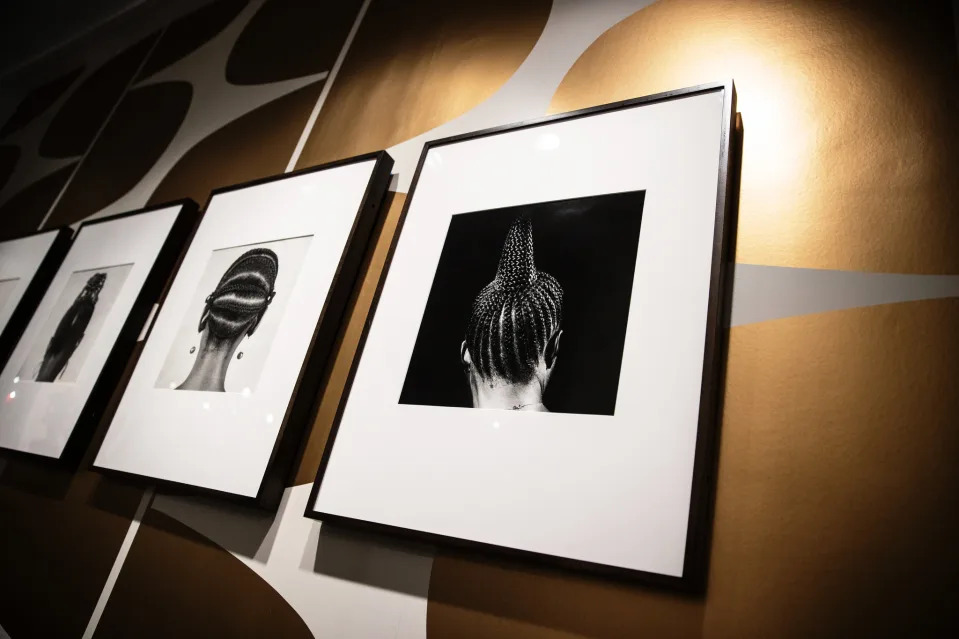
Photographer J.D. ‘Okhai Ojeikere’s images of African hairstyles are among more than 50 additional items from the Brooklyn Museum’s collection.
Additional new contemporary pieces also include Brother Vellies designer Aurora James’ Mother Nature gown with a raffia skirt and basket bodice, which the Ghanaian-Canadian designer wore to the 2019 Met Gala; a basket bag from Sudanese-American designer Eilaf Osman; and a shirt and skirt ensemble from Studio One Eighty Nine that features a pineapple husk belt and dried raffia straw hat.
“Haute couture, notions of the handmade and luxury, slow fashion, using dyes or materials that are non-invasive to the environment, this conversation around sustainability has always been part of the African continent,” says Ernestine White-Mifetu, the Brooklyn Museum’s Sills Foundation Curator of African Art, who adapted the exhibition with Annissa Malvoisin, the museum’s postdoctoral fellow in the Arts of Africa.
“And the contemporary designers from the continent have continued those traditions while taking the making and design of African textiles to a new level that’s extremely exciting,” continues White-Mifetu. “And this is an opportunity for audiences in North America to get to know what that looks like.”
The exhibit includes more than 50 items from the museum’s collection, including Egyptian jewelry from B.C.E. through 1st century C.E. and 19th and 20th century jewelry from Niger, Nigeria, Ghana, Ethiopia, the Democratic Republic of Congo, Burkina Faso. Many of the items have not preciously been on view. (The museum’s African galleries are currently undergoing a major renovation with a reinstallation slated for 2025.)
“African regions and culture and art isn’t stuck in a specific time period,” says Malvoisin. “The African fashion scene has always been vibrant, even 3,000 years ago. It was really important for us to include our collection because our collection highlights the cultural continuity and technological and manufacturing production that has continued for thousands of years and which are still being used today by the designers featured in the show.”
The contributions of African-born designers is already obvious in the fashion industry, but the exhibit is arguably the first comprehensive recognition of that legacy.
“We do fashion shows a lot [at the Brooklyn Museum], but to focus on African fashion in an expansive way, and to bring something like this to North America and in New York, which is one of the fashion capitals of the world, is really important. These shows are quite commonplace for European and North American designers,” says Malvoisin, invoking the Brooklyn Museum’s recent retrospectives of Christian Dior and Thierry Mugler. “This is placing African fashion designers on the same level as all of these other luxury fashion houses and designers. I feel like it’s just the beginning. Perhaps this will also lay the foundation and groundwork for something like that happening for an African fashion designer.”
Standing in the exhibit’s large central hall, Oppong — dressed head-to-toe in black Balenciaga, right down to his kitten-heeled shoe socks — takes in the designs from his contemporaries. “I know so many people in here,” he says, raising an arm toward a mannequin draped in Christie Brown’s She is King gold and black gown.
“I did art direction at Christie Brown for a year,” he says. “I love Kenneth Ize, Imane Ayissi. This hall is just magical.”




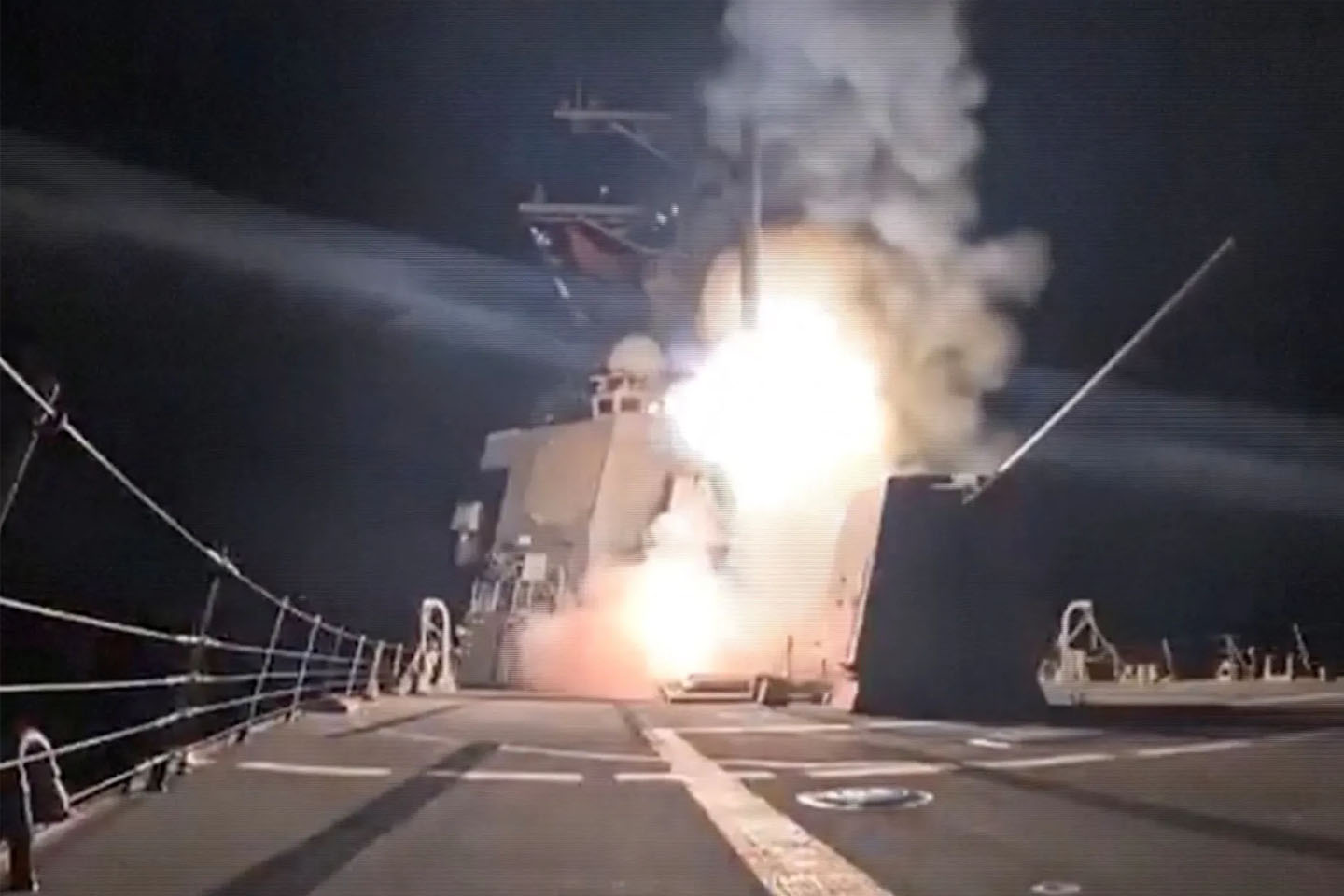
The United States has warned that further airstrikes against Islamic State targets in north-western Nigeria are imminent, as Nigerian officials confirmed that recent attacks were part of coordinated operations between both countries.
The warning came hours after U.S. forces struck militant camps in Sokoto State, an operation President Donald Trump publicly framed as a response to what he described as the killing of Christians in Nigeria. U.S. Defense Secretary Pete Hegseth said the strikes were only the beginning.
“The president was clear last month: the killing of innocent Christians in Nigeria (and elsewhere) must end,” Hegseth wrote on X. “The Pentagon is always ready, so ISIS found out tonight—on Christmas. More to come. Grateful for Nigerian government support & cooperation.”
Nigeria’s foreign minister, Yusuf Tuggar, confirmed on Friday that the strikes were carried out as part of “joint ongoing operations,” pushing back against earlier tensions sparked by Trump’s public criticism of Nigeria’s handling of insecurity.
The airstrikes followed a brief diplomatic rift after Trump accused Nigeria’s government of failing to protect Christians from militant violence. Nigerian officials responded by reiterating that extremist groups in the country target both Christians and Muslims, and that the conflict is driven by insurgency and criminality rather than religious persecution.
Speaking to Channels Television, Tuggar said Nigeria provided intelligence support for the strikes in Sokoto and described close coordination with Washington. He said he spoke with U.S. Secretary of State Marco Rubio for nearly 20 minutes before briefing President Bola Tinubu and receiving approval to proceed, followed by another call with Rubio to finalize arrangements.
“We have been working closely with the Americans,” Tuggar said. “This is what we’ve always been hoping for—to work together to combat terrorism and stop the deaths of innocent Nigerians. It’s a collaborative effort.”
U.S. Africa Command later confirmed that the strikes were conducted in coordination with Nigerian authorities. An earlier statement, later removed, had suggested the operation was carried out at Nigeria’s request.
Trump, speaking in an interview with Politico, said the operation had originally been scheduled for Wednesday but was delayed at his instruction. “They were going to do it earlier,” he said. “And I said, ‘Nope, let’s give a Christmas present.’ They didn’t think that was coming, but we hit them hard. Every camp got decimated.”
Neither the U.S. nor Nigerian authorities have disclosed casualty figures or confirmed whether militants were killed. Tuggar, when asked whether additional strikes were planned, said only: “You can call it a new phase of an old conflict. For us, this is ongoing.”
Nigeria is officially a secular state, with a population split roughly between Muslims and Christians. While violence against Christian communities has drawn increasing attention from religious conservatives in the United States, Nigeria’s government maintains that extremist groups operate without regard to faith, attacking civilians across religious lines.
Trump’s public rhetoric contrasts with his 2024 campaign messaging, in which he cast himself as a “candidate of peace” who would pull the United States out of what he called endless foreign wars. Yet his second term has already seen expanded U.S. military action abroad, including strikes in Yemen, Iran, and Syria, as well as a significant military buildup in the Caribbean directed at Venezuela.
On the ground in Sokoto State, residents of Jabo village—near one of the strike sites—reported panic and confusion as missiles hit nearby areas. Local residents said no casualties had been recorded, but security forces quickly sealed off the area.
“As it approached our area, the heat became intense,” Abubakar Sani told the Associated Press. “The government should take appropriate measures to protect us. We have never experienced anything like this before.”
Another resident, farmer Sanusi Madabo, said the night sky glowed red for hours. “It was almost like daytime,” he said. “We only learned later that it was a U.S. airstrike.”
For now, both Washington and Abuja are projecting unity. Whether the strikes mark a sustained shift in strategy—or another brief escalation in a long war—remains unclear.
The brief detention of a Nigerian Air Force C-130 Hercules aircraft and its crew in Burkina Faso may have ended quietly, but it exposed a deeper rift shaped by mistrust, insecurity, and uneven military power in West Africa. What was officially a technical emergency landing quickly became a diplomatic and security flashpoint, reflecting not hostility between equals, but anxiety between unequally matched states navigating very different political realities.
On December 8, 2025, the Nigerian Air Force transport aircraft made an unscheduled landing in Bobo-Dioulasso while en route to Portugal. Nigerian authorities described the stop as a precautionary response to a technical fault—standard procedure under international aviation and military safety protocols. Burkina Faso acknowledged the emergency landing but emphasized that the aircraft had violated its airspace, prompting the temporary detention of 11 Nigerian personnel while investigations and repairs were conducted. Within days, the crew and aircraft were released, underscoring a professional, if tense, resolution.

Yet the symbolism mattered. In a Sahel region gripped by coups, insurgencies, and fragile legitimacy, airspace is not merely technical—it is political. Burkina Faso’s reaction reflected a state on edge, hyper-vigilant about sovereignty amid persistent internal threats. Nigeria’s response, measured and restrained, reflected confidence rooted in capacity.
The military imbalance between the two countries is stark. Nigeria fields one of Africa’s most formidable armed forces, with a tri-service structure that includes a large, well-equipped air force, a dominant regional navy, and a sizable army capable of sustained operations. The Nigerian Air Force operates fighter jets such as the JF-17 and F-7Ni, as well as A-29 Super Tucanos for counterinsurgency operations, heavy transport aircraft like the C-130, and an extensive helicopter fleet. This force is designed not only for internal security but for regional power projection and multinational operations.
Burkina Faso’s military, by contrast, is compact and narrowly focused. Its air arm relies on a limited number of light attack aircraft, including Super Tucanos, and a small helicopter fleet primarily dedicated to internal counterinsurgency. There is no navy, no strategic airlift capacity comparable to Nigeria’s, and limited logistical depth. The Burkinabè military is stretched thin, fighting multiple insurgent groups while also managing the political consequences of repeated military takeovers.
This imbalance shapes behavior. Nigeria’s military posture is institutional, outward-looking, and anchored in regional frameworks such as ECOWAS. Burkina Faso’s posture is defensive, reactive, and inward-facing. Where Nigeria seeks stability through deterrence and cooperation, Burkina Faso seeks survival amid constant internal pressure. That difference explains why a technical landing could be perceived as a “serious security breach” rather than a routine aviation incident.
The incident also illuminates why Burkina Faso continues to struggle to regain political balance. Repeated coups have eroded civilian institutions, fractured command structures, and blurred the line between governance and militarization. The armed forces are not just security actors; they are political stakeholders. This creates a cycle where insecurity justifies military rule, and military rule deepens insecurity by weakening democratic legitimacy and regional trust.
Nigeria, despite its own security challenges, has managed to avoid this spiral. Civilian control of the military remains intact, democratic transitions—however imperfect—continue, and its armed forces operate within a clearer constitutional framework. This stability enhances Nigeria’s regional credibility and amplifies its military superiority beyond hardware alone.
The C-130 episode did not escalate into confrontation precisely because of this asymmetry. Burkina Faso could assert sovereignty, but not sustain defiance. Nigeria could have asserted its capability, but chose restraint. In the end, professionalism prevailed.
Still, the rift lingers. It is not about one aircraft or one landing, but about two countries moving in different strategic directions. Nigeria stands as a regional anchor with superior military power and institutional depth. Burkina Faso remains a state searching for equilibrium—politically fragile, militarily constrained, and acutely sensitive to every perceived threat from the skies above.

Immediately after getting drafted, Maluach was asked: “So many people, when they think about Africa, think about strife, think about war, think about not so great things about the continent, let alone South Sudan. How much of a responsibility do you think you have in changing perceptions of what people think Africa is in terms of thinking more about the resources, thinking about the people of Africa and South Sudan, specifically?”
Maluach’s native country, South Sudan, is undergoing a humanitarian crisis. His family fled the country to a suburb of Kampala, Uganda, in search of safety and opportunity during the South Sudan crisis. He now hopes to change the narrative about the region by highlighting its good parts on the world stage.
“I think about showing them the good parts of Africa,” Maluach said at the press conference after he was drafted. “I’m thinking about showing them the great places in Africa, like Kigali, whether it’s Senegal, whether it’s the safaris in Africa, and showing them the cultures we have and the people we have, which is different from the stuff they see on TV. I just want to change the narrative, the narrative of our people and how they see my continent.”
Maluach was born in Rumbek, once an important city in South Sudan that was ravaged by the country’s civil war. The 7’2″ center’s road to success was far from easy. The nearest basketball court to his house was nearly an hour’s walk away and usually packed. Moreover, he played his first game in Crocs, not basketball shoes. But his dedication was enough to catch the eye of local coaches Wal Deng and Aketch Garang.
Through the effort that he put in, Maluach made it to the NBA Academy Africa in Saly, Senegal, then to the Duke Blue Devils, and now the Suns. He hopes the moment inspires kids on the continent.
“Living in Africa, I had the whole continent on my back. Giving hope to young kids,” he said after the Suns selected him No. 10 overall.
Maluach considers basketball a gift God gave him, and hopes to finish off his NBA career as a Hall of Famer.


TSU’s CommWeek Positions School of Communication at the Forefront of AI, Innovation, and Student Success

Report Indicates Africa faces growth slowdown due to war on Iran

Donald Trump Receives Message From Iran After His Threats

Emotional Conflict: Is She Toying with Me?

Corruption at the Nigerian Consulate Atlanta – A Victim’s Nightmarish Experience

From Threats to Partnership: How Diplomacy Repositioned Nigeria in Washington

Video: Omambala Cultural Association in Houston Celebrates Motherhood with Joyous Igbo-Inspired Mother’s Day Event

VIDEO: Chris Hollins Opens Cartoon Art Showcase at TSU’s CommWeek

Commissioner Dexter L. McCoy speaks about the African-American Memorial Event
-

 Books5 days ago
The Color of Memory: A Rescue Mission in Print
-
 Education5 days ago
TSU’s CommWeek Positions School of Communication at the Forefront of AI, Innovation, and Student Success
-
 News5 days ago
Donald Trump Receives Message From Iran After His Threats
-
 United States5 days ago
Report Indicates Africa faces growth slowdown due to war on Iran