Nigeria
Two PDP Deputy National Chairmen Claim Secondus’ Post
Published
5 years agoon
As five NWC members meet to fix NEC meeting
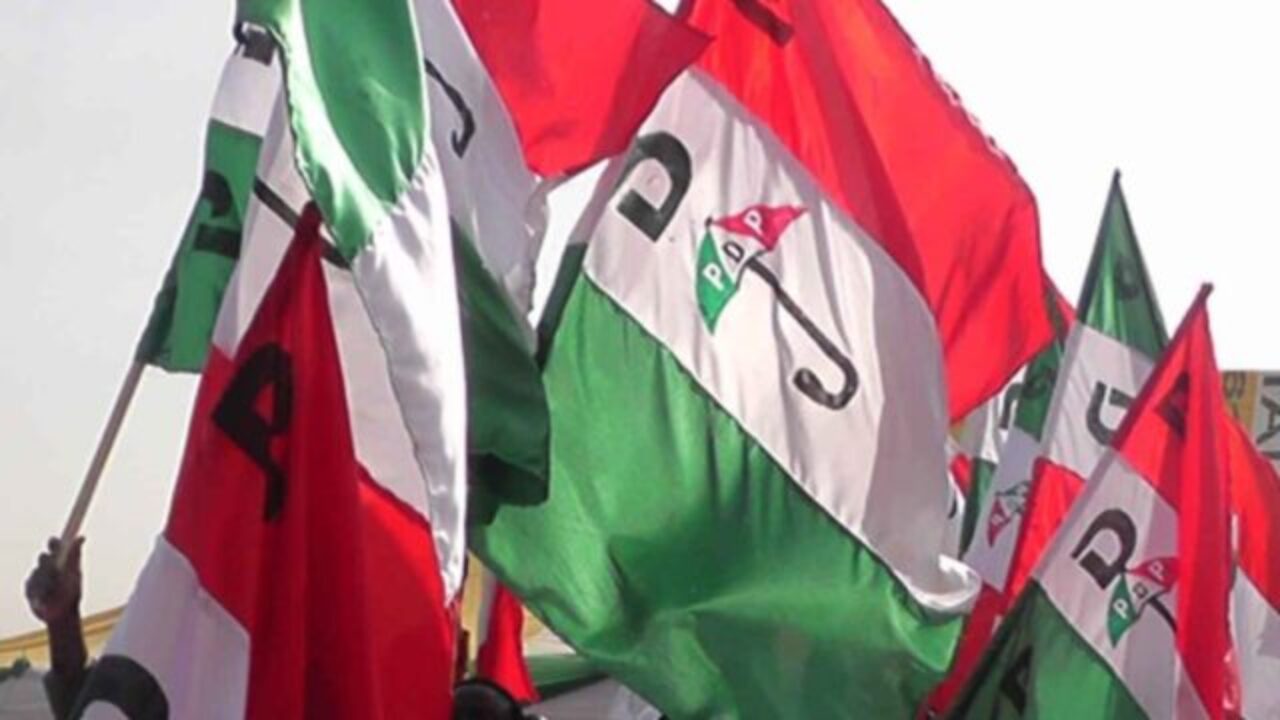
Two substantive national deputy chairmen of the Peoples Democratic Party (PDP), Elder Yemi Akinwonmi (South) and Senator Nazif Sulieman (North) have locked horns over who should take over the national chairmanship position of the party in acting capacity following the court order on Prince Uche Secondus to step aside.
In a new twist in the ongoing leadership crisis in the main opposition party, Suleiman declared Akinwonmi incapable of assuming the post even when the party’s constitution favours him.
The Deputy National Chairman (South) was the first to declare himself the acting national chairman on Tuesday citing Section 35(3) (b) of the PDP constitution, which says that in the event of the removal or resignation of the national chairman, a national deputy chairman from his zone should assume the post in an acting capacity.
Pursuant to this, Akinwonmi had issued a statement proclaiming himself and also announcing the indefinite postponement of the National Working Committee (NWC) meeting planned for Tuesday.
In explaining that he assumed the office in the absence of the substantive National Chairman, Prince Uche Secondus, who was ordered by the court to stop parading as such, Akinwonmi said: “Section 35(3) (b) of the constitution of the Peoples Democratic Party empowers me to summon and preside over party meetings in the absence of the national chairman.
“Our attention was drawn yesterday evening to a court order which purports to restrain our National Chairman, Prince Uche Secondus, from summoning and presiding over the meetings of the organs of the party.
“In the foregoing circumstances, as Deputy National Chairman (South) of the Peoples Democratic Party, after due consultations and in the exercise of the aforesaid powers, [I] hereby deem it fit and proper to postpone the National Working Committee meeting earlier scheduled for today till further notice to allow for broader consultations in the overall interest of our party,”
However, Suleiman, in a press conference later in the day, said he was the one that has become the acting national chairman of the PDP.
He conceded that going by the constitution, a deputy national chairman from Secondus’ South zone ought to act in his stead but has not been attending meetings because he is allegedly incapacitated.
Suleiman said based on this, he, as the other national deputy chairman of the party, has assumed the position in an acting capacity and has now fixed a meeting of the National Executive Committee (NEC) for Friday.
He said this followed a meeting of the NWC, which he presided over on Tuesday attended by only five of the 18-member committee.
Suleiman explained why he took over the top PDP post: “Members of the NWC, we will recall that this morning we are in possession of a valid court order, from a high court in Degema, Rivers State. Issuing an order removing Secondus as a member of the Peoples Democratic Party (PDP), as well as National Chairman of our great party.
“A court has also ordered that from the 23rd of August 2021, Prince Uche Secondus should stop parading himself as a National Chairman. NWC hereby comply fully with the court order.
“Consequently, the NWC hereby calls for an emergency NEC meeting on Friday, 27th August 2021, at 10 am prompt to deliberate on matters affecting the party.
“You are all aware PDP is a law-abiding party, the party that follows due process. So we have received this order and this is it.
“And in line with the constitution of the peoples’ democratic party, and I quote ‘functions of a deputy national chairman, there shall be two deputy national chairman, one shall come from the northern part, while the other from the southern part of the country. Deputy national chairman shall perform the following functions: 1) assist the national chairman in the discharge of his duty. 2) perform such other functions as may be assigned them. 3) In a result of resignation, removal, death, incapacitation or absence of the national chairman, a deputy national chairman from the region part of the country where the national chairman originates from shall assume office as the national chairman in an acting capacity
“Without prejudice to section 47 (6)of the Party Constitution. 4) in the absence of the National chairman and the deputy national chairman from the region part of the country where the National chairman originates from, the other deputy national chairman shall act as national chairman without prejudice to 47 (6) of this Constitution.
“On this note, distinguish NWC members I hereby take full charge of the Peoples Democratic Party (PDP) as Chairman in an acting capacity.
“We have waited this morning for the deputy national chairman (south), who has been incapacitated, who has not been attending NWC meeting in the last 9 months and I believe there was a communication between the deputy national chairman (south). Like you know, in the absence of the deputy chairman south, I take full charge. So, I am hereby calling for an emergency NEC meeting on August 27, 2021, at 10 am prompt to deliberate.
“And I believe all the leaders of this party, the owners of this party, will be in attendance are our governors, former presiding officers will be part of the NEC meeting to deliberate all pending issues.”
On whether there is now a division in the NWC, Suleiman explained: “Let me make this very clear that this meeting was called for 2 pm and like I said, the deputy national chairman south has been incapacitated and did not attend any meeting in the last 9 to 10 months as far as NWC is a concern. He has not been in communication with any member of the NWC for the last 10 months. And like I said this party must continue its process.
“And if I am not available someone else will take over. If the national chairman is not available someone will take over, if the deputy national chairman south is not available, the deputy chairman north will take charge.
“This is the resolution that was passed by the expanded caucus. And this was the resolution passed by the NWC in our last meeting and we all agreed that there will be a meeting today, a meeting that was supposed to be presided over by the National Chairman. Unfortunately, the court order came from a competent court and stopped the chairman from acting as chairman of the party.”
Drama soon continued as Akinwonmi stormed the Wadata Plaza national secretariat of the PDP hours after Suleiman spoke to say that he is the authentic acting national chairman of the party.
Accompanied by the 2019 governorship candidate of the party in Ogun State, Ladi Adebutu, Akinwonmi asserted that fate has bestowed to the office on him, declaring that there is no victor, no vanquished in the crisis.
He appealed to party members to join him in running the affairs of the party.
The new PDP acting national chairman stated: “I am a man of peace, not a man of crisis. PDP has a good succession order. There is order here. The chairman is followed by the deputy national chairman one (South), followed by the deputy national chairman two (North).”
On the meeting presided over by Nazif, the acting national chairman said “everything conducted while I was not here is null and void. At the appropriate time, we will call on a meeting of National Executive Committee, NEC and the Board of Trustees, BoT.”
When informed about Suleiman’s assertion that he was incapacitated, Akinwonmi responded: “Sickness is not a friend of anybody. I was on my way to Wadata Plaza when I had a stroke in my car. I was at the Cidacrest hospital for three months. Anybody can be sick but I am getting back and better. It was not my making to be sick. In the past, I could not stand up but I stood up singing the national anthem here this afternoon.
“It is wrong for people to start making reference to my ill health. Anybody can be sick but I am getting better now.”
Also speaking, the National Secretary of the party, Ibrahim Tsauri, said no faction exists in the NWC, adding that Nazif only presided over the meeting of the working committee earlier because Akinwonmi was not present at the time.
He added: “NWC was one under Secondus and there was no division. We are here to adopt the doctrine of necessity. PDP is a law-abiding party, with people of integrity and respect. PDP is the only political party in Nigeria today. We never changed our name, we never changed our logo.
“Yesterday (Monday), we were faced with something very challenging, which we never expected. We have no other option but to accept the order of the court. There are people that took this matter to court. We have given the judgement to our lawyers to study.”
Culled from the Tribune News Nigeria
You may like
-
From Noise to Votes: Nigerian Youth Must Turn Online Fire into Electoral Power
-
Between Silence and Sabotage: Jonathan’s Return to Political Manipulation
-
The Devastation of Insurgency: Nigeria Cannot Kill Its Way Out of Insecurity
-
Igbo Dynamism and The Politics of Misalignment
-
Gowon’s Book and the Dangerous Politics of Selective Memory
-
Donald Trump Receives Message From Iran After His Threats
Books
A Chronicle of Community: Tracing the Roots of Amaiyi Igbere
Published
2 weeks agoon
July 13, 2026
- Book Title: Amaiyi Igbere: A Historical Look Back on Life, People, and Places That Shaped the Community
- Author: By Emmanuel O. Ukandu, P.E.
- Publishers: Intekspress Publishers
- Reviewer: Emeaba O. Emeaba
- Pages: 285
There is a particular kind of historical work that does not begin in an archive but around family compounds, market squares, church yards, streams, and evening conversations. Amaiyi Igbere: A Historical Look Back on Life, People, and Places That Shaped the Community by Emmanuel O. Ukandu belongs to that tradition. It is not merely a local history. It is an act of cultural preservation, an ambitious effort to rescue an entire way of life from the erosion of memory. The book announces that purpose immediately, presenting itself as a historical record of “life, people, and places that shaped the community.”

Ukandu understands something many professional historians sometimes overlook: the disappearance of everyday knowledge is often more permanent than the loss of famous events. Kings, wars, and politicians usually find chroniclers. The names of neighbors, customs surrounding childbirth, wrestling ceremonies, market routines, childhood games, and village footpaths frequently vanish within two generations. His response is encyclopedic. Across eighteen chapters, the author documents everything from family genealogies and village compounds to agricultural practices, religious life, education, folklore, the Nigerian–Biafran War, and changing social values.
Rather than pretending to produce an objective, omniscient history, Ukandu openly defines the book as a “personal history.” He carefully explains the limits of eyewitness testimony while arguing that memory itself deserves preservation. In one of the book’s strongest passages, he writes that:
“What may appear to be a small fragment of history today… may spare them the considerable effort and resources that would otherwise be required to search for traces of what transpired.”
That sentence serves as the philosophical foundation for everything that follows. The author is less interested in constructing grand historical theories than in ensuring that ordinary facts survive.
One of the book’s greatest achievements is its treatment of genealogy. Hundreds of names appear throughout the narrative—not as dry census entries but as participants in a living community. Families are connected across compounds, marriages, occupations, churches, schools, and public service. Future descendants searching for ancestors decades from now may find this volume invaluable. The author’s hope that young readers will build their own family trees transforms the book from history into an invitation for continuing scholarship.
The strongest chapters are those describing daily life before modernization transformed southeastern Nigeria. The discussions of rites of passage, farming seasons, fishing traditions, folklore evenings, marriage customs, health practices, markets, and village maintenance recreate a society whose rhythms depended upon community rather than institutions. The cumulative effect resembles an ethnography written by someone who lived the culture rather than observing it from the outside.
Ukandu also demonstrates how education shaped modern Amaiyi. His accounts of scholarship programs, pioneering teachers, and community leaders reveal how one generation deliberately invested in the next. Particularly memorable is his reflection that:
“Good seeds planted in children at an early age may produce results that last for a very long time.”
That observation quietly becomes one of the book’s central themes. Throughout the narrative, the community advances not through dramatic revolutions but through teachers, mentors, churches, scholarship funds, and families determined to educate their children.
The prose possesses an unusual sincerity. Ukandu rarely writes as though he is attempting a literary flourish. Instead, his voice reflects someone determined not to forget. That straightforwardness gives emotional weight to passages describing migration, the Nigeria–Biafra War, and the gradual disappearance of customs that once organized everyday existence.
Perhaps the book’s most affecting declaration appears near the beginning:
“The material presented in this book constitutes ‘a time window’ on a particular period in the life of the people of Amaiyi Igbere.”
The metaphor is exactly right. Readers are not simply learning dates; they are looking through a window into a vanished social world.
What does the book do less well?
Its greatest strength is also its principal weakness.
The book frequently favors completeness over narrative momentum. Long catalogues of names, family relationships, and community figures provide extraordinary documentary value, but they occasionally interrupt the flow for readers unfamiliar with Amaiyi. A more selective organization—or the addition of supplementary family charts, maps, timelines, and genealogical diagrams—would have made the wealth of information easier to absorb.
Editorially, the work could also benefit from tighter compression. Many anecdotes repeat similar themes, particularly regarding exemplary community leaders and educational pioneers. A more robust synthesis would strengthen the narrative without sacrificing historical content.
There are moments when personal admiration for certain individuals overtakes critical historical distance. Since the author explicitly identifies the volume as a personal history grounded in lived memory, this is understandable. Still, readers seeking extensive engagement with conflicting interpretations, documentary evidence beyond recollection, or broader regional historiography may occasionally wish for more comparative analysis.
Yet these criticisms ultimately reflect the book’s chosen mission rather than its failure. Ukandu is not writing a conventional scholarly monograph. He is preserving communal memory before it disappears.
The result is an important contribution to local African historiography and a reminder that history survives not only in national archives but also in villages whose stories are too often left unwritten. If every community possessed a chronicler as determined as Emmanuel Ukandu, historians of the next century would inherit a far richer record of Africa’s social past.
Amaiyi Igbere demonstrates that preserving memory is itself an act of public service. It stands as both a historical record and a gift to future generations seeking to understand not merely where they came from, but how ordinary people built a community whose legacy deserved to be written before it was forgotten.
This book is available on Amazon (Click on Image).

_________
♦ Dr. Emeaba, the author of “A Dictionary of Literature,” writes dime novels in the style of the Onitsha Market Literature sub-genre.
- Book Title: FOOD FOR THOUGHT: Nourishing the Soul, One Bite at a Time
- Author: Professor Rev. Dr. Darlington Iheonu I. Ndubuike
- Publishers: WestBow Press.
- Reviewer: Dr Emeaba O. Emeaba
- Pages: 220
In Food for Thought, Darlington Ndubuike transforms the produce aisle into a pulpit, finding in seventy fruits and vegetables a complete theology of the examined life; its trials, its silences, and its unexpected harvests.
Consider, for a moment, the humble prune. Dismissed by most as a geriatric remedy, shriveled and graceless beside its more glamorous neighbors in the produce section, it is not the obvious vehicle for theological meditation. Yet it is precisely here, at the unglamorous end of the fruit bowl, that Professor Rev. Dr. Darlington Iheonu I. Ndubuike begins his ambitious, idiosyncratic, and occasionally arresting book of devotional reflections. “Before it becomes a prune,” he writes, “the plum undergoes a transformation; it is dried, its moisture removed, and its form altered. Though the process may seem like a loss, the prune becomes more concentrated, sweeter, and longer-lasting than the original fruit.” The pruning of the plum becomes, in Ndubuike’s telling, the pruning of the soul; God as Master Gardener, cutting away what comforts in order to cultivate what endures.
This is the central conceit of Food for Thought, and it is one the author pursues with a kind of joyful relentlessness across seventy chapters, each devoted to a different fruit, vegetable, or herb. From peach to peas, from chard to walnut, from kiwi to kale, each item in Ndubuike’s spiritual pantry yields a devotional lesson, a biblical parallel, and an acronymic framework for right living. The book belongs to a long lineage of nature-as-sermon writing; from the medieval Physiologus, which found moral instruction in the habits of real and fantastical animals, to the pastoral homiletics of the American evangelical tradition. But Ndubuike brings to the genre something distinctly his own: an exuberant fondness for wordplay, an autobiographical candor that occasionally startles, and a devotional warmth that persists even when the metaphors strain their seams.
The book’s organizing principle is phonetic rather than botanical. Ndubuike pairs each food with a homophonic or near-homophonic English word or phrase: the peach becomes a meditation on the “pitch,” or the power of words; the kiwi prompts a reflection on “Can we?”—a question of communal possibility and spiritual unity; the walnut, with a brisk semantic pivot, becomes “Worry Not.” The raisin asks us to search for “reason” in the dry seasons of life; the lettuce implores us to “Let Us” choose reconciliation; the cantaloupe reminds us that we “Can’t Elope” from our responsibilities. Some of these puns land with the satisfying click of genuine insight. Others; the beet becoming “beats,” the corn becoming “con;” are more strained, their theological freight arriving at the station considerably ahead of any logical locomotive to carry it. Ndubuike is clearly aware that he is operating in the territory of the playful homily rather than the systematic treatise, and he generally deploys his puns with enough good humor to disarm objection.
What distinguishes Food for Thought from its devotional shelf-mates is the quality of Ndubuike’s autobiographical interjections. In a chapter ostensibly about chard—”charred,” in his reading, as a metaphor for transformation through trial—he pivots without warning into a searing personal memoir: his years as an international student in Houston, the hurricane that destroyed his workplace, the repossessed car, the miles walked before dawn from Stella Link Road to West Belfort, folding newspapers in the back of a pickup truck, shoulder still aching decades later. These passages are written with a plainness and precision that distinguish them sharply from the book’s more ornate homiletical moments. They arrest the reader because they are specific in a way that allegory rarely is; because they insist that the fire he describes is not only figurative. “I had a return ticket,” he writes. “I could have gone home. But I stayed. That was over forty years ago. What felt like the end was actually the beginning.” The chard chapter, in other words, becomes something more than a meditation on resilience; it becomes testimony.
The book’s theological framework is unambiguously evangelical and Protestant, rooted in the conviction that Scripture is the primary lens through which the natural world—and human experience—ought to be interpreted. Ndubuike cites Proverbs, the Psalms, the Pauline epistles, and the Gospels with the ease of long familiarity. His approach to biblical narrative is typological and hortatory: Joseph, Esther, Naomi, Gideon, Abraham, and Ruth appear as recurring figures, their stories pressed into service as analogues for contemporary spiritual dilemmas. This is a deeply traditional mode of Christian preaching, and readers already within that tradition will find the interpretive moves intuitive, even comforting. Those approaching from other perspectives—secular, interfaith, or from within Christianity’s more historically minded wings—may find the hermeneutic at once earnest and occasionally reductive. Ndubuike is not much interested in the ambiguities of biblical narrative, in the gaps and silences that have occupied critical scholarship for a century and a half. He reads for moral and spiritual direction, and he finds it consistently wherever he looks.
Structurally, the book follows a disciplined if somewhat formulaic pattern. Nearly every chapter concludes with an acronym that spells out the chapter’s food—the pecan yields PECAN (Positioned in Christ, Empowered by the Spirit, Called with Purpose, Anchored in Faith, Nourished by Grace); the peach yields PITCH (Pause Before You Speak, Intend to Build, Tell the Truth in Love, Choose Words Carefully, Honor God and Others). These frameworks are designed, one senses, for pedagogical application; for church small groups, Sunday school classes, sermons, and workshops. As pastoral tools, they are admirably efficient. As literary devices, they occasionally impose a tidiness on complexity that the preceding meditation has not quite earned. Life, as Ndubuike himself demonstrates when he is writing from memory rather than from schema, is rarely as categorical as an acronym.
The book’s range is its most impressive quality. In the space of a single volume, Ndubuike moves from modesty and bodily dignity (the citrus chapter’s meditation on “see-throughs” and discretion) to individuality and self-expression (the garlic chapter’s spirited defense of the “Gar-ilk,” those uncommon souls who carry bold presence without apology), from the communal ethics of the kiwi to the eschatological patience of wheat. The chapter on basil is perhaps the most quietly searching in the collection: Ndubuike warns against what he calls “basil living”—a life of safe, flavorless adequacy, the spiritual equivalent of the default herb—and invokes Esau’s sale of his birthright as its scriptural type. The Israelites in the wilderness, longing for the cucumbers and garlic of Egypt even after their miraculous deliverance, are pressed into service here as cautionary archetypes of comfort-seeking and diminished vision.
The final chapter, devoted to peas—peace—arrives with the warmth of a well-prepared meal’s last course. Peas, Ndubuike observes, “grow together in a pod, side by side, close-knit, and in harmony. They don’t compete for space; they share it.” It is a fittingly communal image with which to close a book that is, at its best, an invitation to a shared table; to the practice of attending carefully to the ordinary, of finding in the quotidian not distraction but direction.
Food for Thought is not a book without faults. It is uneven in texture, moving between passages of genuine spiritual depth and others that settle for the pleasant cliché. The acronymic scaffolding, useful as a preaching tool, can feel mechanical when encountered seventy times. And there are moments when the phonetic conceits require a suspension of credulity that the theological argument is not quite strong enough to support. But Ndubuike writes from a place of authentic vocation; he tells his readers, only half in jest, that he cannot cook, and that the Holy Spirit is the true chef of this volume, and that sincerity has a flavor of its own.
For readers willing to receive it on its own terms; as an extended pastoral exercise in finding sacred meaning in the ordinary world, written by a man who has walked miles in the dark and emerged with his faith intact; Food for Thought offers something genuinely nourishing. Ndubuike’s grandfather’s voice can be heard throughout: in the dedication to his grandson Lennox, he sets the book as “a table I’ve set with care, each page a dish seasoned with reflection, truth, and love.” That is, in the end, exactly what it is.
This book is available on Amazon (Click on Image).
_________
♦ Dr. Emeaba, the author of “A Dictionary of Literature,” writes dime novels in the style of the Onitsha Market Literature sub-genre.
Column
From Noise to Votes: Nigerian Youth Must Turn Online Fire into Electoral Power
Published
2 months agoon
June 1, 2026
Young Nigerians have shown a remarkable ability to create waves in the digital space. With a single click, they can expose a politician’s corruption, rally tens of thousands of supporters behind a single hashtag, and keep every political actor on edge from dawn until dusk. However, as the 2027 general elections draw closer, it is time to face an uncomfortable truth: loud online noise isn’t the same as real power in the political sphere. If Nigerian youth wish to get the best possible leadership from their nation’s leaders, they need to take their online activity offline (i.e., to places where actual democracy occurs) and start showing up to cast votes.

There is simply too much evidence to ignore that this needs to occur. Nigeria is a young country demographically. Together, Gen Z and Millennials comprise approximately half of the total population—50.1 percent—according to IntelPoint. Gen Z makes up 25.8 percent and Millennials account for 24.3 percent. When we consider Gen Alpha, the percentage rises to 85.7% of the population under 44. According to ActionAid Nigeria, more than 60% of Nigeria’s population is under 30. According to Afrobarometer, Nigeria has a median age of 18.1 years, and 58% of its population is aged 0-29. Therefore, Nigeria isn’t merely a young country; it is a country dominated by young people.
Based on this information, this dominant demographic should wield considerable political influence. Unfortunately, there often appears to be little correlation between these statistics and political influence. The contrast is striking. While a majority of Nigeria’s population is young, there remains a significant gap between how influential young people are politically and how influential they could be. This lack of influence is not due to a lack of ability among young people; rather, it stems from many young people stopping short of completing what is often called the “civic journey,” which involves moving from awareness to action. They consume politics, engage in political debate on social media, participate in meme politics, and express frustration with politics through social media rants; however, many young people still fail to register to vote (PVCs) or participate in elections in sufficient numbers to affect the outcome.
This disparity is important because youth dissatisfaction is far from abstract. More than 23% of Nigerian youth report being unemployed or seeking employment, according to Afrobarometer. Additionally, more than two-thirds of youth aged 18 to 35 report having some form of postsecondary or secondary-level education. Despite Nigeria ranking among the lowest in providing employment and opportunities for youth, and despite identifying high costs of living, unemployment, crime and security concerns, poverty, poor economic management practices, and insufficient access to electricity as the top five issues requiring immediate attention from government officials, youth dissatisfaction cannot be considered indifferent. Rather, youth dissatisfaction reflects citizens’ grievances and legitimate reasons to be deeply interested in who governs their country.
However, mere interest alone will not suffice. Democracy does not reward passion without participation. A young person can identify every weakness inherent in a political system; however, unless that person participates by casting a vote, they will remain a spectator to their own future. If you are mature enough to understand concepts such as inflation, insecurity, broken campaign promises, unemployment rates, and poorly managed governance systems, you are mature enough to accept responsibility for your role in creating solutions to those problems. That responsibility begins with voting.
In addition to continuing to use social media to raise awareness of voter registration, election knowledge, fact-checking mechanisms used during elections, and peaceful participation methods, social media can also serve as a vehicle for facilitating the transition from social media activism to actual civic engagement. Young Nigerians should leverage their social media presence to encourage voter registration, promote election literacy programs, provide fact-checking services to counter election misinformation, and advocate for nonviolent participation throughout the electoral cycle. They should convert their social media timelines into civic classrooms. Where can I find the information I need about voter registration processes? Where is my assigned polling station located? Where do I receive my Permanent Voter Card? How do I protect myself from spreading misinformation? How do I properly monitor election results? These are not dull topics; they represent essential tools required for surviving democracy.
Youth organizations, creators, and social media entities can also help facilitate offline civic engagement. Use your WhatsApp groups to alert others as registration deadlines approach. Use X Spaces and Instagram Live to focus on discussing relevant issues rather than hurling insults. Use TikTok to simplify the voting process. Use Facebook to motivate family members and first-time voters to participate in elections. Use whatever platforms are available to make civic obligation contagious. Nigeria’s youth have shown they can create viral content. Now they must begin to generate participation on a viral scale.
One of the most damaging myths in Nigerian politics is that “your vote doesn’t matter.” It is a self-fulfilling prophecy that only serves the interests of cynics, crooks, and machines whose success depends solely on low turnout. Yes, Nigeria’s electoral process has flaws. Yes, there have been numerous disappointments. However, the response to a flawed democracy is not abandonment; it is increased participation. By staying home on Election Day, youth essentially give their votes — and therefore control — directly to the very same groups they loathe.
Another mythological excuse for the youth’s failure to vote in Nigeria is the claim that “all politicians are alike.” No — they’re not all the same. While some politicians are inept, others are corrupt, and others exhibit both characteristics, democracy is not about seeking holy men or women; it is about making selections and enforcing accountability. An individual who refuses to make a selection for office because none of the options appear acceptable is ultimately selecting the candidate most likely to emerge victorious by default.
Nigeria’s youth already constitute the country’s largest demographic group. It is time for them to become its strongest democratic force as well. However, that will not be achieved by trending hashtags alone. Instead, it will be achieved when online energy is harnessed and directed toward political organization, civic education, voter registration, increasing voter turnout, and holding elected representatives accountable after elections.
The 2023 election saw remarkable youth participation but lacked follow-up. Therefore, the 2027 election should not produce another generation of disillusioned observers; instead, it should yield a new generation of participatory citizens. Let online flames ignite electoral power. Let debates become ballots. Let criticism evolve into participation. If Nigerian youth can dominate social media, they can also dominate democracy. The future will not be handed to them in a retweet. They must elect it into existence.
_________
♦ Chris Ulasi is on the Editorial Board of The West African Pilot News. He contributes stories about culture and tradition, elite politics, ethnicity and national integration, civil society, and social movement. He is a university professor, community builder, poet, film producer, recording the emergent Nollywood cultural history through film.
A Chronicle of Community: Tracing the Roots of Amaiyi Igbere
Book Review: The Gospel According to the Grocery Aisle
Wazobia Family Funfair AT 10 – Decade of Family, Culture, and Community
Emotional Conflict: Is She Toying with Me?
Corruption at the Nigerian Consulate Atlanta – A Victim’s Nightmarish Experience
Gowon’s Book and the Dangerous Politics of Selective Memory
Video: Omambala Cultural Association in Houston Celebrates Motherhood with Joyous Igbo-Inspired Mother’s Day Event
VIDEO: Chris Hollins Opens Cartoon Art Showcase at TSU’s CommWeek