

News
Obi and Ahmed ticket rekindles hope and freedom from chains of captivity


Peter Gregory Obi and Datti Yusuf Baba-Ahmed joint ticket has all the required capacity to unlock the chains of captivity Nigerians have been caged in by selfish politicians in a corrupt riddled economy for so long and to liberate them. With the opportunity the Labour Party has given Nigerians in the duo’s joint ticket – if one goes to north, east west and south one will understand that – hope has been awoken in the hopelessness of the nation.

Nigerians are very conscious of this opportunity especially the youths who do not want the golden chance to slip away have shown enough willingness for self-emancipation. They have grabbed the project with every sense of sincerity, power, enthusiasm, passion and commitment. Their campaign has been very consistent and emphatically clear, they want good and qualitative leaders, and in Obi and Baba-Ahmed they have scrutinized and found what they seem to have been searching for in leaders. The ovations from every part of Nigeria that welcomed Baba-Ahmed as the running mate of Peter Obi were very huge, massively impressively, pleasantly joyous and extremely intimidating.
I have said this severally that ordinary Nigerians have no problem with one another, as long as one is doing what is good, right and legitimate they embrace that person irrespective of the person’s religion or where she or he comes from. The problem has always been the policy makers – the politicians – who are supposed to be pacesetters, but always play the card of ethnicity and religion to divide us for their selfish interests. This bunch has held us in captivity for too long and Nigerian youths are in unison this time to say enough is enough.
While these politicians have always found ways to settle their differences, swum together in corruption and stuck with one another in their exploitation of the masses, we the ordinary Nigerians they exploit have not found a way to say no to their manipulation. Instead they use us and make us to fight each other while they share our collective wealth, and even sometimes they make us kill ourselves in defending them and their evil. The only time we summoned courage, did what was right and came together like them was the time of the #EndSARS protest, and we saw how scared and trembled they were. But again they had the upper hand as they forgot their political and religious differences and came together, planned their evil attack and brutally descended on us militarily and mercilessly. We will never forget this and it is pay back time. With our experience and the elders joining our OBIDIENT and YUSUFUL movement now we are currently more resolute and extra formidable to take back our country and they cannot defeat us again – we are better equipped now and armed than them. Our Permanent Voters Card (PVC) is our AK47 and we are going to “shoot at sight” any recognized destiny destroyer since 1983 who wants to become a governor or a lawmaker etc. We will show no mercy in this mission.
Nigeria is a hijacked country that is at the verge of collapse. In security, terrorists are firmly in control of some parts of the country with the advancement to capture more places. They collect taxes in areas they invaded and occupied with citizens gnashing their teeth in agony, helplessness and disheartenment. In the judiciary, people grief that justice could elude the innocent or be bought by the highest bidder based on controversial and questionable judgments judges have given in recent times. The worst was the shocking Supreme Court judgment that brought Hope Uzodinma of APC as the governor of Imo State. That judgment was a terrible blunder and a judicial tragedy, and there was nothing supreme about it. INEC, the constituted electoral body declared Hope as coming fourth in that election. But supposedly Supreme Court judges accepted votes that came from people that were not even registered voters and gave them to Hope and declared him winner. In that Supreme Court judgment on Imo State justice died in Nigeria.
Obi and Baba-Ahmed joint ticket is a masterstroke. The duo is young, intelligent and with inspiring, clean and successful records as public servants and in their private lives. They are not corrupt. Their academical records, age and sources of wealth are not in question or doubt. So they do not need to pay any SAN or swear any affidavit to defend a very simple question that needs a very simple answer. Therefore, while it is true that Nigeria is a hijacked project by political monsters and corrupt leaders and the country is at the verge of collapse, it is equally a fact to note that the emergence of Obi and Baba-Ahmed have risen hope of liberation and the hijacked country is at the verge of salvation.
Spread this message to those people who are still living in fantasies of how they will bribe us, and inform those dreamers who are equally asking for our political structures that in our quest for a better working Nigeria, we are strongly united, resolute and formidable, no religion, ethnicity, amount of inducement or political party can divide us. The voice of the people is the voice of God. Inform them that Obi and Baba-Ahmed are coming. On May 29, 2023the duo will be sworn in as elected president and vice unless something drastic and unexpected happens which is unlikely. Obi and Baba-Ahmed only need to be very conscious of their security now than ever.
While our hearts ache for the state of the nation today, hope beckons in Obi and Baba-Ahmed for redemption that the economic revolution happening in Rwanda is also possible in Nigeria.
I am just being OBIDIENT and YUSUFUL to Nigeria.
♦ Uzoma Ahamefule, a refined African traditionalist and a patriotic citizen writes from Vienna, Austria. WhatsApp: +436607369050; Email Contact Uzoma >>>>




Houston philanthropist and community leader reflects on five decades of faith, family, resilience and service as friends and well-wishers prepare for her grand golden jubilee celebration on October 31, 2026.
HOUSTON, TEXAS — Turning 50 represents far more than reaching a milestone in age. It is a celebration of maturity, accumulated wisdom, personal accomplishments and the extraordinary journey through life’s challenges and triumphs. For many, the golden jubilee offers an opportunity to reflect on meaningful relationships, embrace renewed purpose and look toward the future with gratitude and confidence.
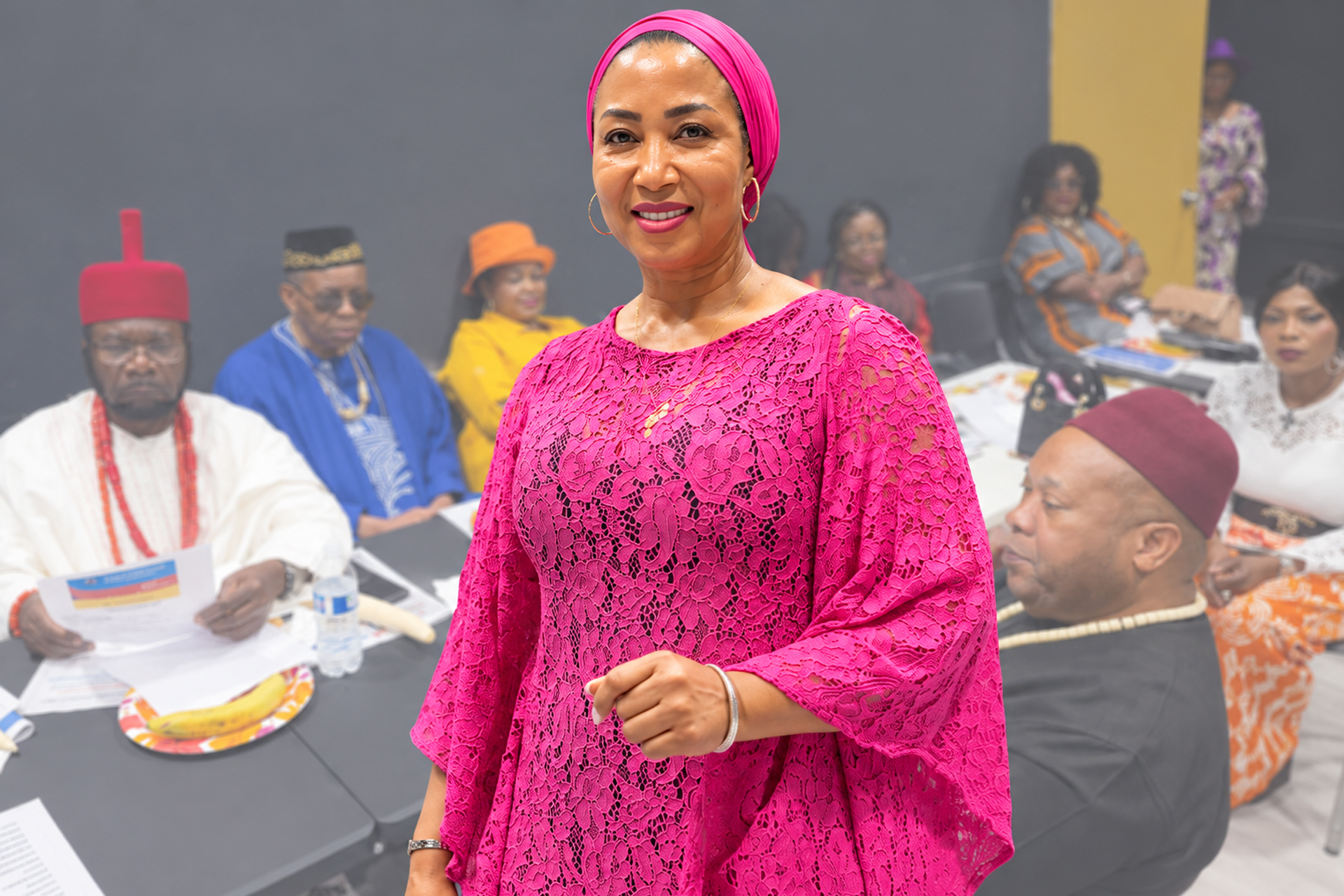
For Houston-based philanthropist and community leader Chief Oby Marcel, that milestone has arrived with excitement, thanksgiving and an unmistakable sense of fulfillment.

Chief Oby Marcel: This milestone has arrived with excitement, thanksgiving and an unmistakable sense of fulfillment.
All roads will lead to the Trinity Event Center, 8402 Howell Sugarland Road, Houston, Texas, on Saturday, October 31, 2026, when Chief Oby Marcel hosts a prestigious golden jubilee celebration beginning at 7 p.m. The anticipated all-formal gathering will bring together family members, friends, community leaders, associates and well-wishers to celebrate a woman whose life reflects a commitment to family, cultural identity, community engagement and service.
Speaking enthusiastically about her approaching birthday, Chief Oby Marcel described the occasion as a deeply personal celebration of divine grace and the experiences that have shaped her journey.
“Wow! I can hardly believe I’m stepping into the radiant glow of 50! My heart is dancing with joy, overflowing with excitement, and wrapped in deep gratitude,” she declared.
“Fifty beautiful years of God’s grace, unfailing love, abundant blessings, renewed strength, and memories that shimmer like precious jewels. Through every storm and sunrise, every challenge and triumph, every tear and laughter-filled moment, God has remained faithful.”
Beyond the birthday festivities, Chief Oby Marcel’s golden jubilee highlights her active participation in several cultural, religious and philanthropic organizations within Houston’s Nigerian community.
She is a prominent member of Gold Club International, where she holds the distinction of Lady Gold and serves as Admission Chairlady. She also serves as Treasurer of Prestige International and Assistant Financial Secretary of CWO Aquinas. Her community involvement extends to First Umuokpu Anambra USA, the Aguleri-Otu cabinet and the Omambala Cultural Association in Houston. Through these affiliations, Petersen maintains connections with organizations dedicated to cultural preservation, fellowship, mutual support and community development.
As a mother, philanthropist and community leader, she represents a generation of Nigerian women in the diaspora who balance family responsibilities with active participation in organizations that strengthen cultural bonds and promote collective progress.

The Young Shall Grow: From the Innocence of Yesterday to the Golden Glory of Today — 50 Years of Grace, Beauty, and Becoming.
The significance of turning 50 reaches beyond organizational achievements or public recognition. It represents an opportunity to embrace life with greater wisdom, confidence and optimism. According to Chief Oby Marcel, “I’m not simply turning 50; I’m crossing the threshold into a dazzling new chapter filled with wisdom, confidence, happiness, purpose, and endless possibilities.”
“I’m proud of the woman I’ve become, grateful for every mile God has carried me, and thrilled by the beautiful horizons unfolding before me.” Her enthusiasm captures the spirit of the forthcoming celebration: an occasion dedicated not merely to marking five decades but to honoring a journey defined by resilience, gratitude and enduring faith.
As preparations continue for the October 31 festivities, Chief Oby Marcel is approaching her golden milestone with a message of renewed hope and determination. “At 50, I’m not getting older; I’m blooming brighter, standing stronger, growing wiser, and becoming even more fabulous!”
And with that declaration, the celebrant offers a fitting conclusion to her golden jubilee reflections: “Cheers to my golden jubilee! My best years are still ahead of me!”
…Credits principled leadership, philanthropy, and a renewed commitment to “Unity, Love and Service” for the historic branch’s growing membership and influence.
SUGAR LAND, TEXAS — The recent growth and renewed visibility of the Sugar Land People’s Club of Nigeria International did not happen by accident. According to the branch’s Grand Patron, Ide Obinna Nnanyelugo Mbachu, its resurgence is rooted in something far more enduring than ceremonies, titles, or social gatherings: a commitment to putting the organization’s guiding principles into practice.
In an interview reflecting on the branch’s recent progress, Mbachu said the philosophy of “Unity, Love, and Service” remains central to the People’s Club’s identity and is increasingly defining the direction of its Sugar Land branch.
“Unity means recognizing that our individual differences must never become greater than the institution that brings us together,” Mbachu said. “Love means genuinely caring about one another—not only when we celebrate, but when members and their families face difficult moments. Service is where those values become action. If we cannot translate fellowship into service to humanity, then we have missed the purpose of the organization.”

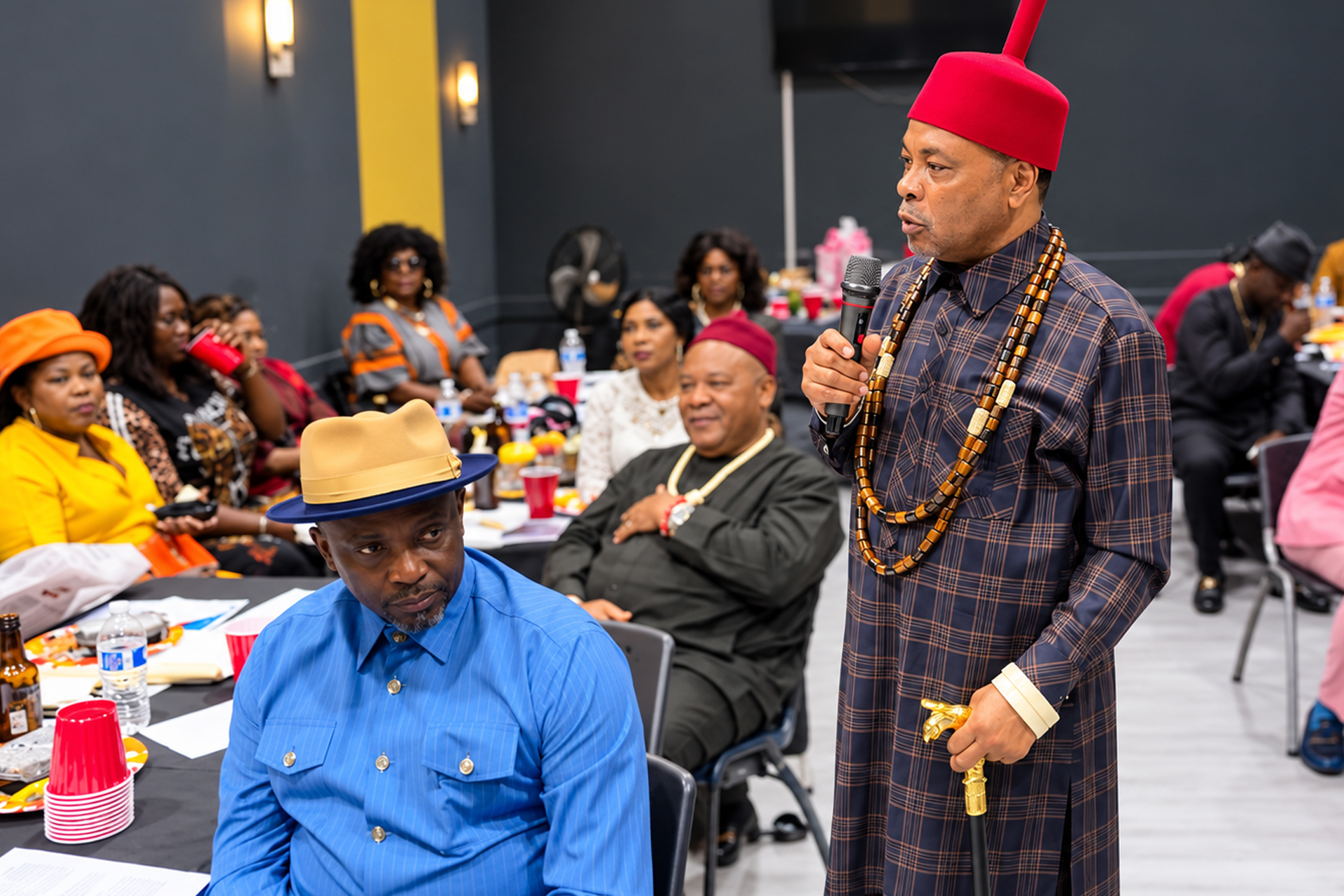
Grand Patron, Ide Obinna Nnanyelugo Mbachu.
People’s Club of Nigeria International traces its origins to Nigeria in 1971 and has since expanded through branches in Nigeria and internationally. Sugar Land occupies a distinctive place in that history as the organization’s First International Branch.
Mbachu said that legacy carries responsibility.
“People’s Club is not simply a social club where people gather, celebrate, and go home,” he said. “At its core, it is a philanthropic institution committed to community welfare. Our fellowship must have a human purpose. We must be able to look beyond ourselves, identify needs within our communities, and respond with compassion, resources, and action.”
He pointed to the COVID-19 pandemic as one example of that philosophy at work.
“I will never forget the COVID period, when fear and uncertainty had disrupted virtually every aspect of life,” Mbachu recalled. “Members of our Sugar Land branch stepped forward to distribute food to families struggling through that crisis. People were concerned about their own safety, yet our members understood that service was most meaningful when the community needed us most. That experience demonstrated what the People’s Club should represent.”
The branch has recently experienced renewed momentum in membership. Following its successful 2026 biannual induction, 16 new members were formally admitted, while additional community members have continued to express interest in joining.
Mbachu attributes that growth partly to greater organizational visibility, active programming, and an environment where prospective members can see fellowship and community engagement working together.
He particularly credited Hon. Prof. Chris Ulasi, Group Chairman of SLPCNI, and his executive team with helping reposition the branch.
“Professor Ulasi and his team deserve tremendous credit,” Mbachu said. “Leadership requires consistency, patience, and the ability to bring different personalities together around a common objective. The progress we are witnessing reflects considerable work behind the scenes; organizing members, strengthening participation, and ensuring that the branch continues moving forward.”
Mbachu also acknowledged PCNI National President Atty. Fidelis Onyebueke, whose leadership he said has contributed to stronger relationships across the organization.
“The National President has emphasized peace, reconciliation, and mutual respect among branches,” he said. “An international organization cannot prosper when its branches operate in unnecessary conflict. His efforts to promote understanding, dialogue, and unity across the People’s Club family have contributed significantly to the stability and renewed enthusiasm we are experiencing.”
For Mbachu, however, growth cannot simply be measured by numbers. The quality and commitment of those joining remain equally important.
“Our doors are open to reputable men and women who believe in what People’s Club represents and are prepared to contribute positively,” he said. “We welcome people who value integrity, fellowship, community service, and mutual respect. Membership should never be about what title you receive; it should be about what value you bring.”
That distinction, Mbachu argues, will determine whether the current momentum becomes lasting institutional progress.
For Sugar Land People’s Club, the formula he offers is remarkably straightforward: protect unity, practice love and make service visible. “When those three principles are genuinely lived,” Mbachu said, “the organization does not have to advertise its greatness. The community will see it.”
Following a successful induction ceremony, the First International Branch continues to attract new members drawn to its tradition of friendship, service, culture, and community
SUGAR LAND, TEXAS — The Sugar Land People’s Club of Nigeria International (SLPCNI) is continuing its membership expansion following its recently concluded induction ceremony, with Dr. Nkem Ugwu becoming one of the latest community members to join the organization.
Ugwu, a Sugar Land resident originally from Nsukka, Enugu State, Nigeria, is an entrepreneur and mother of three sons, a mother-in-law, and a grandmother. She describes service to others, family, and community engagement as important parts of her personal and professional life.

Grand Patron Ide Obinna Nnanyelugo Mbachu addressing the September Conference of the Sugar Land PCNI
Her membership comes on the heels of the branch’s successful bi-annual induction ceremony, during which 16 new members were formally sworn in by PCNI National President Atty. Fidelis Onyebueke. The celebration attracted national leaders, patrons, and members representing branches from across the People’s Club network.

Photo from left: Hon. Chief Sir Michael Okeke; Hon. Anaeto Okakpu “Oranwezuluaku”; Grand Patron Ide Obinna Nnanyelugo Mbachu; Hon. Dr. Nkem Ugwu ; Hon. Prof. Chris Ulasi, Group Chairman; Hon. Chief, Sir Basil Mbuba; Hon. Chief Sir Dr. Uche Egbuchuam “Akudo World Wide.”
Ugwu said joining the organization provides an opportunity to develop meaningful relationships while contributing to its mission.
“I am truly excited and honored to join the prestigious People’s Club of Nigeria International, Sugar Land Branch. I look forward to getting to know fellow members, building lasting friendships, and becoming actively involved in this vibrant and welcoming community. I am especially drawn to the Club’s tradition of fellowship, service, and mutual support, and I hope to contribute my experience, energy, and passion for serving others to its continued growth.”
Grand Patron Ide Obinna Nnanyelugo Mbachu welcomed Ugwu, describing continued interest in membership as encouraging for the historic First International Branch.

Membership Chairperson Hon. Chief Udoji Achebe and Hon. Ndidi Chidume
“When people of accomplishment and community spirit continue to identify with our organization, it tells us that the values upon which People’s Club was built remain relevant. We welcome Dr. Ugwu and look forward to the experience and fellowship she brings to our family.”
Hon. Prof. Chris Ulasi, Group Chairman, said the branch’s recent induction helped showcase an organization that continues to combine Nigerian cultural heritage with community engagement in Houston.
“Our successful induction created tremendous enthusiasm, but our focus goes beyond ceremonies. We are building a stronger organization rooted in friendship, responsibility and service. Dr. Ugwu’s decision to join reflects that continuing momentum.”

One of the meeting hosts, Hon. Professor Keih George, introduces the co-meeting hosts.
Membership Chairperson Hon. Chief Udoji Achebe said the branch remains interested in individuals prepared to participate actively in its programs and fellowship.
“Membership is about belonging, but it is equally about participation and contribution. We are delighted to welcome Dr. Ugwu and other prospective members who share the principles and aspirations of People’s Club.”
For SLPCNI, the growing interest following its induction represents another chapter in the evolution of a branch with a special place in the organization’s history.
And for Ugwu, it marks the beginning of a new journey—one centered on friendship, community, and service.


Fifty and Fabulous: Chief Oby Marcel Celebrates a Golden Milestone in Houston

People’s Club Sugar Land Is Growing — Grand Patron Mbachu Explains Why

Professor Josephine Onyido Earns Prestigious Nigerian Academy of Education Induction

Emotional Conflict: Is She Toying with Me?

Corruption at the Nigerian Consulate Atlanta – A Victim’s Nightmarish Experience

Gowon’s Book and the Dangerous Politics of Selective Memory

Video: Omambala Cultural Association in Houston Celebrates Motherhood with Joyous Igbo-Inspired Mother’s Day Event

VIDEO: Chris Hollins Opens Cartoon Art Showcase at TSU’s CommWeek

Commissioner Dexter L. McCoy speaks about the African-American Memorial Event
-

 Houston3 weeks ago
PCNI Elevates Chief Dr. Emmanuel Opara to Patron in Historic Ihiagwa Investiture
-

 Houston4 weeks ago
Membership Surge Continues as Dr. Nkem Ugwu Joins People’s Club
-
 Community3 weeks ago
People’s Club Sugar Land Is Growing — Grand Patron Mbachu Explains Why
-
 Education3 weeks ago
Professor Josephine Onyido Earns Prestigious Nigerian Academy of Education Induction
-
 Houston6 days ago
Fifty and Fabulous: Chief Oby Marcel Celebrates a Golden Milestone in Houston