

News
ADC & 2027: Is this alliance strong enough to dismantle APC & defeat Tinubu?

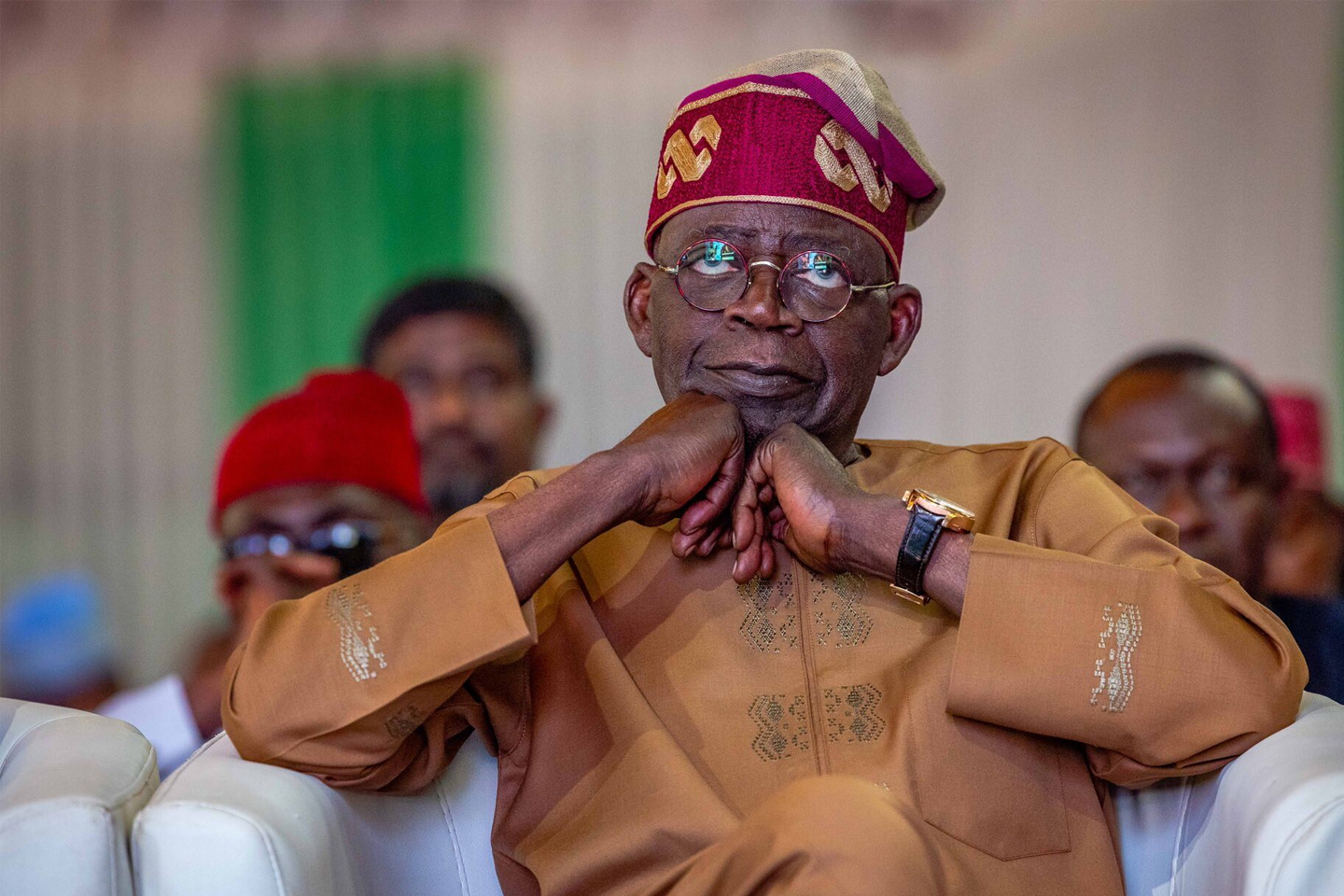
It will not be easy to defeat Tinubu and the APC
Let me emphatically state without any ambiguity that for the opposition to make President Tinubu lose grip of Aso Rock in 2027 and force him to the status of a “former president” is a herculean task that requires more than defeating him in polling booths. Anyone who has followed President Tinubu’s political success from Lagos to Abuja will agree that he is a master of Nigerian politics. Therefore, to take power away from him, the opposition members must understand that the hurdle facing them is not child’s play but a huge political combat.

But yes, of course, the alliance of ADC without any doubt is very capable of defeating President Tinubu and sending APC out of Aso Rock, but caution must not be thrown to the wind – members of the party must be self-examining, honest, holistic, and critical in taking decisions without sentiments.
Why Peter Obi is the best choice for the ADC alliance
In all fairness, there are notable political heavyweights in this alliance, but if a square peg must be put in a square hole, considering records and national acceptance, Obi currently is the most popular accepted politician in Nigeria and should be the choice of ADC.
We must say it as it is, Obi is not a perfect human being, but in the annals of Nigerian politics, no one, dead or alive,/has the kind of political records he has, and this has endeared him to the hearts of millions of Nigerians. He is just real and different. Whether he is in a public service or in a private business, Obi has remained who he is: humane, caring, humble, civil, considerate, fair, and incorruptible.
In 2023, many did not give him any chance when he left PDP to join Labour Party, but for his character, competence, and transparency, etc. Nigerians not only followed him as a man of honour, but they also spent their money in his campaign throughout the country. It was a generally held view by the majority that he defeated President Tinubu in 2023, allegedly.
If Obi is not part of this political alignment, the best way I would describe the coalition would be an “old wine in a new bottle”, because the new bottle cannot make the old wine taste differently. There is no one in the alliance that we do not know his/her history and political antecedents. WHILE many of them are desperadoes and manipulators, and the reason we do not have Nigeria Airways and constant electricity, etc., many owe Nigerians an explanation of those stealing our gold, etc., in Zamfara State.
What I dread about the coalition
My fear is that I am constantly seeing the hands of Esau but hearing the voice of Jacob in the alliance. I say so because I have seen mischievous steps selfishly played out that are politically suicidal to the alliance and that will not be good for the interests of all Nigerians.
If Nigerians were to choose who will be the candidate of ADC, I am pretty sure that Obi would have an easy ride, but here only party agents will, and that is where the danger lies. Obi, we all know, is not ready to bribe anyone to vote for him because he sees politics as a service to the people and not a business. Owing to this reason, many say he is stingy, and I was in total shock and disappointed the day I saw Barr. Kenneth Okonkwo reprimanded Obi on national television for the same reason. But it is what it is, and I will leave that for another day. Obi is not a desperate politician, and this is one of the things that has differentiated him from others and why we Nigerians really want him.
I am frightened that Obi may be schemed out as the ADC presidential candidate. But let me re-echo this as a warning. If Mr. Peter Obi does not emerge as the candidate of the coalition or is forced to walk out of the alliance, the coalition becomes toothless, what late veteran football commentator Ernest Okonkwo would have described as “beautiful nonsense”. It will make the participation of ADC in 2027 a mere political exercise that will end in futility as long as the presidential election is concerned. And if, for any reason, Obi agrees to be a running mate to anyone, I will withdraw my support from him and give it to President Tinubu.
Mr. Peter Obi, Sir, you are not ready to buy the agents, and many of the agents seem not ready to vote for you either because of your kind of politics of “I will not give shi shi”. Games are already on. Are you ready for this coalition? Did you consider very well, and the coalition was not a trap for you, Sir? Because members of the alliance know that you are the most acceptable Nigerian politician currently and the only person the majority of Nigerians want. They are consciously aware that without you, they cannot defeat APC and President Tinubu, hence the ploy with the alliance. Furthermore, they know you will not try to influence the conscience of any party agent to vote for you during the primary; therefore, they will take advantage of that and influence the agents against you. Please, Sir, if you feel what I suspect, kindly withdraw from the alliance even before the primary. You are the hope of millions of Nigerians, and anywhere you go, we are sincerely willing to follow you.
Why the coalition should be encouraged
Irrespective of my expressed fear, the coalition is a good one. But let me re-emphasize that the mission of ADC members to wrestle power out of the hands of Mr. President in 2027 is like one going into a lion’s den to take its meat. It will not be easy. To get this accomplished, members of the party must make sacrifices and be willing to do away with selfishness. Mr. President is a man who knows how to compensate and care for those supporting him, like he has done to Nyesom Wike, the FCT Minister.
Wike, who may become a victim of his own political arrogance, could be consumed by his overzealousness to be a president one day, and will go to any political extent to make sure that his launch is not taken away from his mouth. And there are many Wikes around Mr. President. The mistake someone like Atiku made was not ensuring that Wike was forced out of the PDP before he left. His continuous stay in PDP is not politically good for ADC’s coalition. I will not be surprised if PDP’s structures are used in supporting APC in 2027 at some point. Consequently, it is a requisite without option that members of the alliance tenaciously combine their resources and strength together for the battle ahead without betraying each other. They must proportionately be prepared to match Mr. President and APC strategy-to-strategy, propaganda-to-propaganda, intimidation-to-intimidation, and force-to-force, etc. That is the only way President Tinubu and the APC could be beaten to submission.
Long, incredible processes an election winner must go through, or else he /she will be declared the loser.
In Nigeria, it absurdly seems like even winning all polling booths in an election is not enough for one to be announced a winner by the electoral umpire INEC (Independent National Electoral Commission). Why? Because there appear to be three stages, the candidates must first struggle with and overcome.
Stage (1): The candidate, his/her political party, and their agents must first of all make sure that the ballot boxes are safely transported from the polling booths to their designated collation centres without being hijacked by thugs or hired hoodlums and swerved with manipulated and stuffed boxes.
Stage (2): They must equally make sure that at the collation centres, the real figures are correctly computed without alteration.
Stage (3) – INEC: Here, the party agents must be very vigilant and ensure that the real figures, deprived of Tippex and cancellation of digits, are actually submitted without extra zeros and numbers added or removed. This becomes crucial in view of what happened in 2023, where INEC’s IReV, for whatever reason, failed to transmit election results from polling booths. This issue must be addressed and avoided so as not to repeat itself.
Remember, once the INEC Chairman announces results and pronounces a winner, one can do nothing but go to court. But the danger is that those factors that induced the announcement of the wrong winner are more likely to also influence courts’ proceedings and sustain what should not be sustained as a final judgment.
Thus, to say that any election winner in Nigerian polling booths who is not well-connected could get announced as a loser by INEC unless a miracle happens, and the most powerful one with political strength and financial influence gets declared winner is a statement past experiences have supported. Whosoever is not willing or who does not have the capacity to go through the processes that influence the final outcome should not bother going into politics, at least for now. It is sad and a very terrible situation, but that is the fact.
If coalition members fail at this juncture to get the electoral system reformed, it is not a good one. And I wonder why they are silent on this crucial point. Though one does not need to be pessimistic, if they fail to ensure that their engineers certify that all BIVAS machines are in good condition before being taken to their various destinations and results transmitted from polling booths, it may not be abstract to say that the election may have already been won and lost even without votes being cast.
Why Obi needs the alliance
In a free and fair election, Obi will clearly defeat APC and President Tinubu with or without the coalition. But because Nigeria is a country where elections are neither free nor fair, considering the factors analyzed above and below, Obi needs the alliance as much as the alliance needs him to close the loophole witnessed in 2023.
On the day of the election, coalition members should make sure that voters’ votes are counted as cast, results transmitted as enshrined in the electoral act without flimsy excuses on any concocted technical hitch, and figures written on the official provided result sheets. They should have the capacity against any bullion van, armored cars, bulletproof jeeps, and other private cars moving around. They should be at the forefront to defend their party’s votes and mandates and mobilize their confidants and agents throughout the country. It is no longer enough to tell the masses to stand with empty hands and defend their votes against well-armed criminals illegally moving around polling booths and collation centres, changing figures, and altering results. Most importantly, they must have the capacity to make the INEC Chairman announce the original documented results and not manipulated figures with Tippex. Anything less will be the same story as it was in 2023.
Conclusion
My sincere message to ADC party agents is that, in their capacity to decide who becomes the presidential candidate of their party, lies the hope of millions of Nigerians for a functioning society. They must be critical and holistic because the choice they make will either take Nigeria out of the throes of death, shape the future we all will be proud of, or pave the way for the continuation of hunger, killings, criminality, hopelessness, and disaster.
We have chosen before based on religion, but it failed us. We have also chosen based on ethnicity, and it was a tragedy. We have equally made choices based on party even when we saw better choices, but our loyalties were rewarded with hunger, insecurity, terrorism, killing, rascality, corruption, sorrow, and tears. We cannot continue in the same direction anymore. We must get it right this time by choosing capacity, integrity, competence, tolerance and a person of honor. Peter Gregory Obi is that option. Choose wisely.
♦ Uzoma Ahamefule, a refined African traditionalist and a patriotic citizen writes from Vienna, Austria. WhatsApp: +436607369050; Email Contact Uzoma >>>>



Houston philanthropist and community leader reflects on five decades of faith, family, resilience and service as friends and well-wishers prepare for her grand golden jubilee celebration on October 31, 2026.
HOUSTON, TEXAS — Turning 50 represents far more than reaching a milestone in age. It is a celebration of maturity, accumulated wisdom, personal accomplishments and the extraordinary journey through life’s challenges and triumphs. For many, the golden jubilee offers an opportunity to reflect on meaningful relationships, embrace renewed purpose and look toward the future with gratitude and confidence.
For Houston-based philanthropist and community leader Chief Oby Marcel, that milestone has arrived with excitement, thanksgiving and an unmistakable sense of fulfillment.

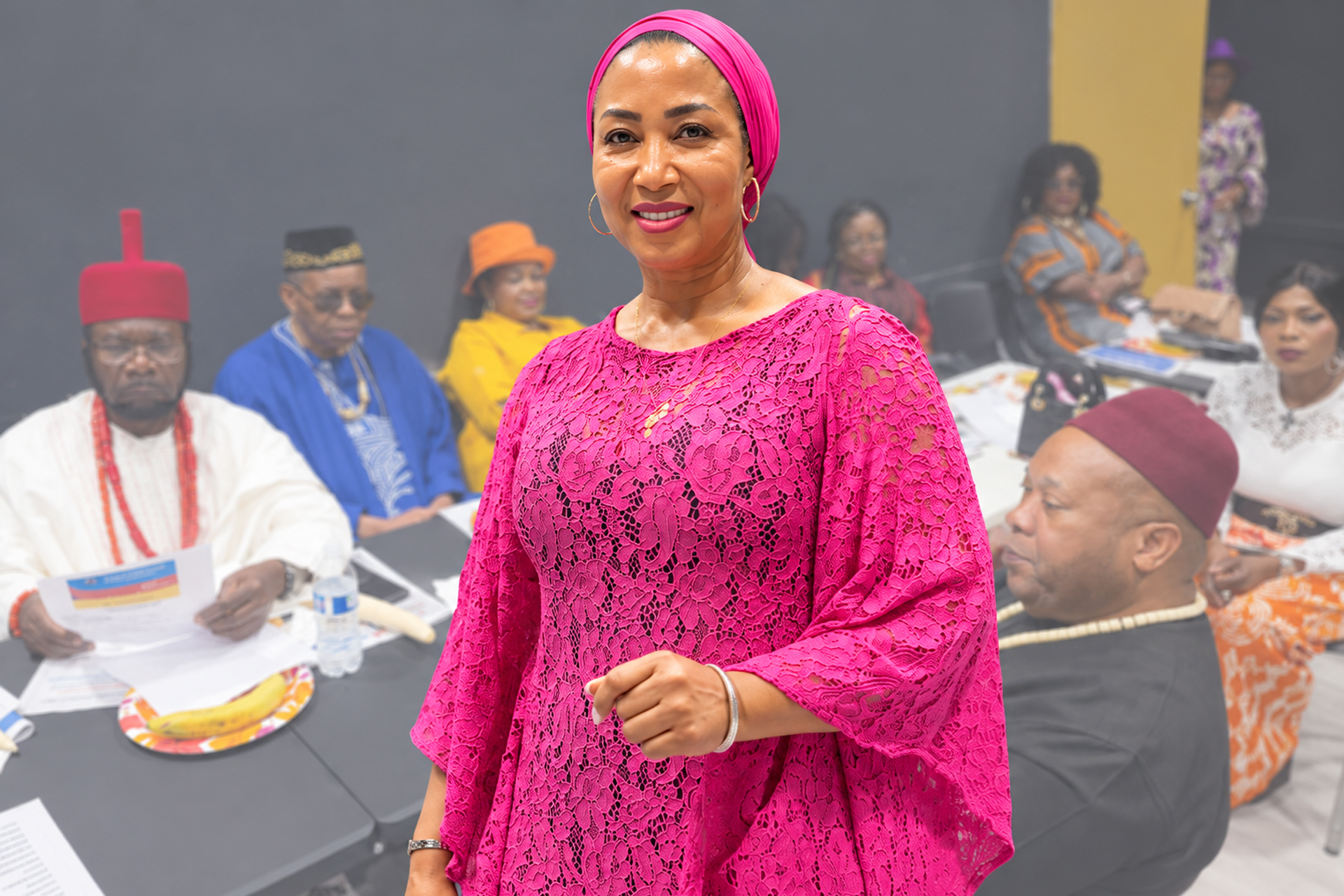
Chief Oby Marcel: This milestone has arrived with excitement, thanksgiving and an unmistakable sense of fulfillment.
All roads will lead to the Trinity Event Center, 8402 Howell Sugarland Road, Houston, Texas, on Saturday, October 31, 2026, when Chief Oby Marcel hosts a prestigious golden jubilee celebration beginning at 7 p.m. The anticipated all-formal gathering will bring together family members, friends, community leaders, associates and well-wishers to celebrate a woman whose life reflects a commitment to family, cultural identity, community engagement and service.
Speaking enthusiastically about her approaching birthday, Chief Oby Marcel described the occasion as a deeply personal celebration of divine grace and the experiences that have shaped her journey.
“Wow! I can hardly believe I’m stepping into the radiant glow of 50! My heart is dancing with joy, overflowing with excitement, and wrapped in deep gratitude,” she declared.
“Fifty beautiful years of God’s grace, unfailing love, abundant blessings, renewed strength, and memories that shimmer like precious jewels. Through every storm and sunrise, every challenge and triumph, every tear and laughter-filled moment, God has remained faithful.”
Beyond the birthday festivities, Chief Oby Marcel’s golden jubilee highlights her active participation in several cultural, religious and philanthropic organizations within Houston’s Nigerian community.
She is a prominent member of Gold Club International, where she holds the distinction of Lady Gold and serves as Admission Chairlady. She also serves as Treasurer of Prestige International and Assistant Financial Secretary of CWO Aquinas. Her community involvement extends to First Umuokpu Anambra USA, the Aguleri-Otu cabinet and the Omambala Cultural Association in Houston. Through these affiliations, Petersen maintains connections with organizations dedicated to cultural preservation, fellowship, mutual support and community development.
As a mother, philanthropist and community leader, she represents a generation of Nigerian women in the diaspora who balance family responsibilities with active participation in organizations that strengthen cultural bonds and promote collective progress.

The Young Shall Grow: From the Innocence of Yesterday to the Golden Glory of Today — 50 Years of Grace, Beauty, and Becoming.
The significance of turning 50 reaches beyond organizational achievements or public recognition. It represents an opportunity to embrace life with greater wisdom, confidence and optimism. According to Chief Oby Marcel, “I’m not simply turning 50; I’m crossing the threshold into a dazzling new chapter filled with wisdom, confidence, happiness, purpose, and endless possibilities.”
“I’m proud of the woman I’ve become, grateful for every mile God has carried me, and thrilled by the beautiful horizons unfolding before me.” Her enthusiasm captures the spirit of the forthcoming celebration: an occasion dedicated not merely to marking five decades but to honoring a journey defined by resilience, gratitude and enduring faith.
As preparations continue for the October 31 festivities, Chief Oby Marcel is approaching her golden milestone with a message of renewed hope and determination. “At 50, I’m not getting older; I’m blooming brighter, standing stronger, growing wiser, and becoming even more fabulous!”
And with that declaration, the celebrant offers a fitting conclusion to her golden jubilee reflections: “Cheers to my golden jubilee! My best years are still ahead of me!”
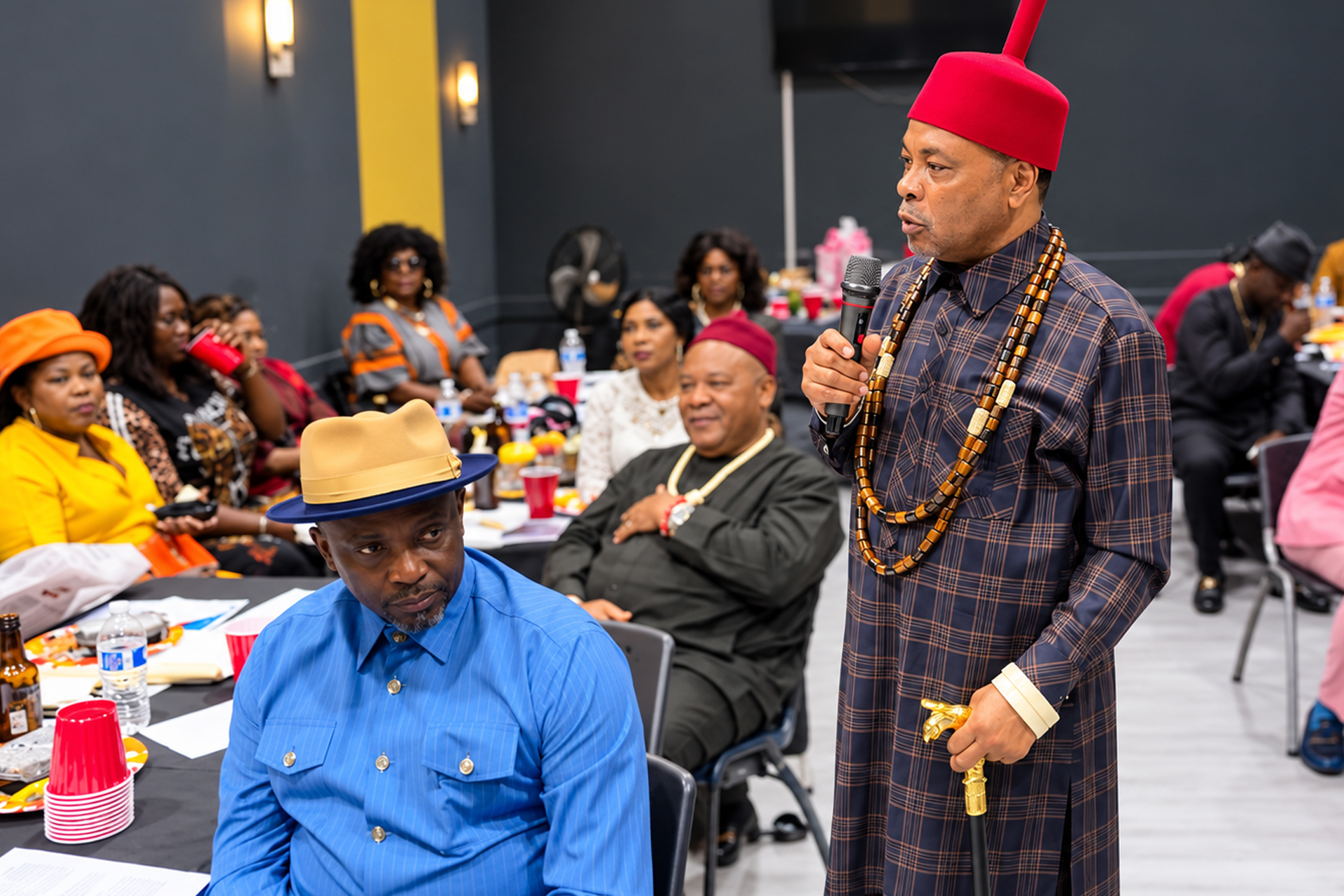
…Credits principled leadership, philanthropy, and a renewed commitment to “Unity, Love and Service” for the historic branch’s growing membership and influence.
SUGAR LAND, TEXAS — The recent growth and renewed visibility of the Sugar Land People’s Club of Nigeria International did not happen by accident. According to the branch’s Grand Patron, Ide Obinna Nnanyelugo Mbachu, its resurgence is rooted in something far more enduring than ceremonies, titles, or social gatherings: a commitment to putting the organization’s guiding principles into practice.
In an interview reflecting on the branch’s recent progress, Mbachu said the philosophy of “Unity, Love, and Service” remains central to the People’s Club’s identity and is increasingly defining the direction of its Sugar Land branch.
“Unity means recognizing that our individual differences must never become greater than the institution that brings us together,” Mbachu said. “Love means genuinely caring about one another—not only when we celebrate, but when members and their families face difficult moments. Service is where those values become action. If we cannot translate fellowship into service to humanity, then we have missed the purpose of the organization.”

Grand Patron, Ide Obinna Nnanyelugo Mbachu.
People’s Club of Nigeria International traces its origins to Nigeria in 1971 and has since expanded through branches in Nigeria and internationally. Sugar Land occupies a distinctive place in that history as the organization’s First International Branch.
Mbachu said that legacy carries responsibility.
“People’s Club is not simply a social club where people gather, celebrate, and go home,” he said. “At its core, it is a philanthropic institution committed to community welfare. Our fellowship must have a human purpose. We must be able to look beyond ourselves, identify needs within our communities, and respond with compassion, resources, and action.”
He pointed to the COVID-19 pandemic as one example of that philosophy at work.
“I will never forget the COVID period, when fear and uncertainty had disrupted virtually every aspect of life,” Mbachu recalled. “Members of our Sugar Land branch stepped forward to distribute food to families struggling through that crisis. People were concerned about their own safety, yet our members understood that service was most meaningful when the community needed us most. That experience demonstrated what the People’s Club should represent.”
The branch has recently experienced renewed momentum in membership. Following its successful 2026 biannual induction, 16 new members were formally admitted, while additional community members have continued to express interest in joining.
Mbachu attributes that growth partly to greater organizational visibility, active programming, and an environment where prospective members can see fellowship and community engagement working together.
He particularly credited Hon. Prof. Chris Ulasi, Group Chairman of SLPCNI, and his executive team with helping reposition the branch.
“Professor Ulasi and his team deserve tremendous credit,” Mbachu said. “Leadership requires consistency, patience, and the ability to bring different personalities together around a common objective. The progress we are witnessing reflects considerable work behind the scenes; organizing members, strengthening participation, and ensuring that the branch continues moving forward.”
Mbachu also acknowledged PCNI National President Atty. Fidelis Onyebueke, whose leadership he said has contributed to stronger relationships across the organization.
“The National President has emphasized peace, reconciliation, and mutual respect among branches,” he said. “An international organization cannot prosper when its branches operate in unnecessary conflict. His efforts to promote understanding, dialogue, and unity across the People’s Club family have contributed significantly to the stability and renewed enthusiasm we are experiencing.”
For Mbachu, however, growth cannot simply be measured by numbers. The quality and commitment of those joining remain equally important.
“Our doors are open to reputable men and women who believe in what People’s Club represents and are prepared to contribute positively,” he said. “We welcome people who value integrity, fellowship, community service, and mutual respect. Membership should never be about what title you receive; it should be about what value you bring.”
That distinction, Mbachu argues, will determine whether the current momentum becomes lasting institutional progress.
For Sugar Land People’s Club, the formula he offers is remarkably straightforward: protect unity, practice love and make service visible. “When those three principles are genuinely lived,” Mbachu said, “the organization does not have to advertise its greatness. The community will see it.”
Following a successful induction ceremony, the First International Branch continues to attract new members drawn to its tradition of friendship, service, culture, and community
SUGAR LAND, TEXAS — The Sugar Land People’s Club of Nigeria International (SLPCNI) is continuing its membership expansion following its recently concluded induction ceremony, with Dr. Nkem Ugwu becoming one of the latest community members to join the organization.
Ugwu, a Sugar Land resident originally from Nsukka, Enugu State, Nigeria, is an entrepreneur and mother of three sons, a mother-in-law, and a grandmother. She describes service to others, family, and community engagement as important parts of her personal and professional life.

Grand Patron Ide Obinna Nnanyelugo Mbachu addressing the September Conference of the Sugar Land PCNI
Her membership comes on the heels of the branch’s successful bi-annual induction ceremony, during which 16 new members were formally sworn in by PCNI National President Atty. Fidelis Onyebueke. The celebration attracted national leaders, patrons, and members representing branches from across the People’s Club network.

Photo from left: Hon. Chief Sir Michael Okeke; Hon. Anaeto Okakpu “Oranwezuluaku”; Grand Patron Ide Obinna Nnanyelugo Mbachu; Hon. Dr. Nkem Ugwu ; Hon. Prof. Chris Ulasi, Group Chairman; Hon. Chief, Sir Basil Mbuba; Hon. Chief Sir Dr. Uche Egbuchuam “Akudo World Wide.”
Ugwu said joining the organization provides an opportunity to develop meaningful relationships while contributing to its mission.
“I am truly excited and honored to join the prestigious People’s Club of Nigeria International, Sugar Land Branch. I look forward to getting to know fellow members, building lasting friendships, and becoming actively involved in this vibrant and welcoming community. I am especially drawn to the Club’s tradition of fellowship, service, and mutual support, and I hope to contribute my experience, energy, and passion for serving others to its continued growth.”
Grand Patron Ide Obinna Nnanyelugo Mbachu welcomed Ugwu, describing continued interest in membership as encouraging for the historic First International Branch.

Membership Chairperson Hon. Chief Udoji Achebe and Hon. Ndidi Chidume
“When people of accomplishment and community spirit continue to identify with our organization, it tells us that the values upon which People’s Club was built remain relevant. We welcome Dr. Ugwu and look forward to the experience and fellowship she brings to our family.”
Hon. Prof. Chris Ulasi, Group Chairman, said the branch’s recent induction helped showcase an organization that continues to combine Nigerian cultural heritage with community engagement in Houston.
“Our successful induction created tremendous enthusiasm, but our focus goes beyond ceremonies. We are building a stronger organization rooted in friendship, responsibility and service. Dr. Ugwu’s decision to join reflects that continuing momentum.”

One of the meeting hosts, Hon. Professor Keih George, introduces the co-meeting hosts.
Membership Chairperson Hon. Chief Udoji Achebe said the branch remains interested in individuals prepared to participate actively in its programs and fellowship.
“Membership is about belonging, but it is equally about participation and contribution. We are delighted to welcome Dr. Ugwu and other prospective members who share the principles and aspirations of People’s Club.”
For SLPCNI, the growing interest following its induction represents another chapter in the evolution of a branch with a special place in the organization’s history.
And for Ugwu, it marks the beginning of a new journey—one centered on friendship, community, and service.


Fifty and Fabulous: Chief Oby Marcel Celebrates a Golden Milestone in Houston

People’s Club Sugar Land Is Growing — Grand Patron Mbachu Explains Why

Professor Josephine Onyido Earns Prestigious Nigerian Academy of Education Induction

Emotional Conflict: Is She Toying with Me?

Corruption at the Nigerian Consulate Atlanta – A Victim’s Nightmarish Experience

Gowon’s Book and the Dangerous Politics of Selective Memory

Video: Omambala Cultural Association in Houston Celebrates Motherhood with Joyous Igbo-Inspired Mother’s Day Event

VIDEO: Chris Hollins Opens Cartoon Art Showcase at TSU’s CommWeek

Commissioner Dexter L. McCoy speaks about the African-American Memorial Event
-

 Houston3 weeks ago
PCNI Elevates Chief Dr. Emmanuel Opara to Patron in Historic Ihiagwa Investiture
-

 Houston1 month ago
Membership Interest Soars After Sugar Land People’s Club’s Successful Induction
-

 Houston4 weeks ago
Membership Surge Continues as Dr. Nkem Ugwu Joins People’s Club
-
 Community2 weeks ago
People’s Club Sugar Land Is Growing — Grand Patron Mbachu Explains Why
-
 Education3 weeks ago
Professor Josephine Onyido Earns Prestigious Nigerian Academy of Education Induction
-
 Houston2 days ago
Fifty and Fabulous: Chief Oby Marcel Celebrates a Golden Milestone in Houston