Connect with us

Nigeria

How Nigerian Government Gave Indicted Cocaine Trafficker Multi-million Dollar Supply Contract

Published

on

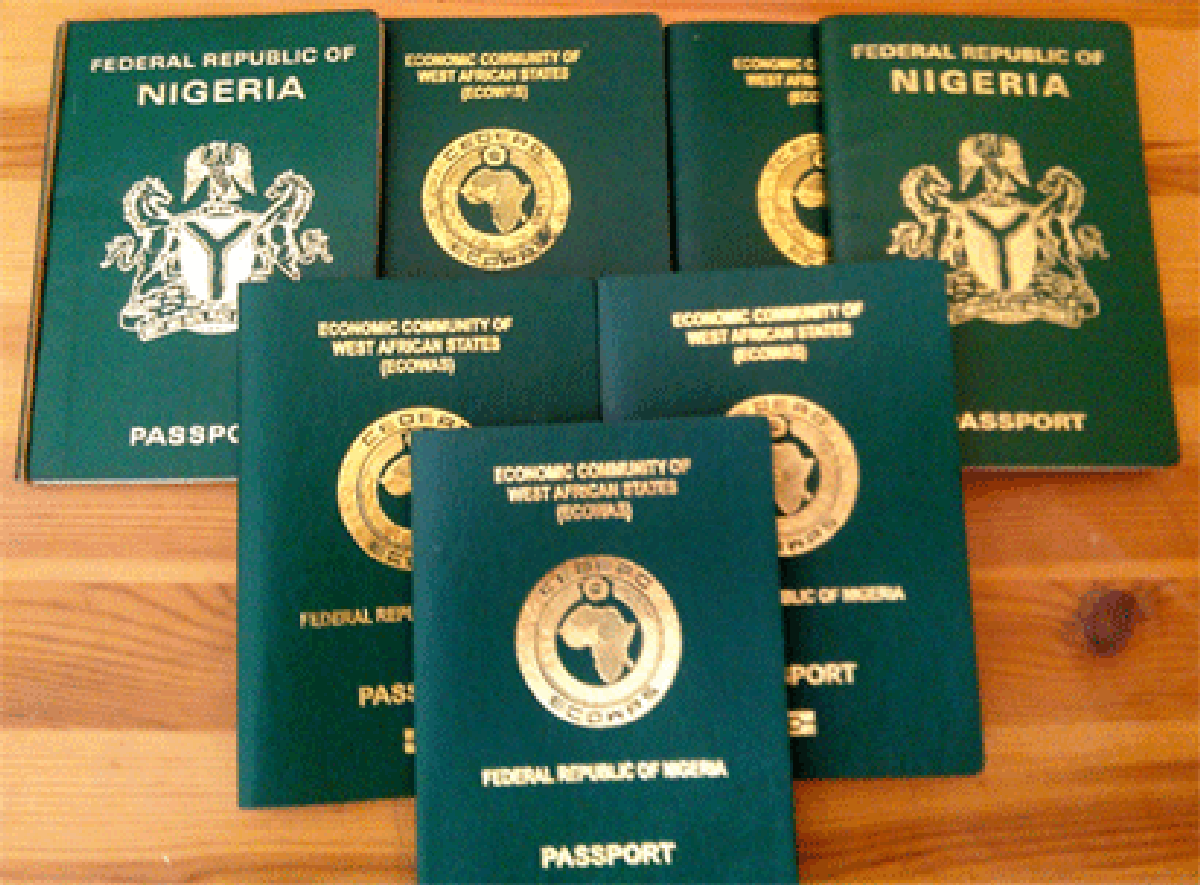
The investigation, which was done by Nigerian journalist, David Hundeyin and reported by West Africa Weekly, delves into how the rot in the system led to an embarrassing scarcity of passports for Nigerians at home and abroad.

This report exposes the rot, racketeering, ethnic nepotism, complete failure of due diligence, and how an indicted cocaine trafficker has come to control the supply of passports to Nigerian citizens.

The investigation, which was done by Nigerian journalist, David Hundeyin and reported by West Africa Weekly, delves into how the rot in the system led to an embarrassing scarcity of passports for Nigerians at home and abroad.

“We acknowledge and apologise for the challenges faced in the past few weeks regarding passport booklets availability. I am glad to inform you that booklets are now available and are being distributed to all our passport issuing centres.”

With these words on March 31, former Comptroller-General of the Nigeria Immigration Service (NIS) Babandede verbally signed a cheque that the NIS would subsequently fail to cash. Through the course of his tenure as CG, Nigerians had become used to chronic passport booklet shortage and the associated black market arbitrage, but the shortage had become acute by 2021. He needed to make a statement to reaffirm his competence.

Speaking at the commissioning of the Maitama Passport Express Centre – itself a master class in formalised black market arbitrage – Babandede made that statement, and then some. A special team would be dispatched to “facilitate enrollment and production” of passports across Nigeria and its foreign missions. New passport offices to service air passengers would be sited at the airports in Lagos, Kano and Abuja. The new “premium passport processing centre” in Abuja would cut the length of passport issuance and renewal from several weeks to just 72 hours.

Ultimately, Babandede’s statement turned out to be just that – a statement.

From when he made these pronouncements until his retirement earlier this month, passport booklets continued to be a scarce and expensive commodity in Nigeria. Several factors were blamed for the baffling inability of Africa’s most populous country to provide passports for its citizens. Chronic corruption at the NIS; disputes between the NIS and a private contractor responsible for printing booklets; scarcity of forex to pay for security printing materials; even an alleged unofficial government policy to stem brain drain by making passports hard to access – all these have variously been blamed for this state of affairs.

As is so often the case in Nigeria, no theory or explanation should be dismissed out of hand, which is why when I set out to find out what is really behind the perennial shortage of these little green booklets, I was prepared for anything. Or at least I thought I was. What would emerge as I sank my teeth into this however, was not a story about supply chain disruptions or government inefficiencies. It was nothing like I had ever seen before, which is saying something.

Think Transformers meets Black Mirror meets Karishika, with protagonists who are part Elon Musk, part Lawrence Anini and part Bakin Zuwo. There is a murder in New York; a million dollar cocaine deal in Bogotá. Court cases in New Jersey; a legitimate high tech manufacturing operation in Kuala Lumpur; art exhibitions in Lagos; high society marriages; prominent placement in lifestyle and celebrity magazines, and the most comically brazen lawbreaking hidden in plain sight. If this story were a movie, it would be the conceptual offspring of Michael Bay and Ugezu J. Ugezu, which is to say, low on plot and purpose, but high on sheer crash-bang value.

There are 3 main characters in this story. Their existence and relevance was determined after speaking to 5 different sources within the NIS ecosystem. These 3, more than any other people, have had the most influence on passport issuance and the wider state of the Immigration Service. Unsurprisingly, the first name on the list is immediate past CG Muhammad

None of my sources have any especially nice words to say about him, but neither do they have any bitter personal complaints either. The impression that comes through about Babandede is that of a fundamentally limited man who is neither virtuous nor especially malevolent. As one of the sources puts it frankly:

“He tried to make some moves such as the passport express centres, but it didn’t work out because he was just there to make money before he retired. He didn’t really care about fixing any systemic issues like staff motivation or the ISTL contract. All that one was not his business.”

The sources inform me that under Babandede’s tenure, complete opacity was institutionalised, with Immigration officers now not even knowing how much to expect on their payslip at the end of the month. Apparently during his tenure, NIS staff were migrated to the Integrated Payroll and Personnel information system (IPPIS), and with that went any sort of transparency regarding staff pay scales, deductions and entitlements. As a source colourfully puts it during one of our long conversations:

“It has now got to the point that you don’t know what will come in at the end of the month, and whatever it is that comes in – you just have to take it like that. The deductions vary every month so we don’t know how much we will take home. So tell me as a man with people depending on you, how else will you survive if not through ‘egunje’ (bribes)?”

While the sources mention different things that Babandede could have done to protect NIS staff welfare and morale, they all have one consistent criticism of him – his alleged ethnocentric posting policy. During his tenure they say, desirable NIS postings such as NIS offices in Lagos, were given exclusively to northerners, while the southerners working there were all posted out. The Ikoyi immigration office I am told, is now staffed almost exclusively by northerners – a state of affairs that would be impossible if the roles were reversed.

Under Babandede and even in these early days of his successor Idris Jere, the sources say, many northerners in the NIS, encouraged by the prebendalist disposition of their superiors, are keen to let everyone know that it is “their turn” and they are in power. Following Idris Jere’s appointment a source claims, the next most senior Deputy Comptroller – a southerner from Lagos – who might have been next in line to succeed Jere, was promptly transferred to Sokoto. At press time, I have been unable to independently verify this.

The other name that every source mentions is a certain “Liman” at the Ikoyi Passport Office. None of the sources bothers to hide how they feel about this fellow. This man and his extreme racketeering they say, is one of the major reasons behind Nigeria’s passport shortage. A bit of research brings up his name as Abdullahi I. Liman, a Deputy Comptroller in charge of the Ikoyi Passport Command of the NIS.

Every single source has a terrible story to tell about Abdullahi Liman. Liman they say, is responsible for the northernisation of the Ikoyi Passport Command. Even worse one source tells me, under Liman’s tenure, the atmosphere at the Command has taken on explicitly polarised ethnic and religious overtones. Take this anecdote from one of the sources for example:

“You can imagine that you are in the middle of doing a capture, then all of a sudden your colleague who is also capturing will just stand up and leave his station with a crowd of people there – because he says he is going to pray. You now end up doing his work for him, can you imagine that? This did not happen before Liman came in.”

Liman they say, is in the habit of pointedly using Hausa to converse with his subordinates at work, which automatically puts every southerner working under his command at a real career disadvantage. Speaking English – or in fact any other language but Hausa – at work is now a career demerit at the Ikoyi Passport Command under Liman’s watch.

A few days after I speak to this source, this story by the Foundation for Investigative Journalism was published, detailing persecution of a southern NIS officer at the Ikoyi Command in the exact ways described by my sources. Notice the reporter’s description of his interaction with Liman.

Up to this point, I have relied on testimony from sources I consider trustworthy, but even their knowledge of affairs at the NIS has its limits. While people like Abdullahi Liman are running rackets within the NIS to restrict access to passport booklets in large population centres like Lagos so as to create a lucrative black market, the sources are also clear that they believe that the NIS simply does not have enough passport booklets. To truly understand why the NIS appears to have not just a distribution problem, but also a supply problem with passport booklets, I had to figure out whose interests were served by the status quo.

First, a brief primer on how Nigeria’s passport system works.

Starting in 2003, Nigeria adopted the e-passport standard to defeat counterfeiting, resulting in a contract awarded to IRIS Smart Technologies Limited (ISTL) which commenced in 2007. The scope of the contract was to implement the Nigeria Harmonised ECOWAS Electronic (SMART) Passport Autogate Systems as well as to supply e-passport booklets, wafers, laminates and maintenance services from 2006 and 2015. ISTL is affiliated with Malaysia’s Iris Corp, which carries out the actual security printing services including supply of e-passport booklets.

The services that ISTL renders to the NIS include creating and maintaining the electronic database containing the passport details of Nigerian citizens, as well as maintaining the communication infrastructure that keeps a constant uplink between passport registration offices and the ISTL data centre. In case the reader has not seen the problem with this, allow me to spell it out clearly:

A private company working for a profit incentive has full and unrestricted access to the sensitive data of all Nigerian passport holders, but more importantly, it alone has access to this data. In other words, ISTL has more access to passport holders’ data than the NIS itself. ISTL does not actually produce passport booklets, but sub-contracts production to the Malaysian firm Iris Corp. Essentially, this company that most people have never heard of, controls a valuable sovereign database exclusively, and all it has to do is maintain a few dozen closed VSAT links from passport registration centres. Essentially, tech support.

This in fact caused a row between the NIS and the company in 2017 when the 10-year contract came up for renewal. Speaking to Daily Trust in 2017, some NIS insiders claimed the following: That the initial contract was a threat to national security because it vests control of the Country Signing Certification Authority (CSCA) – an official government seal – in ISTL, instead of the Nigerian government, which on paper is a risk factor for fraud;

That its implementation did not follow due process;

That the database and other infrastructure was paid for by the Nigerian government, but ISTL holds on to government property and uses tactics such as refusing to train NIS officers in the management of the system as a way to strong-arm the government into renewing its contract;

That NIS officers cannot conduct basic maintenance and repairs on the ISTL systems, meaning that the Nigerian government cannot withdraw from the ISTL contract without incurring catastrophic costs, which violates public procurement regulations;

That the contract had questionable exclusion clauses that gave undue advantage to ISTL at the expense of the Nigerian taxpayer.

The Malaysian company subcontracted by ISTL to print the booklets meanwhile, has found itself facing corruption probes by Malaysian authorities over its activities in other African e-passport jurisdictions such as Guinea. So putting this picture together, we have a tech support company that has somehow wrangled its way into a $138 million 10-year government contract (which was eventually renewed in 2019). Its main activity is maintaining equipment and an electronic database, and it sub-contracts passport booklet printing to a company halfway around the world whose executives have been arrested on corruption charges.

For the purpose of balance, it must be pointed out that the $138 million figure is not paid by the government, but rather comes from the company’s revenue generation activities within the scope of the e-passport project. It is also important to point out that the criticisms of the ISTL contract were possibly made in bad faith by individuals who merely wanted to replace ISTL with their own companies. Indeed, the senior NIS official quoted by the Daily Trust in 2017 remarked, “[The controversy] is between contractors who want the contract. The NIS’ concern is simply the supply of the booklets.”

It is also important to mention that the cost of sub-contracting Iris Corp to print the booklets is paid is USD, while ISTL’s revenue comes in naira, with the CBN refusing to provide forex for the company. This I am reliably informed, is the material reason behind the chronic booklet shortages since 2017 – the cost of printing passport booklets has more than doubled in dollar terms since 2015. Hence, ISTL simply cannot afford to print as many booklets as before.

With that being said, we now know that there is an incredibly lucky or powerful entity behind ISTL. Who is this person? This is where the story really takes a few turns, so hold on to your hats.

High Society Gentleman or Ex-Cocaine Trafficker?

On its website, ISTL describes itself as a “major subsidiary of the flagship company, Image Technologies Limited (Imagetech).” A quick CAC database check on Imagetech brings up the elusive character behind the curtain.

For a Lagos socialite, Olayinka Fisher is a man who somehow keeps a decidedly low profile. For one thing, while researching this story, establishing what exactly his name is turns out to be quite the task. In some places, he is “Yinka Fisher.” In some other places, he is “Olayinka Fisher.” In still other places, he is “Olayinka Fischer” or “Sonayon Fisher.” Only in a few places that he would rather the world did not know about, does his full and correctly spelled government name appear: “Olayinka Sonayon Fisher.” So who is this guy and what is there to him?

Quite a bit, as it turns out.

The story starts in Mr. Fisher’s previous iteration as a high flying Nigerian diplomat in in mid-to-late 1970s. At the time, when he was still known to the world as Olayinka Sonayon Fisher, he was the Second Secretary of the Nigerian Mission to the United Nations.

Researching the many variants of his name online, references to his diplomatic career can be seen right up until about 1980 when he seems to vanish off the face of the historical earth. In 1989, he resurfaces on CAC documents in Nigeria as the majority shareholder in a new company called Imagetech. Presumably at this point, the high-achieving diplomat has decided to pivot into a career in tech entrepreneurship. Nigeria being what it is, nobody ever really bothers to ask why, and by 2003 he is signing the contract above for ISTL under President Olusegun Obasanjo.

The good times are rolling. Following the end of his marriage to River State scion Doris Amachree, he weds Dr. Pius Okigbo’s daughter Anne. He becomes an avid art collector and patron of the arts. He hosts art exhibitions with the Spanish Embassy in Lagos, which are co-curated by both of his sons who share his love of the visual arts. To all intents and purposes, he is the SI unit of the classy and respectable old money Lagosian. There’s just one problem:

According to U.S. court records, Mr. Fisher allegedly used to be part of an intercontinental cocaine smuggling ring.

I obtain the following documents from the United States District Court for the District of New Jersey. They detail court proceedings from a 1983 case involving a violent drug dealer wanted for a murder in the Bronx, New York, a successful American businessman who dabbled into the illegal drug business with him, and a Nigerian diplomat who used his diplomatic immunity to traffic shipments of cocaine into the U.S. on their behalf.

The diplomat’s name? A certain Olayinka Sonayon Fisher.

According to Tracy Wong, the indicted American businessman, he paid Fisher the sum of $50,000 for a single shipment. The indictment further states that this arrangement lasted for at least 2 years with multiple Cocaine trafficking trips made worth several million dollars. Exactly how much Fisher made from this arrangement in total is a question only he can answer, but it certainly raises a few interesting questions.

Perhaps the most telling part of this story is that following the release of this NYT article and his subsequent exit from the diplomatic corps, Fisher appears to have intentionally dropped all mention of “Sonayon” from his name. In fact, it took the extraordinary step of making a few calls to my hometown Badagry, where the name “Sonayon” also originates from, to confirm his identity. The fact that this has somehow slipped under the radar for decades despite his custody of one of the most sensitive databases in Nigeria is a sign of a catastrophic failure of state intelligence and due diligence.

Making this point further, I speak to a lawyer, Solomon Igberaese to give his professional opinion of this issue. He points out that according to the Public Procurement Act 2007, someone with Fisher’s background should have been disqualified from the public procurement process. In his words:

“Falsification of fact can be interpreted to also include drug trafficking. Carrying out drug trafficking under any other guise will constitute falsification of fact. That he concealed packages inside diplomatic pouches certainly qualifies as falsification of fact. Again the section said falsification of facts relating to any matter.”

So there we have it – possibly the most mind-bending story in Nigeria’s rich history of dodgy public procurement and contracting. For added measure, the third person in the drug ring, a career drug dealer called Joseph Anthony Margarite was also wanted in connection with a murder at the time of his involvement with Wong and Fisher.

Culled from the Sahara Reporters  

Lifestyle

Kaduna Governor Commissions Nigeria’s First 100-Building Prefabricated Housing Estate

Published

on

Kaduna, Nigeria – November 6, 2025 — In a major milestone for Nigeria’s housing sector, the Governor of Kaduna State has commissioned a 100-unit mass housing estate developed by Family Homes and executed by Karmod Nigeria, marking the first-ever large-scale prefabricated housing project in the country.

Completed in under six months, the innovative project demonstrates the power of modern prefabricated construction to deliver high-quality, affordable homes at record speed — a sharp contrast to traditional building methods that often take years.

Each of the 100 units in the estate is designed for a lifespan exceeding 50 years with routine maintenance. The development features tarred access roads, efficient drainage systems, clean water supply, and steady electricity, ensuring a modern and comfortable living environment for residents.

According to Family Homes, the project represents a new era in Nigeria’s mass housing delivery, proving that cutting-edge technology can accelerate the provision of sustainable and cost-effective homes for Nigerians.

“With prefabricated technology, we can drastically reduce construction time while maintaining top-quality standards,” said a spokesperson for Family Homes. “This project is a clear demonstration of what’s possible when innovation meets commitment to solving Nigeria’s housing deficit.”

Reinforcing this commitment, Governor Uba Sani of Kaduna State emphasized the alignment between the initiative and the state’s broader vision for affordable housing.

“The Family Homes Funds Social Housing Project aligns with our administration’s commitment to the provision of affordable houses for Kaduna State citizens. Access to safe, affordable and secure housing is the foundation of human dignity. We have been partnering with local and international investors to frontally address our housing deficit,” he said.

Also speaking at the event, Mr. Ademola Adebise, Chairman of Family Homes Funds Limited, noted that the project embodies inclusivity and social progress.

“The Social Housing Project also reflects our shared vision of inclusive growth, where affordable housing becomes a foundation for economic participation and improved quality of life.”

Karmod Nigeria, the technical partner behind the project, utilized its extensive expertise in prefabricated technology to localize the process, employing local artisans and materials to enhance community participation and job creation.

Industry experts have described the Kaduna project as a blueprint for future housing initiatives nationwide, capable of addressing the country’s housing shortfall more efficiently and sustainably.

With this pioneering development, Kaduna State takes a leading role in introducing modern housing technologies that promise to reshape Nigeria’s urban landscape.

Continue Reading

Books

The Pioneer’s Burden: Building the First Private Network in a Vacuum of Power

Published

on

  • Book Title: The Making of Bourdex Telecom
  • Author: David Ogba Onuoha Bourdex
  • Publishers: Bourdex
  • Reviewer: Emeaba Emeaba
  • Pages: 127

In the history of Nigerian entrepreneurship, stories of audacity often begin with frustration. A man waits hours in a dimly lit government office to place a single overseas call, his ambitions held hostage by bureaucracy. From that moment of exasperation, an empire begins. Such is the animating pulse of The Making of Bourdex Telecom, David Ogba Onuoha Bourdex’s sweeping autobiographical account of one man’s effort to connect the disconnected and to rewrite the telecommunications map of Eastern Nigeria.

At once memoir, corporate history, and national parable, the book reconstructs the emergence of Bourdex Telecommunications Limited—the first indigenous private telecom provider in Nigeria’s South-East and South-South regions—against a backdrop of inefficiency, corruption, and infrastructural neglect. Its author, a businessman turned visionary, narrates not merely how a company was built but how a new horizon of possibility was forced open in a society long accustomed to closed doors.

Bourdex begins with a stark diagnosis of pre-deregulation Nigeria: a nation of over 120 million people served by fewer than a million telephone lines. Through a mix of statistical precision and personal recollection, he paints a portrait of communication as privilege, not right—of entire regions condemned to silence by state monopoly. His storytelling thrives in such contrasts: the entrepreneur sleeping upright in Lagos’s NET building to place an international call; the Italian businessman in Milan conducting deals with two sleek mobile phones. That juxtaposition—between deprivation and effortless connectivity—serves as the book’s moral axis.

From these moments of contrast, Bourdex constructs the founding myth of his enterprise. What began as an irritation became a revelation, then a crusade. “I saw a people left behind,” he writes, “a region cut off while others dialed into the future.” His insistence on framing technology as a means of liberation rather than profit underscores the moral ambition that threads through the book. The Making of Bourdex Telecom reads not like a manual of business success but like an ethical manifesto: to build not simply for gain, but for dignity.

As the chapters unfold, Bourdex’s narrative oscillates between vivid personal storytelling and granular technical detail. He recounts his early business dealings in the 1980s and ’90s, the bureaucratic mazes of NITEL, and the daring pursuit of a telecommunications license under General Sani Abacha’s military government. There is a cinematic quality to his recollections—the tense midnight meetings in Abuja, the coded alliances with military officers, the improbable friendships that turned policy into possibility.

These sections recall Chinua Achebe’s The Trouble with Nigeria in tone and intention: both works diagnose the systemic failures of governance but find redemption in individual initiative. Yet Bourdex’s narrative differs in form. Where Achebe offered moral critique, Bourdex offers demonstration—an anatomy of perseverance in motion. He documents the letters, negotiations, and international correspondences with Harris Canada, showing how an indigenous company emerged through sheer force of will and global collaboration.

Such passages risk overwhelming the reader with acronyms, specifications, and telecom jargon—R2 signaling, SS7 interconnection, E1 circuits—but they also lend the book an authenticity rare in corporate memoirs. What might have been opaque technicalities become, under Bourdex’s hand, instruments of drama. The machinery of communication becomes metaphor: wires and waves as extensions of faith and tenacity.

To situate The Making of Bourdex Telecom within Nigeria’s socio-political history is to confront the paradox of private enterprise under public decay. The book chronicles the twilight of NITEL’s monopoly, the hesitant dawn of deregulation, and the emergence of entrepreneurial actors who filled the void left by government paralysis. In this sense, Bourdex’s story parallels that of other indigenous pioneers—figures such as Mike Adenuga and Jim Ovia—whose ventures in telecommunications and banking transformed the national economy from the late 1990s onward.

Yet Bourdex’s tone is less triumphant than reflective. He does not romanticize deregulation; he portrays it as both opportunity and ordeal. The government’s inertia, the labyrinthine licensing process, and the outright extortion by state agencies form the darker undertones of his tale. His clash with NITEL’s leadership—recounted with controlled indignation—stands as one of the book’s most gripping sequences. When a senior official demanded an illegal payment of ₦20.8 million for interconnection rights, Bourdex’s defiant reply, “You are not God,” rang out like an act of civil disobedience. In such moments, the narrative transcends the genre of business autobiography and enters the moral theatre of national reform. The entrepreneur becomes citizen-prophet, challenging a corrupt establishment with the rhetoric of justice and self-belief. That blending of economic narrative with civic conscience is perhaps the book’s most compelling feature.

Stylistically, The Making of Bourdex Telecom occupies an intriguing space between oral history and polished memoir. The prose is direct, rhythmic, and often sermonic, reflecting its author’s background as both businessman and public speaker. Anecdotes unfold with the cadences of storytelling; sentences sometimes pulse with the energy of spoken word: “Amateurs built the Ark. Professionals built the Titanic.” The repetition of such aphorisms imbues the work with a sense of conviction, though occasionally at the expense of subtlety.

Where the book excels is in its evocation of atmosphere—the dusty highways between Aba and Lagos, the sterile corridors of power in Abuja, the crisp air of Calgary where the author first glimpsed technological modernity. These scenes transform what could have been a linear corporate chronicle into a textured work of memory.

Still, the narrative structure is not without flaws. The absence of an external editor’s restraint is occasionally felt in the pacing; digressions into technical exposition or moral reflection sometimes interrupt narrative flow. Readers accustomed to the concise storytelling of international business memoirs—Phil Knight’s Shoe Dog or Elon Musk’s authorized biography—may find the prose dense in places. Yet such density mirrors the complexity of the terrain Bourdex navigated. His sentences, like his towers, are built from layers of persistence.

Beyond its entrepreneurial chronicle, the book doubles as social history—a record of Eastern Nigeria’s encounter with modernization. The chapters on “The FUTO Boys,” a cadre of young engineers recruited from the Federal University of Technology, Owerri, offer a microcosm of the new Nigerian professional class emerging in the late 1990s: educated, idealistic, and determined to prove that technical expertise could thrive outside the state. Their improvisations—installing antennas by candlelight, building networks amid power outages—embody the collective grit that sustained Bourdex’s vision.

The narrative’s cumulative effect is generational. Through the story of one company, we glimpse a society in transition—from analogue isolation to digital awakening. The book captures that liminal moment when the sound of a dial tone became a symbol of freedom.

Running through The Making of Bourdex Telecom is a persistent theology of success. Bourdex attributes every turn in his journey to divine orchestration: friendships “placed by the Invisible Hand,” setbacks reinterpreted as “divine redirections.” Such language, while characteristic of Nigerian entrepreneurial spirituality, acquires here an almost literary force. It recasts corporate history as providential narrative, where the invisible infrastructure of grace mirrors the visible architecture of towers and transmitters.

For some readers, this piety may feel excessive; yet it provides the emotional coherence of the book. The author’s faith is not ornamental—it is constitutive. Without it, the story of Bourdex Telecom would read as mere ambition. With it, it becomes vocation.

The foreword by Abia State Governor Alex Otti and the preface by former Anambra Governor Peter Obi frame the book as both inspiration and instruction. They read Bourdex’s career as parable: the triumph of private initiative over public inertia. Yet their presence also situates the work within Nigeria’s broader discourse on nation-building. The Making of Bourdex Telecom is not only the autobiography of an entrepreneur; it is a treatise on indigenous agency—on what happens when Africans cease to wait for imported solutions and begin to engineer their own.

In this respect, the book extends its influence beyond its immediate industry. Its lessons—about courage, timing, friendship, and faith—extend to any field where innovation must contend with adversity.

Judged as a work of literature, The Making of Bourdex Telecom is direct and sincere. Its prose favors clarity over ornament, and its authenticity gives the story a compelling sense of truth. Bourdex writes not to embellish, but to bear witness—to a time, a struggle, and a conviction that technology could serve humanity. The result is a hybrid work: part documentary, part sermon, part memoir of enterprise.

As a contribution to Nigerian business literature, it deserves serious attention. Few firsthand accounts capture with such detail the messy birth of private telecommunications in the 1990s—a revolution that reshaped the country’s economic and social fabric. In its pages, we hear both the crackle of the first connected call and the larger resonance of a people finding their voice.

Bourdex’s central message endures: progress begins when frustration becomes purpose. His journey from the backrooms of NITEL to the boardrooms of international telecoms is not merely personal triumph; it is a chapter in Nigeria’s unfinished story of modernization.

In the end, The Making of Bourdex Telecom stands as more than the history of a company. It is an ode to enterprise as nation-building, and to the stubborn optimism of those who refuse to let silence define them.

See the book on Amazon: >>>>>

_________

♦ Dr. Emeaba, the author of “A Dictionary of Literature,” writes dime novels in the style of the Onitsha Market Literature sub-genre.

Continue Reading

Houston

Houston and Owerri Community Mourn the Passing of Beloved Icon, Lawrence Mike Obinna Anozie

Published

on

Houston was thrown into mourning on September 19, 2025, following the sudden passing of businessman and community advocate Lawrence Mike Obinna Anozie, who peacefully joined his ancestors. Immediate family member in Houston, Nick Anozie, confirmed his untimely death and expressed gratitude for the outpouring of love and condolences from both the Houston and Owerri communities.

Lawrence was born to Chief Alexander and Lolo Ether Anozie of Owerri in Imo State, Nigeria, and will be dearly remembered by family members, friends, and the entire Houston community.

An accomplished accountant, the late Lawrence incorporated and successfully managed three major companies: Universal Insurance Company, LLC, Universal Mortgage LLC, and Universal Financial Services. Through these enterprises, he not only built a thriving business career but also created opportunities for countless individuals to achieve financial stability. His contributions to entrepreneurship and community development will remain a lasting legacy.

According to the family, arrangements for his final funeral rites are in progress and will be announced in due course.

Lawrence will forever be remembered as a loving and compassionate man who dedicated much of his life to uplifting others. He helped countless young Nigerians and African Americans overcome economic challenges by providing mentorship, financial guidance, and career opportunities. His generosity touched the lives of many who otherwise might not have found their footing. A devout Catholic, he was unwavering in his faith and never missed Mass, drawing strength and inspiration from his church community. To those who knew him, Lawrence was not only a successful businessman but also a pillar of kindness, humility, and faith whose legacy of service and compassion will continue to inspire generations.

For more information, please contact Nick Anozie – 832-891-2213

Continue Reading

Trending