Connect with us

Nigeria

How Nigerian Government Gave Indicted Cocaine Trafficker Multi-million Dollar Supply Contract

Published

on

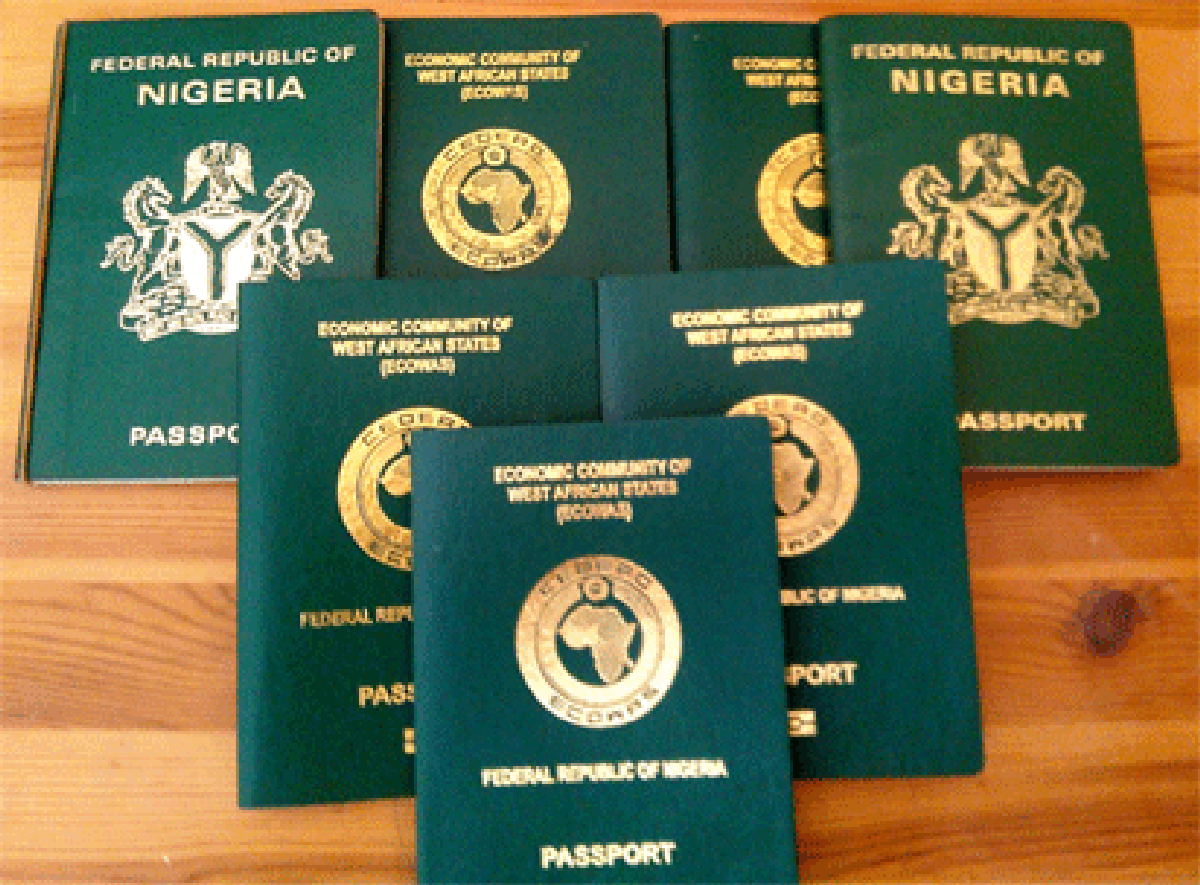
The investigation, which was done by Nigerian journalist, David Hundeyin and reported by West Africa Weekly, delves into how the rot in the system led to an embarrassing scarcity of passports for Nigerians at home and abroad.

This report exposes the rot, racketeering, ethnic nepotism, complete failure of due diligence, and how an indicted cocaine trafficker has come to control the supply of passports to Nigerian citizens.

The investigation, which was done by Nigerian journalist, David Hundeyin and reported by West Africa Weekly, delves into how the rot in the system led to an embarrassing scarcity of passports for Nigerians at home and abroad.

“We acknowledge and apologise for the challenges faced in the past few weeks regarding passport booklets availability. I am glad to inform you that booklets are now available and are being distributed to all our passport issuing centres.”

With these words on March 31, former Comptroller-General of the Nigeria Immigration Service (NIS) Babandede verbally signed a cheque that the NIS would subsequently fail to cash. Through the course of his tenure as CG, Nigerians had become used to chronic passport booklet shortage and the associated black market arbitrage, but the shortage had become acute by 2021. He needed to make a statement to reaffirm his competence.

Speaking at the commissioning of the Maitama Passport Express Centre – itself a master class in formalised black market arbitrage – Babandede made that statement, and then some. A special team would be dispatched to “facilitate enrollment and production” of passports across Nigeria and its foreign missions. New passport offices to service air passengers would be sited at the airports in Lagos, Kano and Abuja. The new “premium passport processing centre” in Abuja would cut the length of passport issuance and renewal from several weeks to just 72 hours.

Ultimately, Babandede’s statement turned out to be just that – a statement.

From when he made these pronouncements until his retirement earlier this month, passport booklets continued to be a scarce and expensive commodity in Nigeria. Several factors were blamed for the baffling inability of Africa’s most populous country to provide passports for its citizens. Chronic corruption at the NIS; disputes between the NIS and a private contractor responsible for printing booklets; scarcity of forex to pay for security printing materials; even an alleged unofficial government policy to stem brain drain by making passports hard to access – all these have variously been blamed for this state of affairs.

As is so often the case in Nigeria, no theory or explanation should be dismissed out of hand, which is why when I set out to find out what is really behind the perennial shortage of these little green booklets, I was prepared for anything. Or at least I thought I was. What would emerge as I sank my teeth into this however, was not a story about supply chain disruptions or government inefficiencies. It was nothing like I had ever seen before, which is saying something.

Think Transformers meets Black Mirror meets Karishika, with protagonists who are part Elon Musk, part Lawrence Anini and part Bakin Zuwo. There is a murder in New York; a million dollar cocaine deal in Bogotá. Court cases in New Jersey; a legitimate high tech manufacturing operation in Kuala Lumpur; art exhibitions in Lagos; high society marriages; prominent placement in lifestyle and celebrity magazines, and the most comically brazen lawbreaking hidden in plain sight. If this story were a movie, it would be the conceptual offspring of Michael Bay and Ugezu J. Ugezu, which is to say, low on plot and purpose, but high on sheer crash-bang value.

There are 3 main characters in this story. Their existence and relevance was determined after speaking to 5 different sources within the NIS ecosystem. These 3, more than any other people, have had the most influence on passport issuance and the wider state of the Immigration Service. Unsurprisingly, the first name on the list is immediate past CG Muhammad

None of my sources have any especially nice words to say about him, but neither do they have any bitter personal complaints either. The impression that comes through about Babandede is that of a fundamentally limited man who is neither virtuous nor especially malevolent. As one of the sources puts it frankly:

“He tried to make some moves such as the passport express centres, but it didn’t work out because he was just there to make money before he retired. He didn’t really care about fixing any systemic issues like staff motivation or the ISTL contract. All that one was not his business.”

The sources inform me that under Babandede’s tenure, complete opacity was institutionalised, with Immigration officers now not even knowing how much to expect on their payslip at the end of the month. Apparently during his tenure, NIS staff were migrated to the Integrated Payroll and Personnel information system (IPPIS), and with that went any sort of transparency regarding staff pay scales, deductions and entitlements. As a source colourfully puts it during one of our long conversations:

“It has now got to the point that you don’t know what will come in at the end of the month, and whatever it is that comes in – you just have to take it like that. The deductions vary every month so we don’t know how much we will take home. So tell me as a man with people depending on you, how else will you survive if not through ‘egunje’ (bribes)?”

While the sources mention different things that Babandede could have done to protect NIS staff welfare and morale, they all have one consistent criticism of him – his alleged ethnocentric posting policy. During his tenure they say, desirable NIS postings such as NIS offices in Lagos, were given exclusively to northerners, while the southerners working there were all posted out. The Ikoyi immigration office I am told, is now staffed almost exclusively by northerners – a state of affairs that would be impossible if the roles were reversed.

Under Babandede and even in these early days of his successor Idris Jere, the sources say, many northerners in the NIS, encouraged by the prebendalist disposition of their superiors, are keen to let everyone know that it is “their turn” and they are in power. Following Idris Jere’s appointment a source claims, the next most senior Deputy Comptroller – a southerner from Lagos – who might have been next in line to succeed Jere, was promptly transferred to Sokoto. At press time, I have been unable to independently verify this.

The other name that every source mentions is a certain “Liman” at the Ikoyi Passport Office. None of the sources bothers to hide how they feel about this fellow. This man and his extreme racketeering they say, is one of the major reasons behind Nigeria’s passport shortage. A bit of research brings up his name as Abdullahi I. Liman, a Deputy Comptroller in charge of the Ikoyi Passport Command of the NIS.

Every single source has a terrible story to tell about Abdullahi Liman. Liman they say, is responsible for the northernisation of the Ikoyi Passport Command. Even worse one source tells me, under Liman’s tenure, the atmosphere at the Command has taken on explicitly polarised ethnic and religious overtones. Take this anecdote from one of the sources for example:

“You can imagine that you are in the middle of doing a capture, then all of a sudden your colleague who is also capturing will just stand up and leave his station with a crowd of people there – because he says he is going to pray. You now end up doing his work for him, can you imagine that? This did not happen before Liman came in.”

Liman they say, is in the habit of pointedly using Hausa to converse with his subordinates at work, which automatically puts every southerner working under his command at a real career disadvantage. Speaking English – or in fact any other language but Hausa – at work is now a career demerit at the Ikoyi Passport Command under Liman’s watch.

A few days after I speak to this source, this story by the Foundation for Investigative Journalism was published, detailing persecution of a southern NIS officer at the Ikoyi Command in the exact ways described by my sources. Notice the reporter’s description of his interaction with Liman.

Up to this point, I have relied on testimony from sources I consider trustworthy, but even their knowledge of affairs at the NIS has its limits. While people like Abdullahi Liman are running rackets within the NIS to restrict access to passport booklets in large population centres like Lagos so as to create a lucrative black market, the sources are also clear that they believe that the NIS simply does not have enough passport booklets. To truly understand why the NIS appears to have not just a distribution problem, but also a supply problem with passport booklets, I had to figure out whose interests were served by the status quo.

First, a brief primer on how Nigeria’s passport system works.

Starting in 2003, Nigeria adopted the e-passport standard to defeat counterfeiting, resulting in a contract awarded to IRIS Smart Technologies Limited (ISTL) which commenced in 2007. The scope of the contract was to implement the Nigeria Harmonised ECOWAS Electronic (SMART) Passport Autogate Systems as well as to supply e-passport booklets, wafers, laminates and maintenance services from 2006 and 2015. ISTL is affiliated with Malaysia’s Iris Corp, which carries out the actual security printing services including supply of e-passport booklets.

The services that ISTL renders to the NIS include creating and maintaining the electronic database containing the passport details of Nigerian citizens, as well as maintaining the communication infrastructure that keeps a constant uplink between passport registration offices and the ISTL data centre. In case the reader has not seen the problem with this, allow me to spell it out clearly:

A private company working for a profit incentive has full and unrestricted access to the sensitive data of all Nigerian passport holders, but more importantly, it alone has access to this data. In other words, ISTL has more access to passport holders’ data than the NIS itself. ISTL does not actually produce passport booklets, but sub-contracts production to the Malaysian firm Iris Corp. Essentially, this company that most people have never heard of, controls a valuable sovereign database exclusively, and all it has to do is maintain a few dozen closed VSAT links from passport registration centres. Essentially, tech support.

This in fact caused a row between the NIS and the company in 2017 when the 10-year contract came up for renewal. Speaking to Daily Trust in 2017, some NIS insiders claimed the following: That the initial contract was a threat to national security because it vests control of the Country Signing Certification Authority (CSCA) – an official government seal – in ISTL, instead of the Nigerian government, which on paper is a risk factor for fraud;

That its implementation did not follow due process;

That the database and other infrastructure was paid for by the Nigerian government, but ISTL holds on to government property and uses tactics such as refusing to train NIS officers in the management of the system as a way to strong-arm the government into renewing its contract;

That NIS officers cannot conduct basic maintenance and repairs on the ISTL systems, meaning that the Nigerian government cannot withdraw from the ISTL contract without incurring catastrophic costs, which violates public procurement regulations;

That the contract had questionable exclusion clauses that gave undue advantage to ISTL at the expense of the Nigerian taxpayer.

The Malaysian company subcontracted by ISTL to print the booklets meanwhile, has found itself facing corruption probes by Malaysian authorities over its activities in other African e-passport jurisdictions such as Guinea. So putting this picture together, we have a tech support company that has somehow wrangled its way into a $138 million 10-year government contract (which was eventually renewed in 2019). Its main activity is maintaining equipment and an electronic database, and it sub-contracts passport booklet printing to a company halfway around the world whose executives have been arrested on corruption charges.

For the purpose of balance, it must be pointed out that the $138 million figure is not paid by the government, but rather comes from the company’s revenue generation activities within the scope of the e-passport project. It is also important to point out that the criticisms of the ISTL contract were possibly made in bad faith by individuals who merely wanted to replace ISTL with their own companies. Indeed, the senior NIS official quoted by the Daily Trust in 2017 remarked, “[The controversy] is between contractors who want the contract. The NIS’ concern is simply the supply of the booklets.”

It is also important to mention that the cost of sub-contracting Iris Corp to print the booklets is paid is USD, while ISTL’s revenue comes in naira, with the CBN refusing to provide forex for the company. This I am reliably informed, is the material reason behind the chronic booklet shortages since 2017 – the cost of printing passport booklets has more than doubled in dollar terms since 2015. Hence, ISTL simply cannot afford to print as many booklets as before.

With that being said, we now know that there is an incredibly lucky or powerful entity behind ISTL. Who is this person? This is where the story really takes a few turns, so hold on to your hats.

High Society Gentleman or Ex-Cocaine Trafficker?

On its website, ISTL describes itself as a “major subsidiary of the flagship company, Image Technologies Limited (Imagetech).” A quick CAC database check on Imagetech brings up the elusive character behind the curtain.

For a Lagos socialite, Olayinka Fisher is a man who somehow keeps a decidedly low profile. For one thing, while researching this story, establishing what exactly his name is turns out to be quite the task. In some places, he is “Yinka Fisher.” In some other places, he is “Olayinka Fisher.” In still other places, he is “Olayinka Fischer” or “Sonayon Fisher.” Only in a few places that he would rather the world did not know about, does his full and correctly spelled government name appear: “Olayinka Sonayon Fisher.” So who is this guy and what is there to him?

Quite a bit, as it turns out.

The story starts in Mr. Fisher’s previous iteration as a high flying Nigerian diplomat in in mid-to-late 1970s. At the time, when he was still known to the world as Olayinka Sonayon Fisher, he was the Second Secretary of the Nigerian Mission to the United Nations.

Researching the many variants of his name online, references to his diplomatic career can be seen right up until about 1980 when he seems to vanish off the face of the historical earth. In 1989, he resurfaces on CAC documents in Nigeria as the majority shareholder in a new company called Imagetech. Presumably at this point, the high-achieving diplomat has decided to pivot into a career in tech entrepreneurship. Nigeria being what it is, nobody ever really bothers to ask why, and by 2003 he is signing the contract above for ISTL under President Olusegun Obasanjo.

The good times are rolling. Following the end of his marriage to River State scion Doris Amachree, he weds Dr. Pius Okigbo’s daughter Anne. He becomes an avid art collector and patron of the arts. He hosts art exhibitions with the Spanish Embassy in Lagos, which are co-curated by both of his sons who share his love of the visual arts. To all intents and purposes, he is the SI unit of the classy and respectable old money Lagosian. There’s just one problem:

According to U.S. court records, Mr. Fisher allegedly used to be part of an intercontinental cocaine smuggling ring.

I obtain the following documents from the United States District Court for the District of New Jersey. They detail court proceedings from a 1983 case involving a violent drug dealer wanted for a murder in the Bronx, New York, a successful American businessman who dabbled into the illegal drug business with him, and a Nigerian diplomat who used his diplomatic immunity to traffic shipments of cocaine into the U.S. on their behalf.

The diplomat’s name? A certain Olayinka Sonayon Fisher.

According to Tracy Wong, the indicted American businessman, he paid Fisher the sum of $50,000 for a single shipment. The indictment further states that this arrangement lasted for at least 2 years with multiple Cocaine trafficking trips made worth several million dollars. Exactly how much Fisher made from this arrangement in total is a question only he can answer, but it certainly raises a few interesting questions.

Perhaps the most telling part of this story is that following the release of this NYT article and his subsequent exit from the diplomatic corps, Fisher appears to have intentionally dropped all mention of “Sonayon” from his name. In fact, it took the extraordinary step of making a few calls to my hometown Badagry, where the name “Sonayon” also originates from, to confirm his identity. The fact that this has somehow slipped under the radar for decades despite his custody of one of the most sensitive databases in Nigeria is a sign of a catastrophic failure of state intelligence and due diligence.

Making this point further, I speak to a lawyer, Solomon Igberaese to give his professional opinion of this issue. He points out that according to the Public Procurement Act 2007, someone with Fisher’s background should have been disqualified from the public procurement process. In his words:

“Falsification of fact can be interpreted to also include drug trafficking. Carrying out drug trafficking under any other guise will constitute falsification of fact. That he concealed packages inside diplomatic pouches certainly qualifies as falsification of fact. Again the section said falsification of facts relating to any matter.”

So there we have it – possibly the most mind-bending story in Nigeria’s rich history of dodgy public procurement and contracting. For added measure, the third person in the drug ring, a career drug dealer called Joseph Anthony Margarite was also wanted in connection with a murder at the time of his involvement with Wong and Fisher.

Culled from the Sahara Reporters  

Continue Reading
Click to comment

Leave a Reply

Books

A Chronicle of Community: Tracing the Roots of Amaiyi Igbere

Published

on

  • Book Title: Amaiyi Igbere: A Historical Look Back on Life, People, and Places That Shaped the Community
  • Author: By Emmanuel O. Ukandu, P.E.
  • Publishers: Intekspress Publishers
  • Reviewer: Emeaba O. Emeaba
  • Pages: 285

There is a particular kind of historical work that does not begin in an archive but around family compounds, market squares, church yards, streams, and evening conversations. Amaiyi Igbere: A Historical Look Back on Life, People, and Places That Shaped the Community by Emmanuel O. Ukandu belongs to that tradition. It is not merely a local history. It is an act of cultural preservation, an ambitious effort to rescue an entire way of life from the erosion of memory. The book announces that purpose immediately, presenting itself as a historical record of “life, people, and places that shaped the community.”

Ukandu understands something many professional historians sometimes overlook: the disappearance of everyday knowledge is often more permanent than the loss of famous events. Kings, wars, and politicians usually find chroniclers. The names of neighbors, customs surrounding childbirth, wrestling ceremonies, market routines, childhood games, and village footpaths frequently vanish within two generations. His response is encyclopedic. Across eighteen chapters, the author documents everything from family genealogies and village compounds to agricultural practices, religious life, education, folklore, the Nigerian–Biafran War, and changing social values.

Rather than pretending to produce an objective, omniscient history, Ukandu openly defines the book as a “personal history.” He carefully explains the limits of eyewitness testimony while arguing that memory itself deserves preservation. In one of the book’s strongest passages, he writes that:

“What may appear to be a small fragment of history today… may spare them the considerable effort and resources that would otherwise be required to search for traces of what transpired.”

That sentence serves as the philosophical foundation for everything that follows. The author is less interested in constructing grand historical theories than in ensuring that ordinary facts survive.

One of the book’s greatest achievements is its treatment of genealogy. Hundreds of names appear throughout the narrative—not as dry census entries but as participants in a living community. Families are connected across compounds, marriages, occupations, churches, schools, and public service. Future descendants searching for ancestors decades from now may find this volume invaluable. The author’s hope that young readers will build their own family trees transforms the book from history into an invitation for continuing scholarship.

The strongest chapters are those describing daily life before modernization transformed southeastern Nigeria. The discussions of rites of passage, farming seasons, fishing traditions, folklore evenings, marriage customs, health practices, markets, and village maintenance recreate a society whose rhythms depended upon community rather than institutions. The cumulative effect resembles an ethnography written by someone who lived the culture rather than observing it from the outside.

Ukandu also demonstrates how education shaped modern Amaiyi. His accounts of scholarship programs, pioneering teachers, and community leaders reveal how one generation deliberately invested in the next. Particularly memorable is his reflection that:

“Good seeds planted in children at an early age may produce results that last for a very long time.”

That observation quietly becomes one of the book’s central themes. Throughout the narrative, the community advances not through dramatic revolutions but through teachers, mentors, churches, scholarship funds, and families determined to educate their children.

The prose possesses an unusual sincerity. Ukandu rarely writes as though he is attempting a literary flourish. Instead, his voice reflects someone determined not to forget. That straightforwardness gives emotional weight to passages describing migration, the Nigeria–Biafra War, and the gradual disappearance of customs that once organized everyday existence.

Perhaps the book’s most affecting declaration appears near the beginning:

“The material presented in this book constitutes ‘a time window’ on a particular period in the life of the people of Amaiyi Igbere.”

The metaphor is exactly right. Readers are not simply learning dates; they are looking through a window into a vanished social world.

What does the book do less well?

Its greatest strength is also its principal weakness.

The book frequently favors completeness over narrative momentum. Long catalogues of names, family relationships, and community figures provide extraordinary documentary value, but they occasionally interrupt the flow for readers unfamiliar with Amaiyi. A more selective organization—or the addition of supplementary family charts, maps, timelines, and genealogical diagrams—would have made the wealth of information easier to absorb.

Editorially, the work could also benefit from tighter compression. Many anecdotes repeat similar themes, particularly regarding exemplary community leaders and educational pioneers. A more robust synthesis would strengthen the narrative without sacrificing historical content.

There are moments when personal admiration for certain individuals overtakes critical historical distance. Since the author explicitly identifies the volume as a personal history grounded in lived memory, this is understandable. Still, readers seeking extensive engagement with conflicting interpretations, documentary evidence beyond recollection, or broader regional historiography may occasionally wish for more comparative analysis.

Yet these criticisms ultimately reflect the book’s chosen mission rather than its failure. Ukandu is not writing a conventional scholarly monograph. He is preserving communal memory before it disappears.

The result is an important contribution to local African historiography and a reminder that history survives not only in national archives but also in villages whose stories are too often left unwritten. If every community possessed a chronicler as determined as Emmanuel Ukandu, historians of the next century would inherit a far richer record of Africa’s social past.

Amaiyi Igbere demonstrates that preserving memory is itself an act of public service. It stands as both a historical record and a gift to future generations seeking to understand not merely where they came from, but how ordinary people built a community whose legacy deserved to be written before it was forgotten.

This book is available on Amazon (Click on Image).


_________

♦ Dr. Emeaba, the author of “A Dictionary of Literature,” writes dime novels in the style of the Onitsha Market Literature sub-genre.

Continue Reading

Books

Book Review: The Gospel According to the Grocery Aisle

Published

on

  • Book Title: FOOD FOR THOUGHT: Nourishing the Soul, One Bite at a Time
  • Author: Professor Rev. Dr. Darlington Iheonu I. Ndubuike
  • Publishers: WestBow Press.
  • Reviewer: Dr Emeaba O. Emeaba
  • Pages: 220

In Food for Thought, Darlington Ndubuike transforms the produce aisle into a pulpit, finding in seventy fruits and vegetables a complete theology of the examined life; its trials, its silences, and its unexpected harvests.

Consider, for a moment, the humble prune. Dismissed by most as a geriatric remedy, shriveled and graceless beside its more glamorous neighbors in the produce section, it is not the obvious vehicle for theological meditation. Yet it is precisely here, at the unglamorous end of the fruit bowl, that Professor Rev. Dr. Darlington Iheonu I. Ndubuike begins his ambitious, idiosyncratic, and occasionally arresting book of devotional reflections. “Before it becomes a prune,” he writes, “the plum undergoes a transformation; it is dried, its moisture removed, and its form altered. Though the process may seem like a loss, the prune becomes more concentrated, sweeter, and longer-lasting than the original fruit.” The pruning of the plum becomes, in Ndubuike’s telling, the pruning of the soul; God as Master Gardener, cutting away what comforts in order to cultivate what endures.

This is the central conceit of Food for Thought, and it is one the author pursues with a kind of joyful relentlessness across seventy chapters, each devoted to a different fruit, vegetable, or herb. From peach to peas, from chard to walnut, from kiwi to kale, each item in Ndubuike’s spiritual pantry yields a devotional lesson, a biblical parallel, and an acronymic framework for right living. The book belongs to a long lineage of nature-as-sermon writing; from the medieval Physiologus, which found moral instruction in the habits of real and fantastical animals, to the pastoral homiletics of the American evangelical tradition. But Ndubuike brings to the genre something distinctly his own: an exuberant fondness for wordplay, an autobiographical candor that occasionally startles, and a devotional warmth that persists even when the metaphors strain their seams.

The book’s organizing principle is phonetic rather than botanical. Ndubuike pairs each food with a homophonic or near-homophonic English word or phrase: the peach becomes a meditation on the “pitch,” or the power of words; the kiwi prompts a reflection on “Can we?”—a question of communal possibility and spiritual unity; the walnut, with a brisk semantic pivot, becomes “Worry Not.” The raisin asks us to search for “reason” in the dry seasons of life; the lettuce implores us to “Let Us” choose reconciliation; the cantaloupe reminds us that we “Can’t Elope” from our responsibilities. Some of these puns land with the satisfying click of genuine insight. Others; the beet becoming “beats,” the corn becoming “con;” are more strained, their theological freight arriving at the station considerably ahead of any logical locomotive to carry it. Ndubuike is clearly aware that he is operating in the territory of the playful homily rather than the systematic treatise, and he generally deploys his puns with enough good humor to disarm objection.

What distinguishes Food for Thought from its devotional shelf-mates is the quality of Ndubuike’s autobiographical interjections. In a chapter ostensibly about chard—”charred,” in his reading, as a metaphor for transformation through trial—he pivots without warning into a searing personal memoir: his years as an international student in Houston, the hurricane that destroyed his workplace, the repossessed car, the miles walked before dawn from Stella Link Road to West Belfort, folding newspapers in the back of a pickup truck, shoulder still aching decades later. These passages are written with a plainness and precision that distinguish them sharply from the book’s more ornate homiletical moments. They arrest the reader because they are specific in a way that allegory rarely is; because they insist that the fire he describes is not only figurative. “I had a return ticket,” he writes. “I could have gone home. But I stayed. That was over forty years ago. What felt like the end was actually the beginning.” The chard chapter, in other words, becomes something more than a meditation on resilience; it becomes testimony.

The book’s theological framework is unambiguously evangelical and Protestant, rooted in the conviction that Scripture is the primary lens through which the natural world—and human experience—ought to be interpreted. Ndubuike cites Proverbs, the Psalms, the Pauline epistles, and the Gospels with the ease of long familiarity. His approach to biblical narrative is typological and hortatory: Joseph, Esther, Naomi, Gideon, Abraham, and Ruth appear as recurring figures, their stories pressed into service as analogues for contemporary spiritual dilemmas. This is a deeply traditional mode of Christian preaching, and readers already within that tradition will find the interpretive moves intuitive, even comforting. Those approaching from other perspectives—secular, interfaith, or from within Christianity’s more historically minded wings—may find the hermeneutic at once earnest and occasionally reductive. Ndubuike is not much interested in the ambiguities of biblical narrative, in the gaps and silences that have occupied critical scholarship for a century and a half. He reads for moral and spiritual direction, and he finds it consistently wherever he looks.

Structurally, the book follows a disciplined if somewhat formulaic pattern. Nearly every chapter concludes with an acronym that spells out the chapter’s food—the pecan yields PECAN (Positioned in Christ, Empowered by the Spirit, Called with Purpose, Anchored in Faith, Nourished by Grace); the peach yields PITCH (Pause Before You Speak, Intend to Build, Tell the Truth in Love, Choose Words Carefully, Honor God and Others). These frameworks are designed, one senses, for pedagogical application; for church small groups, Sunday school classes, sermons, and workshops. As pastoral tools, they are admirably efficient. As literary devices, they occasionally impose a tidiness on complexity that the preceding meditation has not quite earned. Life, as Ndubuike himself demonstrates when he is writing from memory rather than from schema, is rarely as categorical as an acronym.

The book’s range is its most impressive quality. In the space of a single volume, Ndubuike moves from modesty and bodily dignity (the citrus chapter’s meditation on “see-throughs” and discretion) to individuality and self-expression (the garlic chapter’s spirited defense of the “Gar-ilk,” those uncommon souls who carry bold presence without apology), from the communal ethics of the kiwi to the eschatological patience of wheat. The chapter on basil is perhaps the most quietly searching in the collection: Ndubuike warns against what he calls “basil living”—a life of safe, flavorless adequacy, the spiritual equivalent of the default herb—and invokes Esau’s sale of his birthright as its scriptural type. The Israelites in the wilderness, longing for the cucumbers and garlic of Egypt even after their miraculous deliverance, are pressed into service here as cautionary archetypes of comfort-seeking and diminished vision.

The final chapter, devoted to peas—peace—arrives with the warmth of a well-prepared meal’s last course. Peas, Ndubuike observes, “grow together in a pod, side by side, close-knit, and in harmony. They don’t compete for space; they share it.” It is a fittingly communal image with which to close a book that is, at its best, an invitation to a shared table; to the practice of attending carefully to the ordinary, of finding in the quotidian not distraction but direction.

Food for Thought is not a book without faults. It is uneven in texture, moving between passages of genuine spiritual depth and others that settle for the pleasant cliché. The acronymic scaffolding, useful as a preaching tool, can feel mechanical when encountered seventy times. And there are moments when the phonetic conceits require a suspension of credulity that the theological argument is not quite strong enough to support. But Ndubuike writes from a place of authentic vocation; he tells his readers, only half in jest, that he cannot cook, and that the Holy Spirit is the true chef of this volume, and that sincerity has a flavor of its own.

For readers willing to receive it on its own terms; as an extended pastoral exercise in finding sacred meaning in the ordinary world, written by a man who has walked miles in the dark and emerged with his faith intact; Food for Thought offers something genuinely nourishing. Ndubuike’s grandfather’s voice can be heard throughout: in the dedication to his grandson Lennox, he sets the book as “a table I’ve set with care, each page a dish seasoned with reflection, truth, and love.” That is, in the end, exactly what it is.

This book is available on Amazon (Click on Image).

_________

♦ Dr. Emeaba, the author of “A Dictionary of Literature,” writes dime novels in the style of the Onitsha Market Literature sub-genre.

Continue Reading

Column

From Noise to Votes: Nigerian Youth Must Turn Online Fire into Electoral Power

Published

on

Young Nigerians have shown a remarkable ability to create waves in the digital space. With a single click, they can expose a politician’s corruption, rally tens of thousands of supporters behind a single hashtag, and keep every political actor on edge from dawn until dusk. However, as the 2027 general elections draw closer, it is time to face an uncomfortable truth: loud online noise isn’t the same as real power in the political sphere. If Nigerian youth wish to get the best possible leadership from their nation’s leaders, they need to take their online activity offline (i.e., to places where actual democracy occurs) and start showing up to cast votes.

There is simply too much evidence to ignore that this needs to occur. Nigeria is a young country demographically. Together, Gen Z and Millennials comprise approximately half of the total population—50.1 percent—according to IntelPoint. Gen Z makes up 25.8 percent and Millennials account for 24.3 percent. When we consider Gen Alpha, the percentage rises to 85.7% of the population under 44. According to ActionAid Nigeria, more than 60% of Nigeria’s population is under 30. According to Afrobarometer, Nigeria has a median age of 18.1 years, and 58% of its population is aged 0-29. Therefore, Nigeria isn’t merely a young country; it is a country dominated by young people.

Based on this information, this dominant demographic should wield considerable political influence. Unfortunately, there often appears to be little correlation between these statistics and political influence. The contrast is striking. While a majority of Nigeria’s population is young, there remains a significant gap between how influential young people are politically and how influential they could be. This lack of influence is not due to a lack of ability among young people; rather, it stems from many young people stopping short of completing what is often called the “civic journey,” which involves moving from awareness to action. They consume politics, engage in political debate on social media, participate in meme politics, and express frustration with politics through social media rants; however, many young people still fail to register to vote (PVCs) or participate in elections in sufficient numbers to affect the outcome.

This disparity is important because youth dissatisfaction is far from abstract. More than 23% of Nigerian youth report being unemployed or seeking employment, according to Afrobarometer. Additionally, more than two-thirds of youth aged 18 to 35 report having some form of postsecondary or secondary-level education. Despite Nigeria ranking among the lowest in providing employment and opportunities for youth, and despite identifying high costs of living, unemployment, crime and security concerns, poverty, poor economic management practices, and insufficient access to electricity as the top five issues requiring immediate attention from government officials, youth dissatisfaction cannot be considered indifferent. Rather, youth dissatisfaction reflects citizens’ grievances and legitimate reasons to be deeply interested in who governs their country.

However, mere interest alone will not suffice. Democracy does not reward passion without participation. A young person can identify every weakness inherent in a political system; however, unless that person participates by casting a vote, they will remain a spectator to their own future. If you are mature enough to understand concepts such as inflation, insecurity, broken campaign promises, unemployment rates, and poorly managed governance systems, you are mature enough to accept responsibility for your role in creating solutions to those problems. That responsibility begins with voting.

In addition to continuing to use social media to raise awareness of voter registration, election knowledge, fact-checking mechanisms used during elections, and peaceful participation methods, social media can also serve as a vehicle for facilitating the transition from social media activism to actual civic engagement. Young Nigerians should leverage their social media presence to encourage voter registration, promote election literacy programs, provide fact-checking services to counter election misinformation, and advocate for nonviolent participation throughout the electoral cycle. They should convert their social media timelines into civic classrooms. Where can I find the information I need about voter registration processes? Where is my assigned polling station located? Where do I receive my Permanent Voter Card? How do I protect myself from spreading misinformation? How do I properly monitor election results? These are not dull topics; they represent essential tools required for surviving democracy.

Youth organizations, creators, and social media entities can also help facilitate offline civic engagement. Use your WhatsApp groups to alert others as registration deadlines approach. Use X Spaces and Instagram Live to focus on discussing relevant issues rather than hurling insults. Use TikTok to simplify the voting process. Use Facebook to motivate family members and first-time voters to participate in elections. Use whatever platforms are available to make civic obligation contagious. Nigeria’s youth have shown they can create viral content. Now they must begin to generate participation on a viral scale.

One of the most damaging myths in Nigerian politics is that “your vote doesn’t matter.” It is a self-fulfilling prophecy that only serves the interests of cynics, crooks, and machines whose success depends solely on low turnout. Yes, Nigeria’s electoral process has flaws. Yes, there have been numerous disappointments. However, the response to a flawed democracy is not abandonment; it is increased participation. By staying home on Election Day, youth essentially give their votes — and therefore control — directly to the very same groups they loathe.

Another mythological excuse for the youth’s failure to vote in Nigeria is the claim that “all politicians are alike.” No — they’re not all the same. While some politicians are inept, others are corrupt, and others exhibit both characteristics, democracy is not about seeking holy men or women; it is about making selections and enforcing accountability. An individual who refuses to make a selection for office because none of the options appear acceptable is ultimately selecting the candidate most likely to emerge victorious by default.

Nigeria’s youth already constitute the country’s largest demographic group. It is time for them to become its strongest democratic force as well. However, that will not be achieved by trending hashtags alone. Instead, it will be achieved when online energy is harnessed and directed toward political organization, civic education, voter registration, increasing voter turnout, and holding elected representatives accountable after elections.

The 2023 election saw remarkable youth participation but lacked follow-up. Therefore, the 2027 election should not produce another generation of disillusioned observers; instead, it should yield a new generation of participatory citizens. Let online flames ignite electoral power. Let debates become ballots. Let criticism evolve into participation. If Nigerian youth can dominate social media, they can also dominate democracy. The future will not be handed to them in a retweet. They must elect it into existence.

_________

♦ Chris Ulasi is on the Editorial Board of The West African Pilot News. He contributes stories about culture and tradition, elite politics, ethnicity and national integration, civil society, and social movement. He is a university professor, community builder, poet, film producer, recording the emergent Nollywood cultural history through film.

Continue Reading

Trending