Connect with us

News

13 U.S. troops killed in ISIS attacks on Kabul airport

Published

on

The bombings came just hours after defense officials warned about an increased terrorist threat from the Islamic State’s branch in Afghanistan

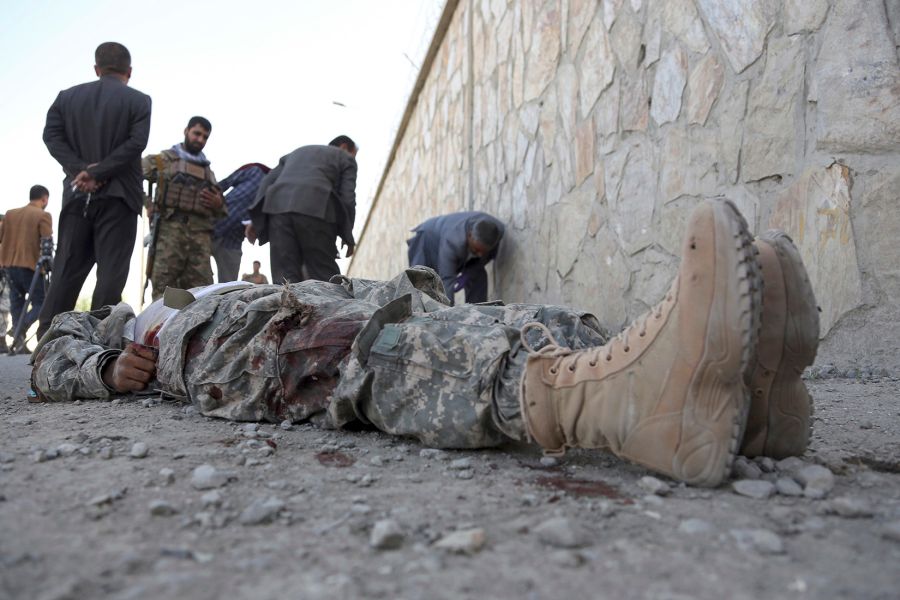
Thirteen U.S. troops were killed and 18 were injured on Thursday when ISIS militants set off two bombs outside Kabul’s main airport, the Pentagon said, where thousands of people have been gathering in recent days amid a massive evacuation effort by the U.S. and NATO allies.

The attacks from ISIS’s affiliate in Afghanistan were the deadliest U.S. casualty event there since 2011, and they come as the U.S. is just days away from a complete withdrawal from a country now controlled by the Taliban.

An ISIS militant wearing a suicide vest was responsible for the first bombing, two U.S. officials and a person familiar with the matter told POLITICO, detonating around 5 p.m. local time just outside Abbey Gate. ISIS gunmen then opened fire on the crowd. Three sources said U.S. troops returned fire soon after. NATO troops were ordered to leave the airport gates immediately due to the threat of additional attacks, two people said.

Videos from the scene viewed by POLITICO showed dozens of bodies strewn across a sewage canal and the surrounding banks outside Kabul’s main airport, which President Joe Biden has warned was vulnerable to terror attacks in recent days.

In remarks at the White House later Thursday, Biden said he has ordered his top military officials to attack the terror group’s assets.

“We will respond with precision at our time at a place that we choose and the moment of our choosing,” Biden said. “Here’s what you need to know: These ISIS terrorists will not win.”

The news comes just hours after defense officials began warning about an increased terrorist threat from the Islamic State’s branch in Afghanistan, known as ISIS-K. Defense officials briefed lawmakers on Tuesday about the new threat targeting airport gates and military and commercial aircraft evacuating people from Kabul, POLITICO first reported.

The explosion occurred at Abbey Gate, where U.S. personnel until recently welcomed American citizens to board evacuation flights, and the Baron Hotel, roughly 300 meters from the site of the first detonation, Pentagon spokesperson Kirby confirmed earlier Thursday. British troops had been using the hotel as a base for evacuating U.K. personnel.

“We try to push out the boundary even further so we don’t get large crowds massing at the gate,” Gen. Frank McKenzie, commander of U.S. Central Command, told reporters. “Clearly at Abbey Gate today we had a larger crowd there than we would like. Which goes to show you the system is not perfect.”

In the meantime, the evacuation flights out of the airport are still running, a defense official told POLITICO.

While the U.S. controls Hamid Karzai International Airport, the Biden administration has been coordinating with the Taliban on security measures outside the airport’s perimeter — a strategy that has proven complicated as Taliban fighters have reportedly been trying to prevent Afghans from fleeing the country. The Taliban has also not stood up effective counterterrorism measures to identify and prevent threats from groups like ISIS-K, which are sworn enemies of the Taliban.

Secretary of State Antony Blinken called the attacks a “devastating reminder of the dangerous conditions in which our servicemembers and diplomats are operating,” in a statement issued later Thursday.

Rep. Michael Waltz (R-Fla.), who served in Afghanistan, told reporters that lawmakers were briefed on the ISIS-K threat during a classified session on Wednesday. “So it was a credible and real threat,” he said. House Minority Leader Kevin McCarthy (R-Calif.) called on Speaker Nancy Pelosi to bring the chamber back into session for briefings and possible legislative action.

On Wednesday evening local time in Washington, the U.S. Embassy in Kabul issued an alert warning Americans to avoid the area “[b]ecause of security threats outside the gates of Kabul airport.”

Less than an hour before confirming the explosion, Kirby said the evacuation was continuing and that the U.S. was committed to relocating “as many people as we can until the end of the mission.”

As of early Thursday morning, the White House said the total number of people evacuated from Kabul since the operation began on Aug. 14 was 95,700, including 13,400 in the last 24 hours. Biden has drawn bipartisan criticism for sticking to an Aug. 31 deadline to withdraw all U.S. troops from the country, with lawmakers and top officials warning that Americans and vulnerable Afghans would be left behind if the mission ended prematurely.

Later Thursday, Blinken said “more than 100,000 people have been safely evacuated from Kabul.”

Before the Taliban takeover, Afghan security forces had long formed a so-called ring of steel around the capital city, with multiple checkpoints operating along main roads and a U.S.-led intelligence system tracking extremists. There have been a series of spectacular Taliban and ISIS attacks in Kabul over the years, but that old system has evaporated since the city’s fall to the Taliban, replaced by chaos and uncertainty, opening the city to attack.

No individual or group has yet taken responsibility for the attack. But Biden this week warned that ISIS wanted to strike the airport. U.S. officials familiar with the intelligence detailed some of its specifics to POLITICO, such as ISIS’s plans to detonate a vehicle-borne improvised explosive device and launch shoulder-fired rockets.

ISIS has moved fighters and materials for the bombs from Nangarhar and Kunar provinces to areas around the airport, a U.S. official said. On Thursday morning, that U.S. official added that an IED attack to breach the outer perimeter wall of the airport might come within six hours. Afterward, ISIS fighters would shoot into the crowd with machine guns and rocket-propelled grenades “in hopes of reaching processing centers” at the airport, the official said.

In the last day, the Taliban spokesperson, Zabihullah Mujahid, had denied that an airport attack had been imminent, telling The Associated Press about the warnings: “It’s not correct.”

The attack ranks as one of the deadliest days in Afghanistan for U.S. forces, coming behind two helicopter shootdowns. The largest loss of life came in 2011 when a helicopter carrying 30 Americans was shot down, killing 17 Navy SEALs, five sailors, five soldiers and three airmen. The second deadliest day came in 2005 during Operation Red Wings, when another helicopter was shot down killing eight SEALs and eight Army special operations soldiers.

Culled from the Politico 

Texas Guardian News

Houston

Turnout, Trust, and Ground Game: What Decided Houston’s Runoff Elections

Published

on

Low-turnout runoff races for Houston City Council and Houston Community College trustee seats revealed how message discipline, local credibility, and voter mobilization determined clear winners—and decisive losers.

The final ballots are counted, and Houston’s runoff elections have delivered clear outcomes in two closely watched local races, underscoring a familiar truth of municipal politics: in low-turnout elections, organization and credibility matter more than name recognition alone.

In the race for Houston City Council At-Large Position 4, Alejandra Salinas secured a decisive victory, winning 25,710 votes (59.27%) over former council member Dwight A. Boykins, who garnered 17,669 votes (40.73%). The margin was not accidental. Salinas ran a campaign tightly aligned with voter anxiety over public safety and infrastructure—two issues that consistently dominate Houston’s civic conversations. Her emphasis on keeping violent criminals off city streets and expanding Houston’s water supply spoke directly to quality-of-life concerns that resonate across districts, especially in an at-large contest where candidates must appeal to the city as a whole.

Salinas’ win reflects the advantage of message clarity. In a runoff, voters are not looking to be introduced to candidates—they are choosing between candidates they are already familiar with. Salinas presented herself as forward-looking and solutions-oriented, while Boykins, despite his experience and political history, struggled to reframe his candidacy beyond familiarity. In runoffs, nostalgia rarely outperforms momentum.

The second race—for Houston Community College District II trustee—followed a similar pattern. Renee Jefferson Patterson won with 2,497 votes (56.63%), defeating Kathleen “Kathy” Lynch Gunter, who received 1,912 votes (43.37%). Though the raw numbers were smaller, the dynamics were just as telling.

Patterson’s victory was powered by deep local ties and a clear institutional vision. As an HCC alumna, she effectively positioned herself as both a product and a steward of the system. Her pledge to expand the North Forest Campus and direct resources to Acres Home connected policy goals to place-based advocacy. In trustee races, voters often respond less to ideology and more to proximity—those who understand the campus, the students, and the neighborhood. Patterson checked all three boxes.

By contrast, Gunter’s loss highlights the challenge of overcoming a candidate with genuine community roots in a runoff scenario. Without a sharply differentiated message or a strong geographic base, turnout dynamics tend to favor candidates with existing neighborhood networks and direct institutional relevance.

What ultimately decided both races was not a surprise, but execution. Runoffs reward campaigns that can re-mobilize supporters, simplify their message, and convert familiarity into trust. Salinas and Patterson did exactly that. Their opponents, though credible, were unable to expand or energize their coalitions in a compressed electoral window.

The lesson from Houston’s runoff elections is straightforward but unforgiving: winners win because they align message, identity, and ground game. Losers lose because, in low-turnout contests, anything less than that alignment is insufficient.

Texas Guardian News
Continue Reading

Africa

Nigeria–Burkina Faso Rift: Military Power, Mistrust, and a Region Out of Balance

Published

on

The brief detention of a Nigerian Air Force C-130 Hercules aircraft and its crew in Burkina Faso may have ended quietly, but it exposed a deeper rift shaped by mistrust, insecurity, and uneven military power in West Africa. What was officially a technical emergency landing quickly became a diplomatic and security flashpoint, reflecting not hostility between equals, but anxiety between unequally matched states navigating very different political realities.

On December 8, 2025, the Nigerian Air Force transport aircraft made an unscheduled landing in Bobo-Dioulasso while en route to Portugal. Nigerian authorities described the stop as a precautionary response to a technical fault—standard procedure under international aviation and military safety protocols. Burkina Faso acknowledged the emergency landing but emphasized that the aircraft had violated its airspace, prompting the temporary detention of 11 Nigerian personnel while investigations and repairs were conducted. Within days, the crew and aircraft were released, underscoring a professional, if tense, resolution.

Yet the symbolism mattered. In a Sahel region gripped by coups, insurgencies, and fragile legitimacy, airspace is not merely technical—it is political. Burkina Faso’s reaction reflected a state on edge, hyper-vigilant about sovereignty amid persistent internal threats. Nigeria’s response, measured and restrained, reflected confidence rooted in capacity.

The military imbalance between the two countries is stark. Nigeria fields one of Africa’s most formidable armed forces, with a tri-service structure that includes a large, well-equipped air force, a dominant regional navy, and a sizable army capable of sustained operations. The Nigerian Air Force operates fighter jets such as the JF-17 and F-7Ni, as well as A-29 Super Tucanos for counterinsurgency operations, heavy transport aircraft like the C-130, and an extensive helicopter fleet. This force is designed not only for internal security but for regional power projection and multinational operations.

Burkina Faso’s military, by contrast, is compact and narrowly focused. Its air arm relies on a limited number of light attack aircraft, including Super Tucanos, and a small helicopter fleet primarily dedicated to internal counterinsurgency. There is no navy, no strategic airlift capacity comparable to Nigeria’s, and limited logistical depth. The Burkinabè military is stretched thin, fighting multiple insurgent groups while also managing the political consequences of repeated military takeovers.

This imbalance shapes behavior. Nigeria’s military posture is institutional, outward-looking, and anchored in regional frameworks such as ECOWAS. Burkina Faso’s posture is defensive, reactive, and inward-facing. Where Nigeria seeks stability through deterrence and cooperation, Burkina Faso seeks survival amid constant internal pressure. That difference explains why a technical landing could be perceived as a “serious security breach” rather than a routine aviation incident.

The incident also illuminates why Burkina Faso continues to struggle to regain political balance. Repeated coups have eroded civilian institutions, fractured command structures, and blurred the line between governance and militarization. The armed forces are not just security actors; they are political stakeholders. This creates a cycle where insecurity justifies military rule, and military rule deepens insecurity by weakening democratic legitimacy and regional trust.

Nigeria, despite its own security challenges, has managed to avoid this spiral. Civilian control of the military remains intact, democratic transitions—however imperfect—continue, and its armed forces operate within a clearer constitutional framework. This stability enhances Nigeria’s regional credibility and amplifies its military superiority beyond hardware alone.

The C-130 episode did not escalate into confrontation precisely because of this asymmetry. Burkina Faso could assert sovereignty, but not sustain defiance. Nigeria could have asserted its capability, but chose restraint. In the end, professionalism prevailed.

Still, the rift lingers. It is not about one aircraft or one landing, but about two countries moving in different strategic directions. Nigeria stands as a regional anchor with superior military power and institutional depth. Burkina Faso remains a state searching for equilibrium—politically fragile, militarily constrained, and acutely sensitive to every perceived threat from the skies above.

Texas Guardian News
Continue Reading

News

Bizarre Epstein files reference to Trump, Putin, and oral sex with ‘Bubba’ draws scrutiny in Congress

Published

on

The latest tranche of emails from the estate of late convicted pedophile Jeffrey Epstein includes one that contains what appear to be references to President Donald Trump allegedly performing oral sex, raising questions the committee cannot answer until the Department of Justice turns over records it has withheld, says U.S. Rep. Robert Garcia, the top Democrat on the House Oversight Committee.

Garcia insists the Trump White House is helping block them.

In a Friday afternoon interview with The Advocate, the out California lawmaker responded to a 2018 exchange, which was included in the emails released, between Jeffrey Epstein and his brother, Mark Epstein. In that message, Mark wrote that because Jeffrey Epstein had said he was with former Trump adviser Steve Bannon, he should “ask him if Putin has the photos of Trump blowing Bubba.”

“Bubba” is a nickname former President Bill Clinton has been known by; however, the email does not clarify who Mark Epstein meant, and the context remains unclear.

Texas Guardian News
Continue Reading

Trending