

Column
“Georgia On My Mind” ―Dazed Republican States Strive to Adopt Autocracy

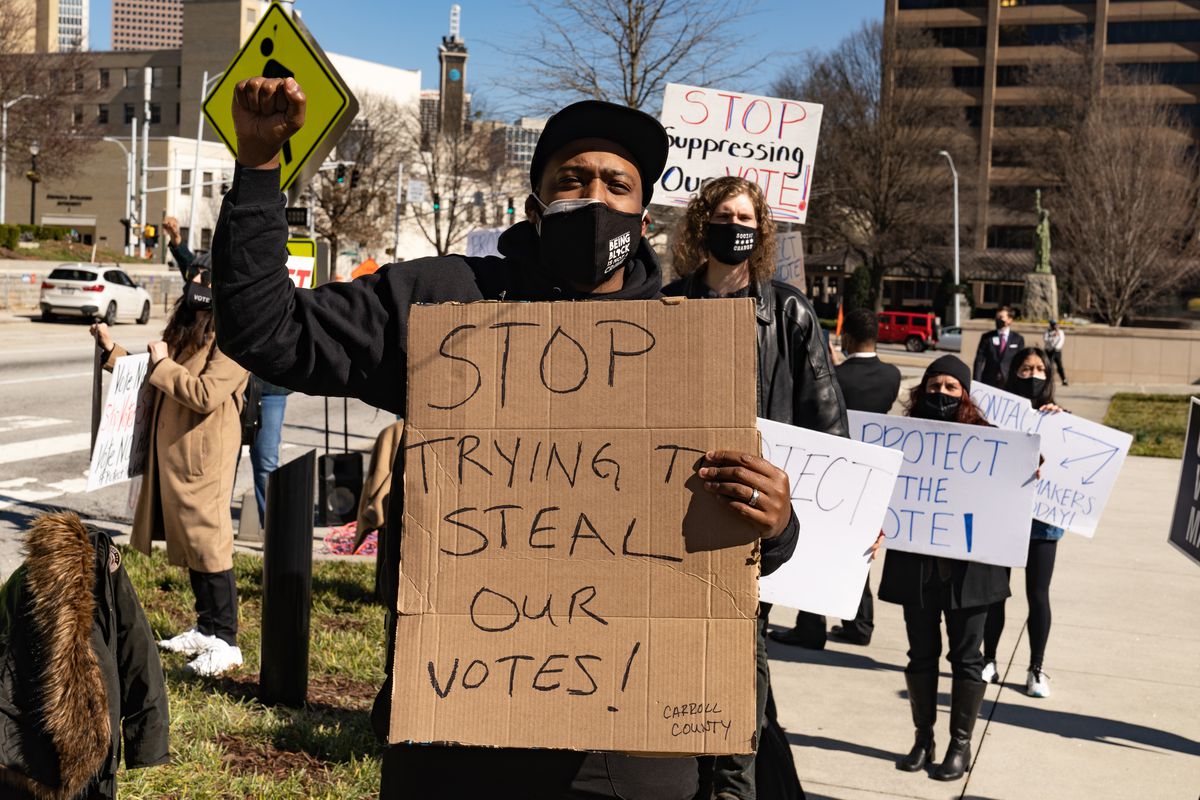
“…if you were lucky and you cast that vote they dreaded, and it turned out they hated the outcome, they would simply declare the republican loser, the victor.”
―Don Okolo
In truth, if you were searching for America’s most evil City or State, you’d have three, maybe four southern States to run through the mill of ignominy, to see which one stands with her head held high…proud she had beaten out the other three. The four States in contention would be, Alabama, Mississippi, Georgia, and Texas: Texas, because she has this dirty, soulless enclave called Vidor. Her people are mostly the long-haired, fifteen century dwellers, whose mugs are jarring to look at.

The common thread these States have is that they have country songs written in their names…and they are great songs. As the city of Vidor in Texas remains the most deplorable and the most dangerous city for any non-white person to live in, you would be surprised that a sizeable number of blacks and Spanish people brave the threat to their lives to live in this hellhole.
Texas is not Georgia. Georgia is the bottom pit of hell. Maybe, Texas is a few rungs up the ladder, even as the State is inching close to the bottom. And one of these days, the State of Texas will draw level with Georgia in that sweltering pit where Satan sits on his throne. A brand spanking, newly rewritten version of the Divine Comedy, Dante’s Inferno, is what I am offering you in this piece. How could the current situation between the two dueling States not remind you of Dante Alighieri’s masterpiece? Satan is sitting on his throne…and on his right and left sides are the two States that have betrayed humanity. Texas and Georgia have replaced Judas and Brutus; they have kicked the despicable Roman and the contemptible Jew out of their once beloved place in the firmament of Hell. Now Satan has both his flanks covered by the biggest, and the baddest twosome of the fifty States in the republic. There is joy in Hell. Yes, I said it: There is singing and dancing. They are inside the free-flowing, wicked kind of frolic…of no-holds barred licentiousness…and the State of Georgia…her representatives, that is, are the suppliers of the States renowned moonshine whiskey, labelled, “Hellot’s Brew’.
You may want to ask yourselves why modern-day man would sink into this depth of murk and self-indulgence
Even the tall Georgia Pines are bent double, wallowing inside this mote of pure evil. Some of the denizens of this depravity, whose voices they want stifled can be heard moaning in agony, wondering how long it would be before someone would come along and pull them from under the weight of absolute misery crushing them…to free them, and to alleviate their pain. They are begging…calling Coca-Cola, the big Delta Airline, to empathize, not offer condolences, because the body polity could still be alive and breathing in shallow patterns below. But the wickedness that has been tendered is Teflon-like in tenacity, and only the fires of the bigger House could sear through it to render it moot and useless.
Here are the dangers of this flaming conflagration if it is allowed to remain an inferno. The death of magnificence (Democracy) is one. The rise of autocracy is assured. States with republican majorities will have no reason to cower and not follow this path… were no guns are aimed at them. This path of no resistance would carry them to the infamous gallery from where they would sit with unbridled power and complacency. Here, on this plateau of grifters, these men would govern with a beck and call. You may want to ask yourselves why modern-day man would sink into this depth of murk and self-indulgence and decree that the voices of his/her ilk should rise to the heavens, and the voices of those he considers leftovers of creation, be mooted, and tossed. And on the day of signing, these curs robbed it in; they sat under the canopy of an image…the scorching metaphor of indignity antebellum south was known for…the one bastion of her great slave-owning and trading days…the one symbol of inhumanity they wear like a halo, to sign and seal, the resurgence of a certain mastery over other humans. F%$# ‘em!!!
Nothing will ever be the same if this were allowed to stand. I don’t see how the spineless democratic side of this divide would do anything to stop this…at least not with a republican in their midst…the one garbed in democratic-styled mantle, the Senator from Virginia, the one towing the republican line, Joe Manchin. They have figured it out. And it is not pretty. The unexpected turnout of democratic voters that repelled Donald Trump…that installed two new Georgian Democratic Senators, Ossorff and Warnock, was the last straw. If you understood how the State of Georgia rolled with all social issues…her Statewide depressive kind of politics, and the Devil’s ownership of the Mason/Dixie line, you’d know that what they did cutting access to voting was long overdue…again, given the nature of the beast.
Take a moment and think about the two dismal things about the voting law these white men in black suits signed into law. Voting lines would be long; an attempt would be made to cause delays, and have people stand in line for more than ten hours to vote. In their thinking, the resilience of the black voter had to be contained. So, if you were foolhardy and impertinent to the white, republican politician’s brand, and stood in that line, they’d be on patrol to make sure no one handed you a bottle of water or, any kind of ration. When that one element was worked into the original draft, you should know that these men and women had lost the last vestiges of what made them human beings. That alone should explain the obvious; wolves in sheep clothing; man as the quintessential predator to his fellow man. It doesn’t end there; if you were lucky and you cast that vote they dreaded, and it turned out they hated the outcome, they would simply declare the republican loser, the victor. It begs the question; do I need to vote at all? In essence, that is what they want from you; a level of disgust to cause you to abandon the system some of us have died to keep.
In essence, that is what they want from you; a level of disgust to cause you to abandon the system some of us have died to keep.
Only animals are governed by instinct. Humans have justifications; they are motivated by nuances of justice, ethics, and morality to create laws humans will abide by. That Georgian voter suppression law was passed on instinct. Almost every animal has enough sense not to devour its own. Not with these republicans. The depth of the insanity into which they have sunk is unfathomable. And with all things in the animal kingdom, the ones at the top of the food chain, would mosey on down after they have marked their territories. They know you couldn’t up and challenge their authority and not get eaten alive. Governor Kemp and his blue-faced political kind are expecting that there would be no challenges mounted. They are aware that this one gambit is tantamount to throwing crap against the wall and see what sticks. You blocks, you stones, you worse than senseless things. Oh you hard hats, you cruel men of Georgia.
♦ Don Okolo, Professor and filmmaker, is on the Editorial Board of the West African Pilot News. He is the author of many books.

- From Threats to Partnership: How Diplomacy Repositioned Nigeria in Washington - January 13, 2026
- Burbank Marriage Unravels After Woman Allegedly Used Tracking Devices to Monitor Husband - December 27, 2025
- U.S. Signals More Strikes in Nigeria as Abuja Confirms Joint Military Campaign - December 27, 2025



“Nigeria reframed terrorism, corrected Washington’s lens, and secured cooperation —a pure anatomy of diplomatic turnaround“ —Anthony Obi Ogbo
Nigeria’s recent engagement of a United States–based lobbying firm under a reported $9 million contract was widely scrutinized, predictably misunderstood by some, and quietly effective. The objective was clear: to shape Washington’s understanding of Nigeria’s complex security challenges—particularly violence affecting Christian communities—within an accurate geopolitical, intelligence, and regional framework. Such engagements are not unusual. In fact, they are a routine and essential feature of modern international diplomacy, allowing governments to clarify policy positions, counter distorted narratives, and ensure that domestic security crises are not flattened into simplistic talking points for foreign consumption.

In an era where global perception can influence aid, sanctions, military cooperation, and diplomatic goodwill, strategic communication has become inseparable from national security. Nigeria’s decision to professionally engage Washington signaled an understanding that security today is fought not only on the battlefield but also in briefing rooms, policy memos, and diplomatic corridors.
Evidence suggests that this recalibration has begun to yield results. Just days ago, former U.S. President Donald Trump publicly acknowledged—belatedly—that Muslims are equally among the primary victims of ISIS terrorism. It was a striking rhetorical shift for a political figure who had long leaned on broad, inflammatory framing that blurred the distinction between extremist violence and religious identity. That admission did not emerge in a vacuum. It followed sustained pressure from global security analysts, regional experts, and Muslim leaders who have repeatedly challenged the false narrative that terrorism is rooted in faith rather than criminal ideology, geopolitical instability, and organized violence.
More importantly, the acknowledgment coincided with tangible policy movement. Trump-aligned U.S. security networks have quietly expanded counterterrorism cooperation with Nigeria under President Bola Ahmed Tinubu’s administration. This development underscores a pragmatic recognition that effective counterterrorism is not achieved through threats, isolation, or performative rhetoric, but through partnership, intelligence sharing, and regional capacity building.
This week, the United States delivered fresh military supplies to Nigeria to support ongoing security operations. The delivery followed recent U.S. air strikes against Islamic State West Africa Province (ISWAP) targets, carried out at Nigeria’s formal request. While air strikes often attract public attention, the more consequential story lies beneath the surface: a shift toward coordinated intelligence operations, logistical support, and sustained military collaboration. This is not symbolic diplomacy. It is functional, operational alignment.
Contrast this moment with an earlier chapter in Nigeria–U.S. relations. During the Jonathan administration, Nigeria experienced significant difficulties in its diplomatic engagement with Washington. Rather than relying on seasoned foreign policy professionals, security strategists, and international communications experts, the government leaned heavily on local intermediaries and political loyalists to interpret and convey Nigeria’s position abroad. The result was a weakened diplomatic posture, fragmented messaging, and persistent misinterpretation of Nigeria’s internal security realities. Critical issues—ranging from Boko Haram’s evolution to regional insurgency dynamics—were often viewed through incomplete or distorted lenses.
That experience offered a lasting lesson: goodwill alone does not translate into influence. In global politics, perception must be managed as deliberately as policy. Strategic silence, amateur diplomacy, or reactive communication leaves a vacuum—one that is quickly filled by external narratives, advocacy groups, or political opportunists with their own agendas.
What has changed now is not merely tone, but method. Nigeria’s current approach reflects an understanding that diplomacy is not capitulation, and lobbying is not a sign of weakness. It is leverage. It is preparation. It is the disciplined articulation of national interest in a language that global power centers understand. By engaging professionally, Nigeria reframed its security narrative—not as a sectarian failure, but as a shared counterterrorism challenge that requires international coordination.
Even Donald Trump’s posture illustrates this transformation. A leader who once relied on threats, ultimatums, and rhetorical spectacle has now, through institutional channels, become part of a support framework working with regional actors to strengthen security and civilian protection. The shift is not ideological; it is a strategic move. And it reflects the enduring truth that diplomacy often succeeds where bluster fails.
In international politics, power is not only measured by firepower or economic weight, but by the ability to persuade, align, and sustain cooperation. Nigeria’s recent experience is a reminder that nations are not judged solely by their crises, but by how effectively they explain, manage, and confront them on the global stage. Diplomacy, when practiced with clarity and professionalism, does not dilute sovereignty—it reinforces it.
♦ Publisher of the Guardian News, Professor Anthony Obi Ogbo, Ph.D., is on the Editorial Board of the West African Pilot News. He is the author of the Influence of Leadership (2015) and the Maxims of Political Leadership (2019). Contact: anthony@guardiannews.us
- From Threats to Partnership: How Diplomacy Repositioned Nigeria in Washington - January 13, 2026
- Burbank Marriage Unravels After Woman Allegedly Used Tracking Devices to Monitor Husband - December 27, 2025
- U.S. Signals More Strikes in Nigeria as Abuja Confirms Joint Military Campaign - December 27, 2025
Anthony Obi Ogbo
When Air Power Becomes a Christmas Performance: The Illusion of Success in Trump’s Nigerian Strike
“Bombs alone do not defeat ideology. Precision without intelligence is noise.“ —Anthony Obi Ogbo
When President Trump announced his authorized United States air strike against ISIL (ISIS) fighters in northwest Nigeria on Christmas Day, there was an immediate burst of celebration on Nigerian social media. For a country exhausted by years of kidnappings, massacres, and territorial insecurity, the announcement sounded like long-awaited international support. Memes circulated, praise poured in, and some Nigerians hailed Trump as a decisive global sheriff finally willing to act where others hesitated.

But after the initial euphoria settled, a sobering assessment emerged: the strike appeared less like a strategic military intervention and more like a made-for-television spectacle designed to burnish Trump’s international strongman image.
This was not the first time the United States has launched air strikes in Africa or the Sahel under the banner of counterterrorism. From Libya to Somalia, from Syria to Yemen, U.S. “precision strikes” have often been announced with confidence and celebrated with press briefings—only for the targeted groups to regroup, mutate, and, in some cases, expand their reach. In Nigeria itself, years of foreign-backed security assistance have failed to decisively neutralize Boko Haram or its ISIS-affiliated offshoots. Instead, violence has fragmented, spread, and grown more complex.
No verifiable evidence has been produced to confirm high-value ISIS targets were eliminated
The Nigerian strike followed a familiar pattern. U.S. officials framed it as a blow against ISIS-West Africa Province (ISWAP), a group aligned with the global ISIS network. Trump’s language suggested a decisive intervention—an act of muscular diplomacy signaling that America still projects power where it chooses. Yet no verifiable evidence has been produced to confirm high-value ISIS targets were eliminated, leadership structures dismantled, or operational capacity degraded.
What followed was a digital smokescreen. Social media accounts, many anonymous and unverified, began circulating gruesome images of dead bodies and destroyed villages—photos long associated with banditry in Nigeria’s northwest. These images were quickly repurposed to “prove” the success of Trump’s strike. However, this is where the narrative falls apart under scrutiny.
Trump’s mission, as publicly stated, was to target ISIS. Not bandits. Not kidnappers. Not rural criminal gangs. ISIS is a transnational terrorist organization with ideological, financial, and operational links across continents. Bandits, by contrast, are primarily armed criminal groups—motivated by ransom, cattle theft, and territorial control, not global jihad. Conflating the two may be politically convenient, but it is analytically dishonest.
Killing or displacing bandits does not equate to dismantling ISIS. In fact, indiscriminate or poorly targeted air strikes often worsen the situation, pushing criminal groups to radicalize, splinter, or align with extremist factions for protection and legitimacy. This pattern has been observed repeatedly in conflict zones where military force substitutes for intelligence-driven strategy.
A truly successful counterterrorism raid is not measured by dramatic announcements or viral images. It is measured by clear, verifiable outcomes, including the confirmed elimination of high-ranking commanders, disruption of recruitment and financing networks, seizure of weapons caches, and—most importantly—sustained reductions in civilian attacks. None of these benchmarks has been credibly demonstrated in the aftermath of Trump’s Nigerian air strike.
Instead, Nigeria wakes up to the same grim reality: villages remain vulnerable, highways unsafe, and communities terrorized. The strike did not change the security equation. It did not empower Nigerian forces. It did not restore civilian confidence. And it certainly did not neutralize ISIS as a strategic threat.
This air strike offered Nigerians symbolism, not security.
In that sense, the air strike was not merely ineffective—it was a failure dressed in the language of strength, executed for optics, and amplified for political gain. It offered Nigerians symbolism, not security.
If the goal is truly to eliminate ISIS and its affiliates in West Africa, the path is neither theatrical nor unilateral. It requires robust intelligence sharing, sustained training, and real-time coordination with Nigerian and regional forces. It demands targeted arms assistance, logistical support, and investments in surveillance capabilities that allow local militaries to act decisively and lawfully. Above all, it requires a long-term commitment to strengthening state capacity—not fleeting air shows announced from afar.
Bombs alone do not defeat ideology. Precision without intelligence is noise. And celebration without results is self-deception. Trump’s Nigerian air strike may have produced headlines, but history will remember it for what it was: a failed mission masquerading as success.
♦ Publisher of the Guardian News, Professor Anthony Obi Ogbo, Ph.D., is on the Editorial Board of the West African Pilot News. He is the author of the Influence of Leadership (2015) and the Maxims of Political Leadership (2019). Contact: anthony@guardiannews.us
- From Threats to Partnership: How Diplomacy Repositioned Nigeria in Washington - January 13, 2026
- Burbank Marriage Unravels After Woman Allegedly Used Tracking Devices to Monitor Husband - December 27, 2025
- U.S. Signals More Strikes in Nigeria as Abuja Confirms Joint Military Campaign - December 27, 2025
“With Obama, Al-Qaeda was not eliminated by noise; it was suffocated by intelligence.“ —Anthony Obi Ogbo
It has now been confirmed that the United States acted in collaboration with Nigeria in the recent strike on Islamic State elements in northwest Nigeria. That cooperation deserves recognition. Intelligence-sharing between Washington and Abuja is necessary, overdue, and welcome. Terrorism is transnational; defeating it requires allies, not isolation.

But let us be clear: bombs alone do not defeat terror. And Donald Trump’s strike—trumpeted loudly on social media before facts, casualties, or strategy were disclosed—was less a turning point than a performance.
Trump’s announcement was a classic spectacle: “powerful,” “deadly,” “perfect strikes.” No numbers. No clarity. No accountability. Just noise. It was the same choreography America has deployed in Iraq, Afghanistan, Syria, Libya, Yemen, and Somalia—places where U.S. airpower landed hard, headlines screamed victory, and instability deepened afterward. Violence escalated. Militancy adapted. Civilians paid the price.
History is unkind to airstrikes sold as solutions.
Nigeria knows this better than anyone. Long before Trump’s tweet, the Nigerian military had already conducted multiple operations in the same terror corridor. At least five major strikes and offensives stand out:
- First, Operation Hadarin Daji, launched to dismantle bandit and terror camps across Zamfara, Katsina, and Sokoto, involving sustained air and ground assaults.
- Second, Operation Tsaftan Daji, which targeted terrorist hideouts in the Kamuku and Sububu forests—precisely the terrain now in the headlines.
- Third, repeated Nigerian Air Force precision strikes in the Zurmi–Shinkafi axis, neutralizing commanders and destroying logistics hubs.
- Fourth, joint operations with Nigerien forces, disrupting cross-border supply routes used by ISIS-linked groups.
- Fifth, recent coordinated offensives involving intelligence-led raids, special forces insertions, and follow-up ground clearing in the northwest.
These were not symbolic gestures. They were Nigerian-led, Nigerian-funded, Nigerian-executed. And yet, there were no fireworks on social media. No flag-waving hysteria. No intoxicated praise of Nigerian commanders as saviors of civilization.
Why? Because there is a dangerous segment of Nigerians who suffer from what can only be called the American Wonder mentality—a colonial hangover that applauds anything louder simply because it comes from Washington. The same Nigerians who ignore their own soldiers dying in silence suddenly abandon Christmas meals to celebrate Trump’s tweets, typing incoherent praise, mangling grammar, and mistaking spectacle for substance.
It is embarrassing. And it is intellectually lazy.
Terrorism is not defeated by volume or virality. It is defeated by intelligence—quiet, patient, unglamorous work. The United States knows this. Barack Obama understood it. Al-Qaeda was not dismantled through social media theatrics or chest-thumping declarations. It was weakened through intelligence fusion, financial disruption, targeted operations, local partnerships, and relentless pressure on leadership networks—mostly without fanfare.
Obama did not tweet. He acted. So what actually works against groups like ISIS in Nigeria?
First, intelligence supremacy. Human intelligence from local communities, defectors, and infiltrators matters more than bombs. Terror groups survive on secrecy. Break that, and they collapse.
Second, financial and logistical strangulation. Terrorists run on money, fuel, arms, and food. Cut access to smuggling routes, illicit mining, ransom flows, and cross-border trade, and their operational capacity withers.
Third, community stabilization and governance. Terrorism thrives where the state is absent. Roads, schools, policing, and justice systems matter. People who trust the state do not shelter terrorists.
Fourth, regional coordination, not episodic strikes. Nigeria, Niger, Chad, and Burkina Faso must sustain joint pressure, not reactive operations driven by headlines.
Airstrikes can support these strategies—but only as tools, never as substitutes.
Trump’s strike may have killed militants. It may have disrupted camps. That is commendable. But it is not a solution. It is a moment. And moments, without strategy, fade.
If Nigerians truly want terror defeated, they should stop worshiping foreign loudness and start demanding disciplined intelligence, consistent policy, and respect for the men and women already fighting on the ground.
Real victories are quiet. Real security is built, not tweeted.
♦ Publisher of the Guardian News, Professor Anthony Obi Ogbo, Ph.D., is on the Editorial Board of the West African Pilot News. He is the author of the Influence of Leadership (2015) and the Maxims of Political Leadership (2019). Contact: anthony@guardiannews.us
- From Threats to Partnership: How Diplomacy Repositioned Nigeria in Washington - January 13, 2026
- Burbank Marriage Unravels After Woman Allegedly Used Tracking Devices to Monitor Husband - December 27, 2025
- U.S. Signals More Strikes in Nigeria as Abuja Confirms Joint Military Campaign - December 27, 2025