

Community
Wazobia Family Funfair AT 10 – Decade of Family, Culture, and Community

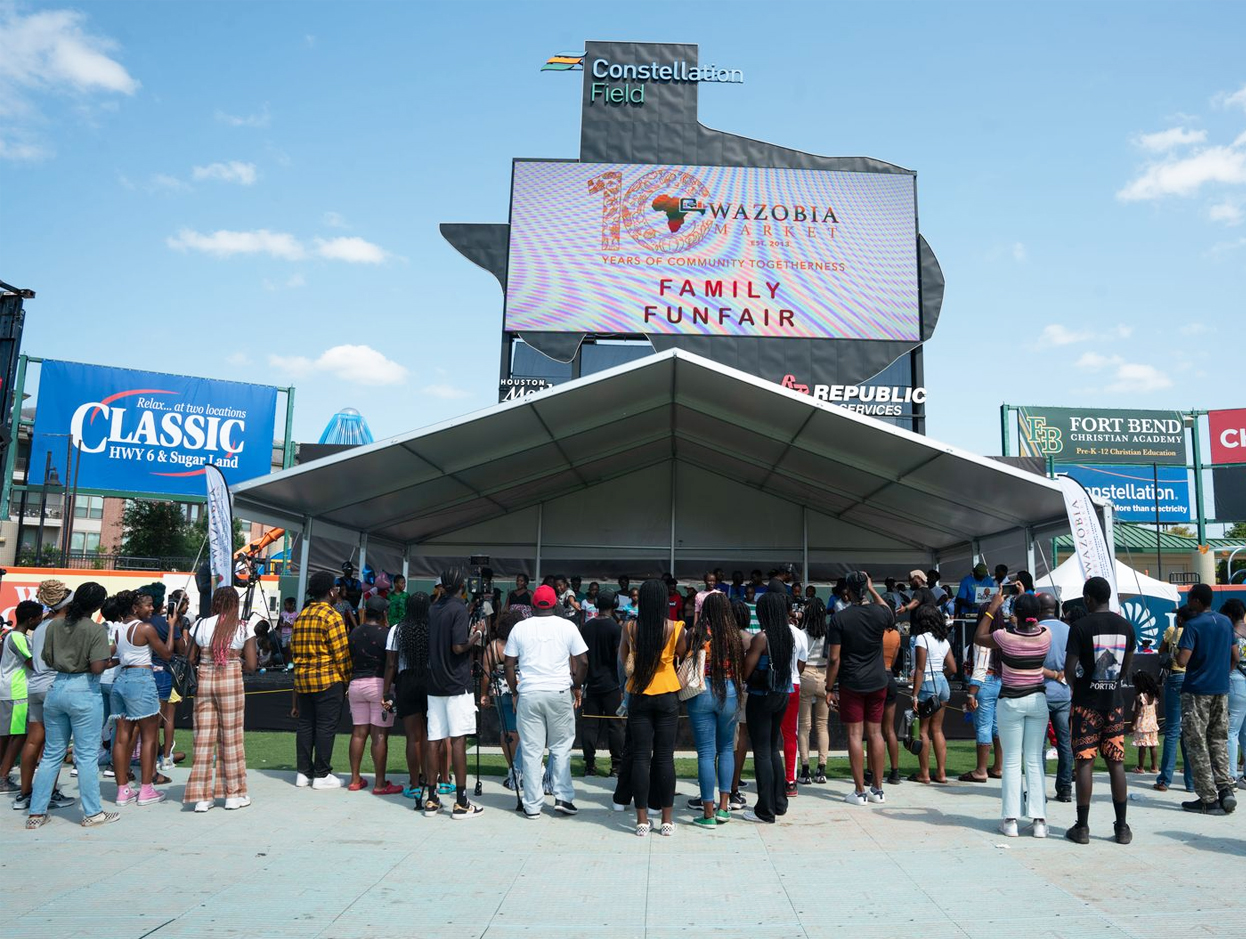
On July 25, 2026, families from across Houston will gather at the West Oaks Mall on 1000 West Oaks, Houston, to celebrate a milestone that extends far beyond food, music, and entertainment. The 10th Anniversary of the Wazobia Family Funfair represents a decade-long journey of community building, cultural preservation, entrepreneurship, and family-centered engagement.
What began as a customer appreciation initiative has evolved into one of the most recognizable African community events in Texas. For ten years, the Funfair has provided a space where families reconnect with culture, children experience heritage, entrepreneurs build relationships, and communities strengthen the bonds that define them.
The story of the anniversary begins with the story of Wazobia itself. Founded in 2013 by entrepreneur Tunde Fashina, Wazobia was created with a vision that stretched beyond commerce. According to Fashina, the goal was never simply to sell products.

FASHINA, OHAZURIKE: For Fashina, leadership carries responsibility. “The feeling is fantastic because you’ve achieved something,” he explained. “But it is also frightening because every decision affects many people.” He added: “The higher you are in an organization, the more people are affected by your decisions.” Those values influence the company’s culture and community engagement efforts.
“The emphasis was not more on getting the products,” he explained. “The emphasis was on creating a feeling of belonging to the customer, so that they feel at home any time they come to our place.”
That philosophy became the foundation of the business. Fashina spent nearly two years developing the business plan. The challenge was enormous. He had limited financial resources and relied heavily on relationships, determination, and faith.
“The business plan had to involve getting this business up with absolutely no money, because I didn’t have any,” he recalled.
The early years tested every aspect of his resolve. He performed multiple roles simultaneously.
“I was a cleaner. I was a restocker. I was a cashier. I did all the work,” he said. “I slept in the shop throughout for almost 18 months because I was working around the clock.”
Despite the challenges, growth came quickly.
“God showed up in ways that I could not describe,” Fashina said. “People started coming in little by little, and the growth rate exceeded everything in the business plan.”
Yet even as the company expanded, community remained central to the mission. “We created a sub-plan,” he explained. “How do we give back to those who built us? How do we let our customers know that we appreciate them?”
The answer became what is now known as the Wazobia Family Funfair.


Over the years, the event evolved from a modest appreciation day into a major annual celebration featuring cultural performances, African music, dance, games, food vendors, business showcases, and family activities.
For Paula Ohazurike, Project Manager at Wazobia, the event represents much more than an annual gathering. Her experience since she joined Wazobia reflects a recurring theme in conversations with employees and customers: Wazobia is viewed not merely as a business but as a community institution.
That philosophy is visible in the Family Funfair. The event creates a rare space where generations come together. Children born in America are introduced to African traditions through music, dance, language, fashion, and food. Parents and grandparents reconnect with memories of home while sharing those experiences with younger family members.
In a city as diverse as Houston, such gatherings carry significant cultural value. Houston is home to one of the largest African immigrant populations in the United States. Yet many families often struggle to maintain cultural connections while navigating modern American life. Events like the Wazobia Family Funfair help bridge that gap.
The significance of the Funfair extends beyond cultural preservation. It serves as a platform for economic empowerment. Small businesses, vendors, artists, and service providers use the event to connect with potential customers. Community organizations engage residents. Entrepreneurs build networks. Relationships formed during the event often extend throughout the year.
According to Ohazurike, the event has become one of the most effective community-engagement platforms within Houston’s African diaspora. The atmosphere itself reflects the spirit of family. Children enjoy games, bounce houses, and face painting. Families participate in contests and group activities. Music fills the air. Food vendors showcase culinary traditions from across Africa.
The result is an experience that feels both festive and deeply personal. Fashina believes that sense of belonging remains the event’s greatest achievement. “There is no reason for us not to provide an environment that people can be proud of,” he said. “A place where they can bring their friends and enjoy themselves.”


That vision continues to guide the organization. Today, Wazobia has expanded significantly, operating multiple locations and employing approximately 250 people. “It is something we are immensely proud of,” Fashina noted. “But this is only the beginning.” Growth, however, is measured by more than financial success.
For Fashina, leadership carries responsibility. “The feeling is fantastic because you’ve achieved something,” he explained. “But it is also frightening because every decision affects many people.” He added: “The higher you are in an organization, the more people are affected by your decisions.” Those values influence the company’s culture and community engagement efforts.
The Family Funfair embodies that philosophy by bringing people together in ways that strengthen relationships and encourage collective progress. Perhaps that is why the event has endured for ten years. Many community events emerge with enthusiasm but struggle to survive. Sustaining a large-scale annual celebration requires trust, consistency, and a genuine commitment to service. The Wazobia Family Funfair has achieved that longevity because it has remained focused on people.
Over the past decade, families have returned year after year. Children who attended the first Funfair now return as young adults. New immigrants have found friendships and support systems. Businesses have launched partnerships. Countless memories have been created.

The anniversary therefore represents more than a milestone date on a calendar; it represents ten years of shared experiences; ten years of preserving culture; ten years of supporting businesses; ten years of strengthening families; and ten years of building community.
As Houston prepares for the 2026 celebration, organizers are looking toward the future while honoring the past. For Ohazurike, the mission remains simple. “We want people to feel welcome,” she said. “We want families to come together and create memories.”
For Fashina, the broader vision remains rooted in possibility. “We can do it,” he said. “We just have to have a goal in mind and take it one step at a time.”
Those words capture the spirit of the Wazobia Family Funfair. At its heart, the event is not simply a festival. It is a living expression of community resilience, cultural pride, and family unity. It demonstrates how a business can become a community anchor. It illustrates how relationships can create opportunities. It reminds us that culture thrives when it is shared. Ten years after its inception, the Wazobia Family Funfair continues to embody the meaning of its name—an invitation for everyone to come together.
In a world increasingly defined by division and isolation, that invitation may be more important than ever. And as families gather once again this July, they will celebrate more than an anniversary. They will celebrate a decade of belonging.



Today, I write with great joy and admiration to wish you, Prof. Chris Chinwe Ulasi, a delighted 70th birthday. It is a glorious milestone, and my family and I are honored to join friends and colleagues in celebrating this remarkable occasion with you here in Cancun, Mexico.
 Since I first met you in 2005 at Texas Southern University (TSU), Houston, Texas, you have consistently demonstrated that you are a true Nwannedinamba—a brother from Anambra State, Nigeria. As both a colleague and a friend, you have been a source of inspiration to all who have crossed your path.
Shortly after I joined TSU, a colleague informed me that I had a “brother” in the School of Communications. That brother was you. Not long afterward, we co-presented a training seminar for Akwa Ibom legislators, accompanied by their then-Governor, Akpabio, who now serves as Senate President of Nigeria. I vividly recall how your training manual immediately impressed me with its depth and clarity. From that moment, we became not only colleagues and friends but brothers in every sense of the word.
You are a bona fide poet whose work resonates deeply with those privileged to read it. Your poems, carefully crafted and rich in meaning, often reflect the pressing issues of the time. I read them more than once to fully grasp their layered insights. They remind me of my younger days, poring over Dele Giwa’s columns in The Concord newspaper, pen and paper in hand, collecting new vocabulary. Thankfully, with the aid of modern technology, deciphering your poetic expressions has become more accessible, though no less profound.
Beyond your academic scholarship, you are a respected public intellectual. Through your efforts and those of your colleagues, you revived the West African Pilot News as co-publisher and executive editor, initially founded by Dr. Nnamdi Azikiwe. I still recall when you invited me to join the editorial board and contribute op-eds. Initially hesitant—declaring myself a criminologist, not a journalist—you quickly convinced me that the goal was to elevate Ndigbo voices. You were right: too often, the positive narratives of Ndigbo are overlooked. Since then, the Pilot has become a vital platform for scholars and writers across disciplines to express optimistic, forward-looking visions of Nigeria and Africa. This is a tremendous legacy—one that you and your team should be proud of.
Your academic and professional accomplishments speak for themselves. You are a Professor of Radio, Television, and Film, the Dean of the School of Communication, and Chair of the Department of Radio, Television, and Film at TSU. With over three decades of teaching, research, and creative work—and more than 25 years of leadership experience—you have distinguished yourself as an educator, scholar, administrator, and cultural leader. Beyond the classroom and administrative offices, you are a dynamic force in the world of media and literature. A talented screenwriter, producer, director, and poet, you have used your voice and platforms to shape narratives and inspire change. You have been a journal and book editor of the Journal of Nigerian Affairs, formerly COMPO REVIEW. Since 2000, you have proudly served as University Marshal at TSU—another testament to your enduring leadership and commitment.
Your leadership in the Houston community is equally outstanding. The more than 200 people who traveled to Cancun to celebrate you are a testament to your enduring impact. As Chairman of the People’s Club of Nigeria International, Sugarland chapter, your leadership has been exemplary. At Our Savior Anglican Church (OSAC), you oversee communications and have trained younger members to manage the system with excellence, even in your absence. You also serve as Dean of the Diocesan Conference, a role appointed by the Bishop, and are a valued member of OSAC’s governing board. Your dedication has contributed significantly to the growth and unity of the church.
Moreover, in the broader community, you once served as Chairman of the Ndi-Ichie Igbo Cultural Club and now lead its annual cultural celebrations in Houston. These events showcase the richness of Igbo heritage—culinary delights, traditional dances, language, and youth involvement—with elegance and pride.
Nwannedinamba, I could fill many more pages with your accomplishments, but allow me to share a personal story. When I lost my beloved brother, Prof. Ebere Onwudiwe (may his soul rest in peace), you traveled all the way from Nnewi to Isunjaba, Imo State, accompanied by a musical group and heartfelt gifts, including Nkwu Elu. I shared that special palm wine only with members of the Onwudiwe family. Your presence in our family compound remains unforgettable. While we danced to the Ogene music you brought, you engaged in deep dialogue with my traditional ruler about the origins of Isu. My Eze later insisted that you visit the palace, where he intended to present you with archival records on Isu’s history. One day, we will fulfill that promise.
Prof. Ulasi, you are not only a distinguished colleague and scholar but also a cherished friend. We are deeply grateful for your friendship and all you have done for us and the broader community. We also thank your wonderful wife for her unwavering support, love, and understanding.
As we mark this milestone with you, we are reminded that true greatness lies not just in titles held or accolades received, but in the lives touched, the values modeled, and the legacy quietly built each day. You exemplify this kind of greatness. May your 70th year be a continuation of your influence, your light, and your unwavering commitment to building a better, more just, and culturally vibrant world.
As you celebrate your 70th birthday, we wish you continued health, joy, and fulfillment. May the years ahead bring even greater blessings. Thank you for being the exceptional person you are, Nwannedinamba.
With warmest regards,
Prof. I. D. Onwudiwe
____
■ Dr. Onwudiwe, a Professor of Criminology at Texas Southern University, is on the EDITORIAL BOARD of the WAP

Community members are invited this Saturday, March 1, 2025, at Alief Community Center in Houston, Texas, for an impactful workshop aimed at supporting African and Black immigrant communities on their journey to naturalization and citizenship. This empowering event will offer crucial guidance on the naturalization process, legal rights, and available resources. The event starts at 2.00 pm.
Immigration service providers will be present to evaluate eligibility for fee waivers and assist with naturalization applications. Participants in need of support must register and complete the legal pre-screening form.
This workshop presents an opportunity for attendees to connect with fellow community leaders and access free legal resources on Know Your Rights, naturalization, and citizenship. Additionally, a thought-provoking panel discussion on Black Immigrant Voices on Rights & Belonging will be held, moderated by Edidiong Obot. Community leaders and advocates will share personal stories, obstacles, and triumphs in their efforts to secure their rights and foster a sense of belonging.

While this event is free, registration is mandatory. Those unable to attend in person can still explore further resources and discover upcoming naturalization and citizenship events in Houston by visiting NaturalizeNowHouston. Event registration link: >>>>


Membership Interest Soars After Sugar Land People’s Club’s Successful Induction

People’s Club Sugar Land Celebrates Landmark Induction of 16 New Members

Houston Ready as People’s Club National President Arrives for Historic Sugar Land Branch Induction

Emotional Conflict: Is She Toying with Me?

Corruption at the Nigerian Consulate Atlanta – A Victim’s Nightmarish Experience

Gowon’s Book and the Dangerous Politics of Selective Memory

Video: Omambala Cultural Association in Houston Celebrates Motherhood with Joyous Igbo-Inspired Mother’s Day Event

VIDEO: Chris Hollins Opens Cartoon Art Showcase at TSU’s CommWeek

Commissioner Dexter L. McCoy speaks about the African-American Memorial Event
-
 Houston4 weeks ago
Houston Ready as People’s Club National President Arrives for Historic Sugar Land Branch Induction
-
 Houston3 weeks ago
People’s Club Sugar Land Celebrates Landmark Induction of 16 New Members
-
 Houston1 week ago
Membership Interest Soars After Sugar Land People’s Club’s Successful Induction